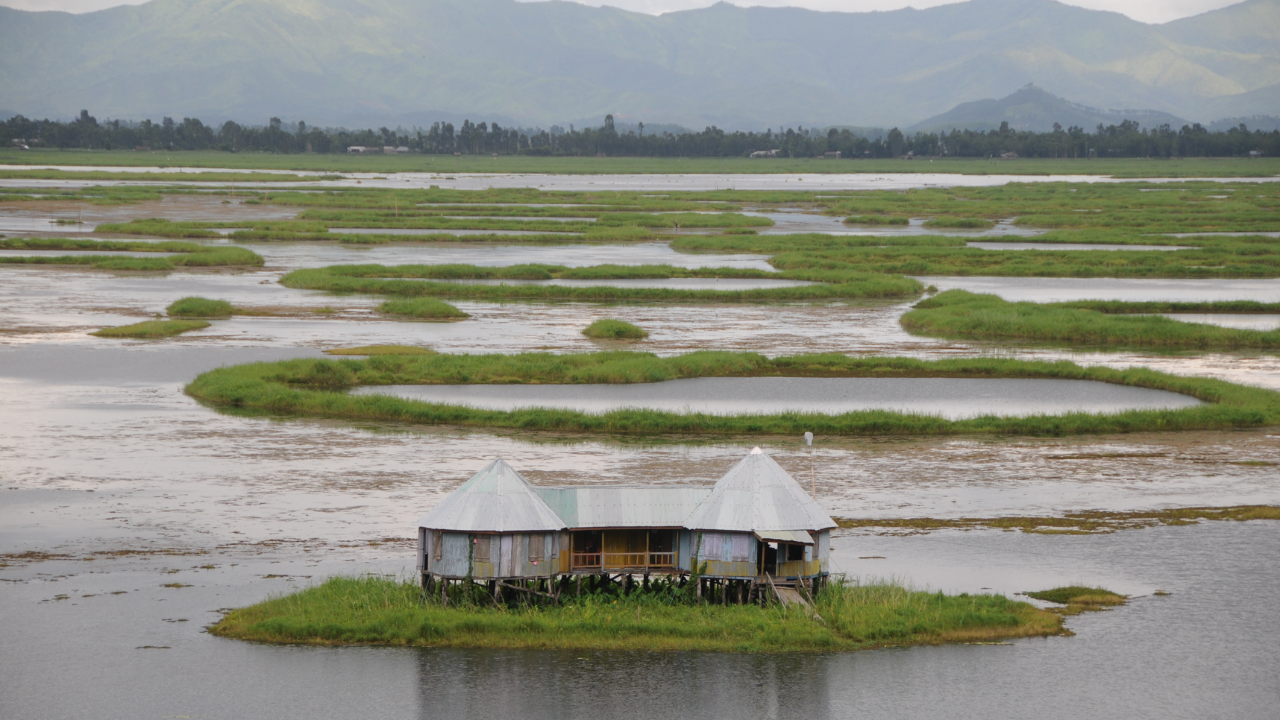
Loktak Lake, a 287-square-kilometer lacustrine system in Manipur, Northeast India, behaves less like a static body of water and more like a mechanical engine driven by cyclical hydrology. The primary mechanics of this system rely on "phumdis"—heterogeneous, floating masses of detritus, soil, and emergent vegetation at varying stages of decomposition. These structures compose the world’s only floating conservation zone, the Keibul Lamjao National Park. Far from being a static biological oddity, the stability of this ecosystem is a direct function of precise seasonal water level fluctuations, which are currently being disrupted by anthropogenic interventions.
The Biomechanical Matrix of the Phumdi Structure
A phumdi operates on a highly specific buoyancy principle determined by its material composition. The structure is not merely a collection of detached plants; it is a dense, woven mat of organic matter where only 20% of the total vertical thickness floats above the water line, leaving the remaining 80% submerged.
+--------------------------------------------------+  <- Water Surface
| 20% Submerged Mat (Photosynthetic Zone)          |
+--------------------------------------------------+
|                                                  |
| 80% Submerged Root & Humus Mass                  |
| (Anoxic Decomposition Core)                      |
|                                                  |
+--------------------------------------------------+
The core structural integrity of a phumdi is maintained through a three-stage mechanical cycle:
- The Fibrous Scaffold: Living emergent macrophytes, predominantly Phragmites karka and Saccharum latifolium, develop extensive, interlocking root networks. These roots act as a structural rebar, trapping suspended silt and organic particulate matter carried into the basin by the Manipur River.
- The Peat Accumulation Phase: As older vegetation dies, it sinks into the submerged section of the mat. Due to low oxygen levels in the water column, decomposition slows significantly, transforming the lower layer into a dense, black, porous humus with a high gas-retention capacity.
- The Buoyancy Feedback Loop: The anaerobic decomposition of this trapped organic material produces methane and carbon dioxide. These gases become trapped within the spongy, porous matrix of the humus, acting as internal flotation bladders that maintain the mat's buoyancy even when supporting heavy apex wildlife.
The Closed Hydrological Loop and Nutrient Recharge Mechanism
Historically, the structural survival of Loktak Lake depended on an annual thermodynamic and nutrient recharge cycle, dictated by the monsoonal rhythm of the Indo-Burma hotspot.
The Monsoon Expansion Phase
During the heavy rainfall season from June to September, the lake surface area expands dynamically from 250 to 500 square kilometers. The influx of water lifts the phumdis entirely off the lake bed. This high-water state permits horizontal movement across the central basin, allowing winds and currents to reconfigure the spatial geometry of the floating masses.
The Dry Season Compression Phase
From January to March, water levels drop significantly, reducing the average depth to less than 2.5 meters. This volumetric contraction forces the heavy phumdis to make physical contact with the exposed lake bed. This grounding stage is a critical biological necessity:
$$\text{Regrowth Capacity} = f(\text{Substrate Nutrient Absorption} \times \text{Dry Season Grounding Duration})$$
While resting on the lake bed, the root systems directly absorb rich alluvial nutrients and minerals accumulated from the basin's drainage. This process recharges the plant systems after months of floating in nutrient-depleted open water. When the next monsoon arrives, the replenished mats detach from the bottom and rise again with a renewed, structurally sound foundation.
Artificial Geometries: The Anthapum Fishery Network
The distinctive circular islands frequently documented by aerial photography are not entirely natural formations. They are highly engineered aquaculture installations known locally as athaphums.
       [ Artificial Athapum Enclosure Geometry ]

                 * * * * * * * *
              * *
            * =================   * <- Stripped Phumdi Perimeter
           * #                 #   *
          * #  Enclosed Fish  #    *
          * #  Stock Canopy   #    *
           * #                 #   *
            * =================   *
              * *
                 * * * * * * * *
Local fishermen slice long, linear strips of naturally occurring phumdis, steer them into targeted zones of the central basin, and bind them into concentric circles. These artificial perimeters serve dual operational purposes. Mechanically, they act as living, flexible wave-breakers that protect enclosed aquaculture nets from turbulent open-water currents. Biologically, the decomposing lower face of the perimeter continually drops organic matter into the enclosed circle, creating a highly localized, nutrient-dense feeding zone that attracts and sustains wild fish populations.
Apex Trophic Dynamics: The Microclimatic Refuge
The dense vegetation and structural isolation of the phumdis create distinct microclimatic conditions that support specialized predator-prey dynamics.
The Sangai Structural Match
The endangered Sangai deer (Rucervus eldii eldii), or brow-antlered deer, is biologically adapted specifically to this floating environment. The deer features splayed, spongy hooves designed to distribute its body weight evenly across the flexible, shifting surface of the vegetative mats. This specific adaptation prevents the animal from breaking through the thin crust of the phumdi into the open water below.
The Reptilian Apex Predation Matrix
The localized humidity and dense canopy cover of the Keibul Lamjao zone provide an ideal environment for large ectothermic predators. The region supports substantial populations of Python molurus (Indian python) alongside documented populations of Ophiophagus hannah (King cobra).
These apex reptiles utilize the distinct structural zones of the phumdis to optimize their hunting strategies:
- The Saturated Sub-Surface: Pythons exploit the water-mat boundary, using the submerged portions of the phumdis as ambush blinds to target foraging waterfowl and small mammals.
- The Dry Upper Canopy: The thick, dry upper layers of older phumdis insulate nests, protecting reptile eggs from sudden water temperature drops.
- Thermal Regulation Zones: The structural variance between dense plant thickets and open-water leads creates sharp thermal gradients over short distances, allowing reptiles to regulate their body temperature efficiently with minimal energy expenditure.
The Ithai Barrage and Systemic Equilibrium Disruption
The greatest structural threat to the Loktak ecosystem stems from a fundamental engineering misalignment: the introduction of the Ithai Barrage for the Loktak Hydroelectric Project. Designed to maintain a constant, elevated water level for continuous power generation, the dam has transformed a naturally pulsating wetland into a static reservoir.
This shift to a permanent high-water state breaks the critical dry-season grounding loop. Because the water level never drops sufficiently, the phumdis are barred from making contact with the lake bed. Deprived of their annual nutrient recharge, the root systems are thinning rapidly.
Compounding this problem, the constant buoyancy stress prevents the lower layers of humus from compacting properly, accelerating internal decomposition. This structural degradation creates a highly unstable ecosystem: if the floating mats thin past a critical structural threshold, they will no longer be able to support the physical weight of large mammals like the Sangai, risking a systemic collapse of the trophic network.
Current conservation models emphasize that long-term stabilization cannot rely solely on localized weed harvesting or surface management. Preserving this environment requires a fundamental shift in regional water management, specifically implementing controlled, seasonal drawdowns at the Ithai Barrage to mimic the natural monsoonal cycles that built this unique ecosystem.