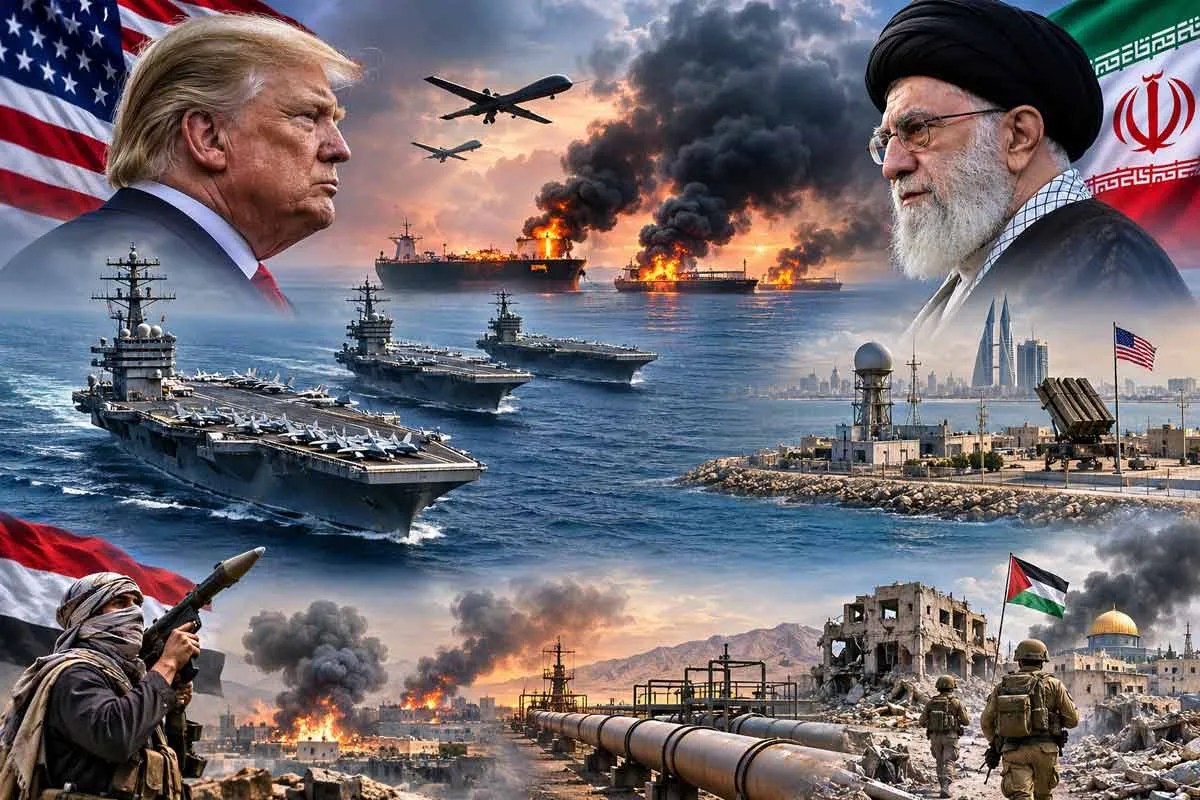
A third American warship enters the Gulf. Tehran vows it will not wait for a first strike. Headlines scream that the region is on the brink of all-out war.
Relax. Put the panic down.
That reaction is textbook lazy consensus. Every time Washington moves another carrier strike group or guided-missile destroyer into Middle Eastern waters and Tehran responds with fiery rhetoric about preemptive action, analysts treat the sequence like a lit fuse waiting for a spark. More ships plus tougher speeches equals imminent conflict. Simple math. Wrong math.
Naval deployments and uncompromising rhetoric are not proof that war is around the corner. In Persian Gulf crises, they are often the exact mechanisms both sides use to manage risk without crossing the threshold into open hostilities.
To understand what is actually happening between Washington and Tehran, you have to stop reading the headlines as play-by-play combat forecasts and start reading them as signaling, deterrence theater, and domestic posturing.
The Wrong Question Everyone Keeps Asking
Most coverage fixes on the wrong question: Will the third US warship trigger a full-scale war with Iran?
That framing assumes that military buildup and aggressive public threats automatically snowball into direct state-on-state combat. History in the Gulf—from the Tanker War of the 1980s to repeated naval standoffs over the past two decades—shows something far messier and more calculated. States routinely posture to the edge of confrontation precisely because neither side wants the catastrophic costs of going over it.
A better question is: What problem is Washington trying to solve by adding a third hull, and what domestic or strategic pressure pushes Tehran to claim it will strike first?
When you ask that question, the drama looks very different. A third warship in theater gives commanders options: layered air and missile defense, wider maritime surveillance, faster rotation so crews do not burn out, and a visible reminder that US power remains present even when diplomats are talking or sanctions are biting. None of those functions require firing a shot to matter.
Meanwhile, Tehran’s pledge not to wait for a first strike serves two audiences at once. Externally, it tries to raise the perceived cost of an American strike by projecting readiness and unpredictability. Internally, it projects strength at home—where economic strain, sanctions, and political pressure make sounding weak far more dangerous to leadership than sounding defiant.
Defining the Terms Before We Talk Strategy
Sloppy language ruins geopolitical analysis. Before going further, separate three concepts people constantly mush together:
- Deterrence is convincing an adversary that the cost of an action outweighs any possible gain.
- Compellence is forcing an adversary to change behavior they would otherwise keep doing—such as halting enrichment or stopping regional proxy attacks.
- Escalation dominance is the ability to raise the stakes at each step in a way the other side cannot match without inviting ruin.
Adding a third warship is classic deterrence and presence signaling, not automatic compellence. You cannot easily bomb a nuclear facility or dismantle a missile network simply by parking an extra surface combatant in nearby waters, especially in confined spaces where geography favors shore-based anti-ship missiles, drones, and fast-attack craft.
Anyone who treats a naval movement as an invasion fleet hasn't looked at a bathymetric chart of the Strait of Hormuz.
I Have Watched Analysts Blow Credibility on Gulf "Countdowns"
Over years of watching crisis coverage and advising decision-makers who have to price geopolitical risk into real capital, I have seen analysts and desks burn massive credibility predicting imminent war every time a carrier group transits Suez or CENTCOM adjusts posture.
I have watched teams build "worst-case war" models based on cable-news cadence rather than operational incentives. They treat every tough speech from Tehran as a firing order and every Pentagon movement as D-Day minus forty-eight hours. When the expected war does not happen—or when friction takes the form of deniable harassment, cyber jabs, or proxy pressure instead of full-scale invasion—those same models look foolish.
Why does that happen? Because sensationalism sells faster than restraint. "Third warship arrives, standoff continues" does not move clicks. "Brink of war" does.
Heavy hitters in strategic studies—scholars like Thomas Schelling on the dynamics of brinkmanship and coercion, or Barry Posen on escalation and military restraint—have spent decades explaining why states use risk-taking and rigid public commitments as bargaining tools. A threat to strike first can be a genuine warning, a bluff, or a way to keep an opponent guessing. Treating a public vow as an ironclad timetable confuses bargaining posture with inevitable action.
Admitting Where This Contrarian View Can Fail
Being contrarian does not mean pretending risk is zero. There are real downsides to betting that every Gulf buildup is just theater.
First, miscalculation is real. Even when neither Washington nor Tehran wants a full-scale war, a nervous radar operator, a misread drone flight path, or an overzealous local commander can spark an incident that neither capital planned.
Second, credibility traps cut both ways. If Tehran repeats that it will not wait for a first strike often enough, its leadership may feel boxed in during a sharp crisis if backing down looks like humiliation. Likewise, if Washington masses forces repeatedly without clear objectives, adversaries may start testing boundaries to see where the real red line sits.
Third, asymmetric friction still hurts. You do not need a massive conventional war to disrupt shipping insurance, rattle energy markets, or put troops in harm's way. Gray-zone clashes cause real damage even short of full war.
A contrarian read lowers false alarms. It does not erase tail risk.
A Thought Experiment in the Strait of Hormuz
Imagine a scenario where intelligence picks up signs of a limited strike package or heightened alert around the Gulf. Washington sends a third warship to bolster regional air defense and signal resolve. Tehran broadcasts that it will not sit idle waiting to be hit first.
Now trace the incentives on both sides.
If Tehran launches a massive, unprovoked first strike against a US warship, it invites overwhelming retaliatory firepower against its naval assets, air defenses, radar sites, and economic infrastructure. A leadership focused on regime survival knows what that exchange looks like.
If Washington launches a massive, unprovoked war solely because a third ship arrived and Tehran talked tough, it walks straight into a protracted regional quagmire with global energy shockwaves and sprawling proxy fronts.
So both sides look for leverage without triggering catastrophe. A thought experiment like that strips away the melodrama and exposes the core math: bluster is cheap; full-scale war is ruinous.
Dismantling the "People Also Ask" Myths
Does a third US warship mean war with Iran is imminent?
No. It means Washington is increasing naval presence, defensive coverage, and signaling leverage in the region. A deployment expands options; it does not make combat inevitable. Confusing capability and posture with an active decision to fight is one of the oldest mistakes in defense commentary.
Is Iran bluffing when it says it will not wait for a first strike?
Calling it a simple "bluff" misses how deterrence works. Tehran almost certainly has plans and weapons designed to hit first if it concludes an attack on its core interests is already underway or unavoidable. What is often exaggerated is the idea that those words mean Iran is about to launch a bolt-from-the-blue war on its own. Tough talk is a shield and a warning, not a calendar.
Who actually has the upper hand in a Gulf standoff?
That question is flawed because "upper hand" depends on the arena. The US military holds overwhelming conventional firepower, intelligence reach, and global logistics. Iran holds geographic proximity along narrow waterways, large inventories of short-range missiles, drones, and mines, plus regional networks that can complicate any conflict. Conventional superiority does not automatically translate into painless victory in tight littoral waters, and local asymmetric advantages do not erase overall US conventional power.
What Smart Observers Should Do Instead
Stop trading geopolitical headlines like meme stocks. If you want to read Gulf crises accurately—whether for policy, business exposure, or plain situational awareness—change how you track them.
- Watch logistics and readiness, not just podium speeches. Speeches are cheap. Look at fuel, munitions resupply, air-defense battery positioning, civil aviation advisories, and maritime insurance behavior.
- Separate rhetoric from red lines. Track what each side actually treats as existential—regime survival in Tehran, force protection and core regional commitments in Washington—rather than reacting to every tough soundbite.
- Price friction, not fantasy. Prepare for supply-chain jitter, heightened alerts, and localized incidents rather than assuming every naval move is the opening act of World War III.
A third warship in the Gulf and a defiant warning from Tehran prove tension is high. They do not prove war has started. Keep your head, check the incentives, and ignore the war drumbeat until the facts actually justify it.


