Silence.
In the Exclusion Zone thirty miles north of Kyiv, silence is not the absence of noise, because the wind still scrapes through the silver birches and the wild dogs still bark at distant shadows, yet it feels like a heavy wool blanket pressed over the ears of the world. You walk past the rusted Ferris wheel in Pripyat, past the flaking lead paint of abandoned kindergartens where tiny gas masks still lie scattered across dusty floorboards, and then you look up. Rising above the treetops is a silver-gray curve so vast it bends the horizon itself.
It looks like an airplane hangar built for a fleet of giants. Engineers call it the New Safe Confinement. Locals simply call it the Arch. For eight years, that curved steel shell was supposed to be humanity’s century-long truce with its own worst nuclear mistake, sealing away two hundred tons of melted radioactive corium inside Reactor Number Four.
Then came February 2022, and the truce broke.
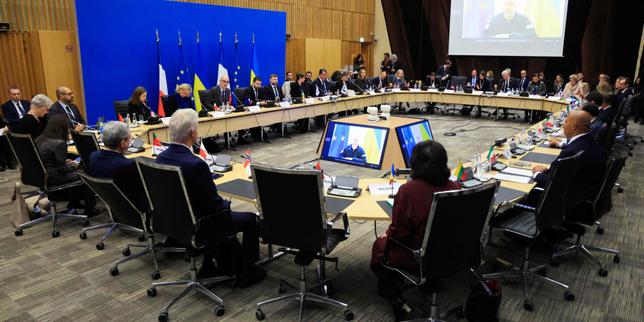
This week in Paris, diplomats, nuclear engineers, and finance ministers filed into a brightly lit conference hall to pass a proverbial hat around the table. The agenda item sounded dry enough to put a room full of bureaucrats to sleep: funding the structural repair and operational survival of the Chernobyl containment arch amid the ongoing war in Ukraine. News tickers flashed the headline in sterile French and English prose. A donor conference. A budget shortfall. A line item in a sprawling geopolitical crisis.
If you treat that meeting as an accounting exercise, you miss the whole terrifying point.
The Architecture of a Sleeping Dragon
To understand why a room full of suits in Paris matters to a baker in Warsaw or a fisherman on the Black Sea, you have to picture what is actually sitting beneath that curved roof.
Imagine trying to lock a rabid bear inside a wooden crate that is slowly rotting from the inside out. That wooden crate was the original 1986 Sarcophagus, thrown together in two hundred and six frantic days by hundreds of thousands of Soviet liquidators who worked in forty-second shifts on radioactive rooftops before their dosimeters screamed. By the early 2000s, the old concrete-and-steel shell was sagging, cracked, and leaking rainwater onto highly enriched nuclear fuel. If that roof had collapsed, a plume of radioactive dust would have lifted into the upper atmosphere, indifferent to border checkpoints, passports, or ceasefires.
So forty-five nations pooled more than two billion euros to build something unprecedented. It weighed thirty-six thousand tons—more than three Eiffel Towers—and stood taller than the Statue of Liberty. Because radiation levels near the reactor would have killed construction workers in minutes, engineers built the Arch a quarter-mile away and slid it across Teflon-coated tracks in November 2016 like a massive sliding door closing over a furnace.
Think of the Arch not as a static concrete tomb, but as a living, breathing intensive care unit. Between its inner and outer steel skins, giant dehumidifiers pump dry air around the clock to stop the metal from rusting. Automated cranes hang from its ceiling, designed to slowly dismantle the unstable 1986 sarcophagus piece by piece over the next hundred years. Every sensor, every airlock, every negative-pressure ventilation fan exists for one single reason: to keep microscopic particles of plutonium, cesium, and strontium from drifting outside.
A machine that complex cannot run on hope. It runs on uninterrupted electricity, spare parts, specialized software, and exhausted human beings.
Five Weeks in the Dark
Consider what happened when Russian armored columns rolled across the Belarusian border in the opening hours of the full-scale invasion.
Tanks weighing forty tons churned through the Red Forest—the very patch of pine woods that absorbed the heaviest fallout in April 1986, turning the needles a sickly rust-red before the trees died and were buried under bulldozed earth. As treads tore up the topsoil, radiation monitors spiked across the zone. Within hours, armed soldiers occupied the Chernobyl nuclear power plant.
Let us step inside the control room during those thirty-five days of occupation, through the eyes of a composite shift supervisor—let us call him Oleksandr, though his story reflects the verified testimonies of the real Ukrainian technicians held at gunpoint that spring.
Oleksandr arrived for a routine twelve-hour shift on a Wednesday evening and did not go home for five weeks. Two hundred workers and national guardsmen were trapped inside the facility with dwindling rations of porridge, sleeping on desks and concrete floors while artillery thudded in the distance. Every time a shell severed a high-voltage power line outside the perimeter, alarms howled across the console.
Without grid power, the Arch’s ventilation system dies. Without ventilation, pressure equalizes, and radioactive dust can seep through tiny structural seams. Diesel backup generators roared to life in the courtyard, gulping thousands of liters of fuel every day while Oleksandr watched the fuel gauges tick downward, knowing no delivery trucks were coming through active front lines.
"You don't fear the bullets as much as you fear the gauges," one real plant engineer told investigators months later after the withdrawal. "A bullet hits one man. A power failure in the confinement zone hits a continent."
When Russian troops finally pulled back at the end of March 2022, they left behind more than ruined morale. They looted radiation monitoring laboratories, smashed computers, stole transport vehicles, and seeded the surrounding forests with thousands of anti-personnel mines and tripwires. Even worse, subsequent missile strikes and drone attacks across Ukraine’s energy grid repeatedly knocked the Chernobyl site off external power, forcing the Arch onto emergency diesel life support again and again. And in early 2025, a strike pierced the outer cladding of the Arch itself, tearing a jagged wound into the very shield meant to hold back a century of poison.
What Happens When a Shield Starts to Rust
You might wonder why a hole in a steel roof or a few days without dehumidifiers triggers an international emergency conference in Paris. After all, the reactor exploded forty years ago. Hasn't the danger faded by now?
Here is where human intuition fails us completely. We are wired to understand threats that roar, burn, or bleed. We struggle to respect threats that are invisible, odorless, and operate on geological clocks.
Strontium-90 and Cesium-137 have half-lives of roughly thirty years, meaning half of what exploded in 1986 is still active today. Plutonium-239 has a half-life of twenty-four thousand years. That is longer than the entire written history of human civilization, stretching backward past the pyramids, past the invention of the wheel, all the way to the last Ice Age.
Inside the Arch, the relative humidity must stay below forty percent. That is the magic threshold where steel stops corroding. When power fluctuates, when spare sensors cannot be imported because supply chains are broken, or when technicians cannot safely patrol perimeter fences because unexploded ordnance lies hidden in the grass, moisture creeps in. Condensation forms on the massive steel trusses. Rust begins its slow, silent feast.
At the same time, the old 1986 Sarcophagus sitting underneath the Arch continues to degrade. Its original builders never meant for it to last past 2016. Every year that remote-controlled dismantling is delayed because money has dried up or engineers are busy patching wartime damage, the risk grows that an internal beam will snap inside the containment shell, kicking up a localized cloud of radioactive dust that tests the integrity of the outer seal.
Ukraine’s state budget, stretched to the breaking point by existential defense, simply cannot absorb hundreds of millions of euros in unexpected structural repairs, grid hardening, and de-mining operations around the Exclusion Zone. Meanwhile, the International Chernobyl Cooperation Account—managed by the European Bank for Reconstruction and Development—has watched its reserves drain faster than donors can replenish them.
The Invisible Ledger in Paris
Walk back into that conference room in Paris and look at the faces around the table.
On paper, this is a technical pledging session organized by France, the European Commission, and the EBRD. Delegates speak in measured tones about grant tranches, engineering assessments, fire-suppression upgrades, and perimeter security. Nobody raises their voice. Nobody pounds a shoe on the table.
Yet beneath the polite diplomatic French lies a blunt reality: nuclear safety is the ultimate public good, and nobody gets to opt out of the atmosphere.
During the Cold War, adversaries understood that even in total conflict, certain thresholds could not be crossed without mutual ruin. In the twenty-first century, active warfare is unfolding around operating and decommissioned nuclear sites—from Zaporizhzhia in the south to Chernobyl in the north—turning civil engineering marvels into inadvertent hostages. When donors hesitate over a fifty-million-euro gap for membrane repairs or electrical substations, they are not saving money. They are deferring a debt that accrues compound interest in isotopes.
I remember standing near the cooling pond at Chernobyl years before the war, watching catfish the size of tree trunks swim lazily beneath the surface while swallows darted in and out of the rafters of unfinished reactor blocks. Nature had reclaimed the concrete with shocking speed. Wild horses grazed near abandoned rail lines. It was easy, standing in the warm afternoon sun, to fool yourself into thinking the disaster was over—that it belonged to black-and-white archival footage and history textbooks.
That illusion died the moment soldiers dug trenches into radioactive soil.
The Vigil That Cannot Blink
What the Paris donor conference is really buying is not concrete, copper wire, or sheets of corrosion-resistant alloy. It is buying time, and it is buying attention.
It funds the night-shift operator watching voltage meters at three in the morning while air-raid sirens wail over Kyiv. It pays for the sapper sweeping overgrown firebreaks with a metal detector so firefighters can reach a forest blaze before smoke carries cesium particles aloft. It keeps the giant dehumidifiers humming in the dark, pushing dry air through the ribs of a thirty-six-thousand-ton umbrella so that the metal holds for another decade, and another after that.
In a world addicted to breaking news, maintenance is boring. Nobody throws a parade for a catastrophe that did not happen, and no television network broadcasts live footage of a steel beam failing to rust.
Yet right now, on a flat plain north of Kyiv, a silent machine built by forty-five nations stands between a ruined reactor core and the prevailing winds of Europe—waiting to see whether the people who built it still remember why they did.



