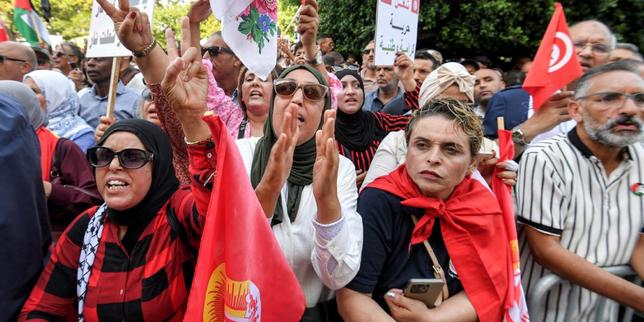
Thousands of Tunisians marched through the capital on Saturday, October 17, 2026, turning anger over daily hardship and political repression into the largest street demonstration against President Kais Saied in years. Estimates ranged from roughly 3,000 to nearly 6,000 people gathering around Place Mohamed Ali Hammi and pressing toward Avenue Habib Bourguiba, despite heavy police deployments and blocked access routes.
Anyone watching Tunisia only through headlines about constitutional decrees misses the real fuel behind this crowd. It wasn't just political elites debating power in Tunis. People came from outside the capital too—including demonstrators traveling roughly 250 kilometers from Sfax—because broken daily basics and shrinking freedoms now hit the exact same households. Meanwhile, you can find similar developments here: Interception Economics and Air Defense Attrition in Eastern European Airspace.
Crowds gathering along Avenue Habib Bourguiba show why that thoroughfare remains Tunisia's symbolic pressure gauge. Even when security forces restrict movement near the end of a march, simply reaching central Tunis signals that fear isn't silencing everyone. To explore the full picture, check out the excellent analysis by NBC News.
Why This Saturday March Felt Different in Tunisia
For years after Saied suspended parliament in July 2021 and moved to rule by decree, opponents struggled to turn frustration into sustained mass marches. Small rallies happened, and anniversary dates drew pockets of activists, yet street mobilization often looked fragmented.
That dynamic shifted on October 17, 2026. Nine national organizations and civil society groups called for the march, bringing together union voices, journalists' advocates, young doctors, and opposition figures who haven't always marched on the same side. Salah Eddine Salmi, speaking for the UGTT labor union, warned that concentrating power in one person's hands cannot build a state, while opposition figure Sihem Bensedrine pressed for fundamental freedoms and the release of political prisoners.
Chants like "The prisons are full, people are hungry" and slogans demanding an end to the regime captured the collision between economic pain and authoritarian rule. When a 21-year-old dental student or a civil servant in their early thirties says the system offers no dignity or future, that's a warning sign no decree can easily erase.
Kitchen-Table Grievances Meet Political Crackdowns
Political analysts often treat economic complaints and civil liberties as separate tracks. On the ground in Tunisia, they're tangled together.
- Rising cost of living: Shoppers face steep price pressures and falling purchasing power, making basic groceries and everyday expenses feel like a constant squeeze.
- Water and power strain: Summer electricity load-shedding and drinking-water cuts—followed by bottled-water shortages—turned utility reliability into a flashpoint by late summer, including August 20 protests.
- Environmental anger: Chemical pollution and industrial grievances in Gabès have fueled fierce local pushback, even as authorities push plans to expand strategic phosphate output by 2030.
- Detentions and free speech: Activists, opposition figures, and journalists—among them Mourad Zeghidi and Borhen Bsaies—have faced prosecutions and imprisonment under Saied's crackdown, feeding demands for due process and press freedom.
Honestly, that mix explains why the march held together. Someone who doesn't care about party politics still notices when the tap runs dry or prices jump, and someone focused on jailed critics sees those daily failures as proof of unchecked power.
What People Usually Get Wrong About Tunisian Protests
A common mistake outside observers make is assuming every big march in Tunis means a repeat of 2011 is right around the corner. Protest size matters, yet crowd numbers alone don't tell you how a government will respond or how durable a coalition is.
Police cordons and road closures around Avenue Habib Bourguiba still constrain where crowds can go and how long momentum lasts. Meanwhile, authorities have framed utility disruptions around alleged premeditated acts and kept a tight grip on judicial and security levers.
Another misconception is treating Tunisia's opposition as one unified bloc. Groups that once clashed or stood apart have found common ground against rising prices and shrinking space for dissent, which gives the movement broader reach. Still, keeping diverse unions, rights advocates, and everyday citizens aligned once the cameras leave is way harder than calling a single Saturday rally.
How to Follow What Happens Next Without Getting Misled
If you're tracking Tunisia from abroad—or trying to make sense of conflicting social media clips—stick to verifiable details rather than viral rumors. Crowd estimates vary between outlets, so treat numbers like "at least 3,000" to "nearly 6,000" as a range rather than an exact headcount.
Watch three concrete indicators over the coming weeks to judge whether October 17 was a peak or a turning point:
- Cross-sector follow-through: See whether labor unions like the UGTT, professional groups, and civil society keep coordinating joint actions or step back separately.
- Regional spillover: Watch towns and cities outside the capital—like Sfax and Gabès—where local economic or environmental grievances can spark parallel pressure.
- State response on liberties and basics: Track whether authorities ease restrictions on assemblies and detainees or tighten enforcement while trying to stabilize prices, water, and power.
Compare dispatches from established international wire services and regional outlets—such as Reuters, TV5MONDE, and Al-Monitor—against local civil society statements so you can separate verified events on the street from speculation online.