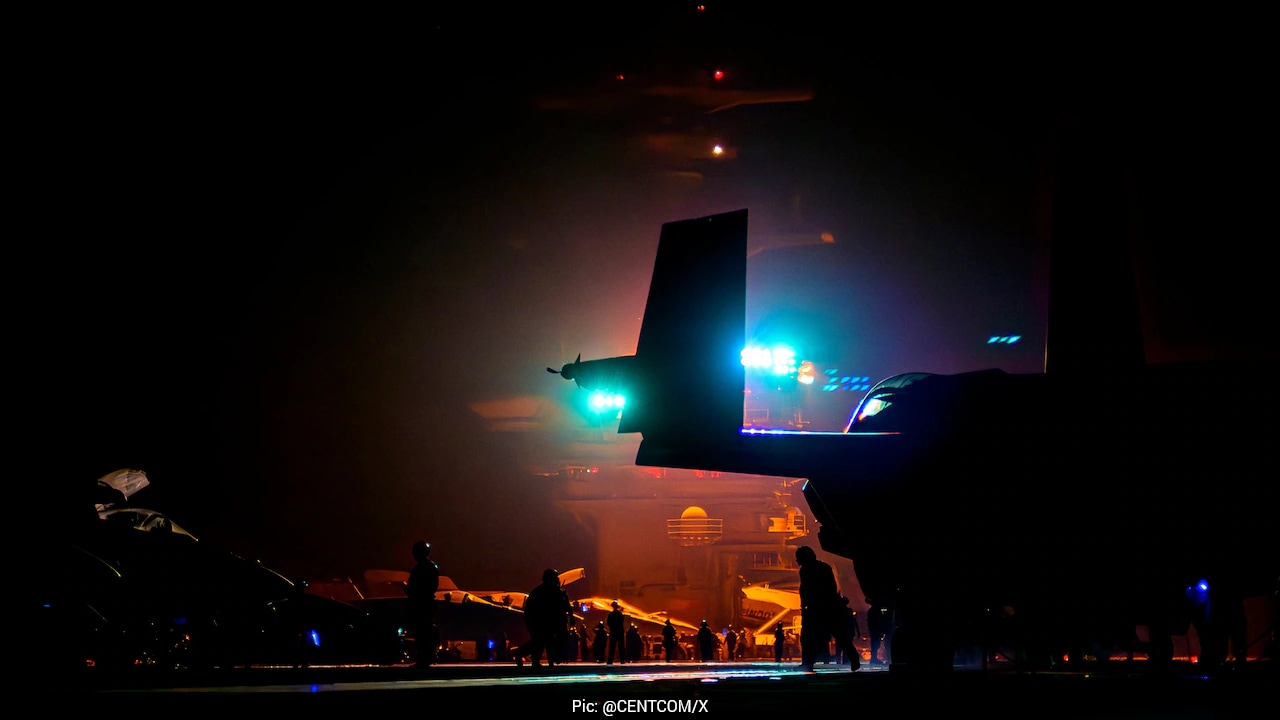
Salt crusts on everything. You feel it in the back of your throat before you even wake up, a dry, metallic tang that lingers beneath the recycled tang of jet fuel and industrial bleach.
Imagine—as a hypothetical composite drawn from thousands of real logs—a nineteen-year-old aviation boatswain’s mate named Miller standing on the foul-weather deck of a Nimitz-class carrier in the Gulf of Oman. He is wearing a yellow cranial helmet and a float coat stiff with dried brine. Above him, the sky is the color of a bruised plum, heavy with the kind of humid, dust-choked heat that makes the air feel thick enough to chew. Three hundred yards away, across a stretch of black water churning like boiling oil, sits a second gray hull. Beyond the horizon, invisible to the naked eye yet pulsing with silent urgency on every radar screen in the combat information center, a third floating fortress holds the line.
Three.
In the sterile, clipped language of a U.S. Central Command press release, that number looks like a simple logistical update. A line item. Another deployment adjustment in a region where military hardware moves like chess pieces across a board few civilians ever look at closely.
Numbers lie by omission. When CENTCOM confirms that three American aircraft carrier strike groups are operating simultaneously in the Middle East, the headline reads like routine deterrence. In reality, it is an extraordinary, heavy-breathed exertion of global power—one that stretches steel, blood, and diplomatic patience to their absolute limits.
The Anatomy of a Hundred Thousand Tons
To understand why three carriers in one theater makes naval historians sit upright in their chairs, you first have to stop thinking of a carrier as a boat. Think of it instead as a sovereign, nuclear-powered city-state that happens to move at thirty knots.
Each carrier displaces roughly 100,000 tons of steel. Beneath its four-and-a-half-acre flight deck live around 5,000 human beings—pilots, nuclear engineers, cooks, surgeons, teenagers from Ohio folding laundry in windowless compartments three decks below the waterline. Each ship carries an air wing of roughly seventy aircraft: F/A-18 Super Hornets, F-35C stealth fighters, electronic warfare planes capable of blinding an enemy's radar grid before a single bomb drops, and helicopters built to hunt submarines in the dark.
And a carrier never travels alone.
Surround that floating airfield with a protective ring of guided-missile cruisers and Arleigh Burke-class destroyers—ships bristling with vertical launch cells packed with Tomahawk cruise missiles and Standard interceptors—and you have a Carrier Strike Group. Multiply that by three.
Suddenly, you are looking at roughly 15,000 to 20,000 American service members concentrated in a maritime corridor bounded by the Red Sea, the Arabian Sea, and the Persian Gulf. You are looking at more than two hundred tactical aircraft capable of generating hundreds of combat sorties every twenty-four hours, operating without needing a single runway permission slip from a nervous host nation.
Why does that sovereignty matter so deeply? Because land bases have addresses.
In a region where ballistic missiles and one-way attack drones have proliferated across borders, fixed airfields in the desert sit inside known coordinates. Every bunker, every fuel depot, every concrete runway can be mapped by satellite years in advance. An aircraft carrier, by contrast, is a moving target the size of three football fields that can relocate seven hundred miles in a single day. It carries its own fuel, its own ammunition, its own hospital, and its own power grid. When diplomats argue behind closed doors in Doha, Cairo, or Geneva, those three moving cities provide the silent, unmistakable punctuation at the end of every sentence.
The Invisible Arithmetic of Deterrence
I remember standing years ago on a pier in Norfolk, watching a strike group return from an extended deployment in the Fifth Fleet area of responsibility. The hull was streaked with rust tears running down from the anchor hawsepipes—the maritime equivalent of dark circles under a runner’s eyes after a marathon. Sailors stood along the rails in their dress whites, squinting against the Virginia sun, looking thinner and older than they had nine months earlier.
That is the part the maps never show.
The Pentagon operates under a brutal mathematical reality known to naval planners as the "rule of three." For every single aircraft carrier deployed at sea, one is typically in the shipyards undergoing deep maintenance or nuclear refueling, and one is in the training cycle working up to replace it. Maintaining a single carrier presence in one corner of the globe requires three carriers in the broader inventory.
When Washington pushes three active strike groups into the Middle East at once, it is breaking the glass on its strategic reserve. It means ships are having their deployments extended past the nine-month mark. It means crews who were supposed to be home for Thanksgiving or a child's first steps are instead running flight quarters in the Bab el-Mandeb Strait, dodging anti-ship missiles launched from rugged coastlines while commercial container ships limp past under naval escort.
Why pay that price? Because deterrence only works when the other side believes the cost of miscalculation is catastrophic—and immediate.
Consider what happens when regional tensions threaten to spill across multiple fronts simultaneously. You have maritime chokepoints like the Strait of Hormuz, through which roughly a fifth of the world's petroleum passes every single day, sitting barely twenty-one miles wide at its narrowest point. You have the Red Sea corridor, where attacks on global shipping can reroute tens of billions of dollars in trade around the southern tip of Africa, driving up the price of everything from winter coats in London to grain in Nairobi. And you have the ever-present shadow of direct state-on-state escalation, where a single stray rocket hitting the wrong apartment building or oil terminal could ignite a war nobody actually wants to fight.
One carrier says: We are watching.
Two carriers say: We are ready to respond.
Three carriers say: Do not test the perimeter, because we can absorb a punch and still overwhelm every air defense grid you own before sunrise.
Life Inside the Pressure Cooker
Still, there is a strange dissonance between grand strategy and the lived human reality inside those hulls.
If you ask a strategist in Washington what three carriers represent, they will talk about "credible combat power," "escalation dominance," and "reassurance to regional allies." If you ask a pilot climbing down the boarding ladder of an F/A-18 at three in the morning after a six-hour patrol over the Arabian Sea, the vocabulary shrinks to exhaustion, salt, and millimeter precision.
Landing a thirty-ton jet onto a pitching, rolling strip of steel in total darkness—a maneuver naval aviators dryly call "controlled crashes"—demands a level of focus that burns calories like a sprint. The flight deck itself is one of the most dangerous work environments on earth. Jet blast can blow a grown man overboard in a heartbeat. Arresting wires under tens of thousands of pounds of tension can snap like whips. Intake ducts can pull a careless sailor off their feet from ten feet away.
Now imagine sustaining that tempo not for a weekend exercise, but month after month, in waters where an incoming drone or anti-ship ballistic missile might leave a destroyer's radar crew less than ninety seconds to detect, track, and intercept the threat.
There is a specific kind of fatigue that sets in during prolonged high-alert deployments. It is not the sharp panic of a sudden crisis; it is the slow, grinding hum of perpetual readiness. You sleep in three-tier racks bolted to steel bulkheads while catapults slam overhead like thunderclaps every ninety seconds. You eat standing up because the mess decks are crowded. You read emails from home that arrive delayed or censored during "river city"—the communications blackouts imposed when ships enter sensitive waters to prevent electronic emissions from giving away their position.
And yet, the machinery keeps turning.
The Ghost of Past Armadas
History offers a sobering mirror for moments like this. The United States has rarely massed three or more carriers in Middle Eastern waters without major tectonic shifts nearby.
During the 1991 Gulf War, six carriers converged across the Red Sea and Persian Gulf to sustain an air campaign of historic intensity. In 2003, five strike groups formed the maritime backbone of the invasion of Iraq. Even during the tense standoffs of the late 1990s or the height of the campaign against ISIS, surges to two or three carriers always signaled the same thing: Washington believed diplomacy alone could no longer carry the weight of stability.
Does three carriers mean a massive regional war is inevitable?
No. In fact, the entire point of assembling that much steel is to make war appear mathematically unwinnable to anyone considering starting one. Deterrence is an invisible victory. When it succeeds, nothing happens. The missiles stay in their silos. The tankers pass through the Strait of Hormuz without burning. The headlines move on to sports scores and stock market dips, and millions of people go to sleep without ever realizing how close the spark came to the dry grass.
That is the paradox that makes this story so hard to grasp from a distance. When a bridge collapses, we see the twisted concrete on the evening news. When a war breaks out, we see the smoke rising over city skylines. When deterrence works, the reward is simply an ordinary Tuesday.
The Thin Margin Between Presence and Exhaustion
Yet honesty requires admitting the uncomfortable truth sitting beneath the surface of this naval surge: you cannot keep three carriers in one theater forever without hollowing out the rest of the world.
Every ship idling off the coast of Yemen or patrolling the Gulf of Oman is a ship that is not in the Western Pacific, where tensions over Taiwan and the South China Sea demand constant vigilance. It is a ship that is not in the North Atlantic, where submarine activity has quietly climbed back toward Cold War levels. The ocean is vast, and even the largest navy on earth cannot be everywhere at once.
Furthermore, modern warfare has changed the geometry of naval power. For eighty years, since the Battle of Midway proved that carrier air wings had replaced battleships as the supreme rulers of the sea, the American flattop operated with near-total impunity. Nobody could touch them.
Today, the proliferation of cheap aerial drones, unmanned surface vessels packed with explosives, and long-range precision missiles has turned every transit through narrow waters into a live-fire test. The carriers themselves remain extraordinarily well defended—layered behind rings of Aegis radar destroyers, electronic jammers, and close-in weapon systems that spit thousands of tungsten rounds per minute. Nobody has sunk a U.S. fleet carrier since World War II, and doing so remains an immense military challenge.
Still, the psychological dynamic has shifted. The ocean is no longer an empty sanctuary. Every radar blip could be a fishing dhow, a commercial freighter, or a decoy meant to exhaust expensive interceptor missiles before a real salvo arrives.
What Remains After the Wake Fades
Back on the hypothetical flight deck in the Gulf of Oman, dawn begins to bleed across the eastern horizon—not a gentle pastel sunrise, but a sudden, glaring white light that turns the sea into hammered silver.
Miller, the nineteen-year-old yellow-shirt, rubs the grit from the corners of his eyes. His knees ache from twelve hours on non-skid steel that feels like coarse sandpaper. Behind him, a pair of Super Hornets squats on the forward catapults, steam curling from the deck tracks like breath in winter air. Soon the deafening roar of afterburners will rattle the fillings in his teeth once again.
Three thousand miles away, oil traders in London check their screens and see crude prices holding steady. Cargo captains in Singapore plot courses through the Red Sea. Diplomats in air-conditioned conference rooms lean across polished tables, testing new phrasing for ceasefires and back-channel understandings.
None of them can see the salt drying on Miller’s uniform, or the dark circles under the eyes of the radar operators watching green sweeps in the dim blue glow of the combat information center. They only see the shadow cast across the water by three gray hulls—a reminder that peace, even an uneasy one, rarely holds itself up without someone standing watch in the dark.