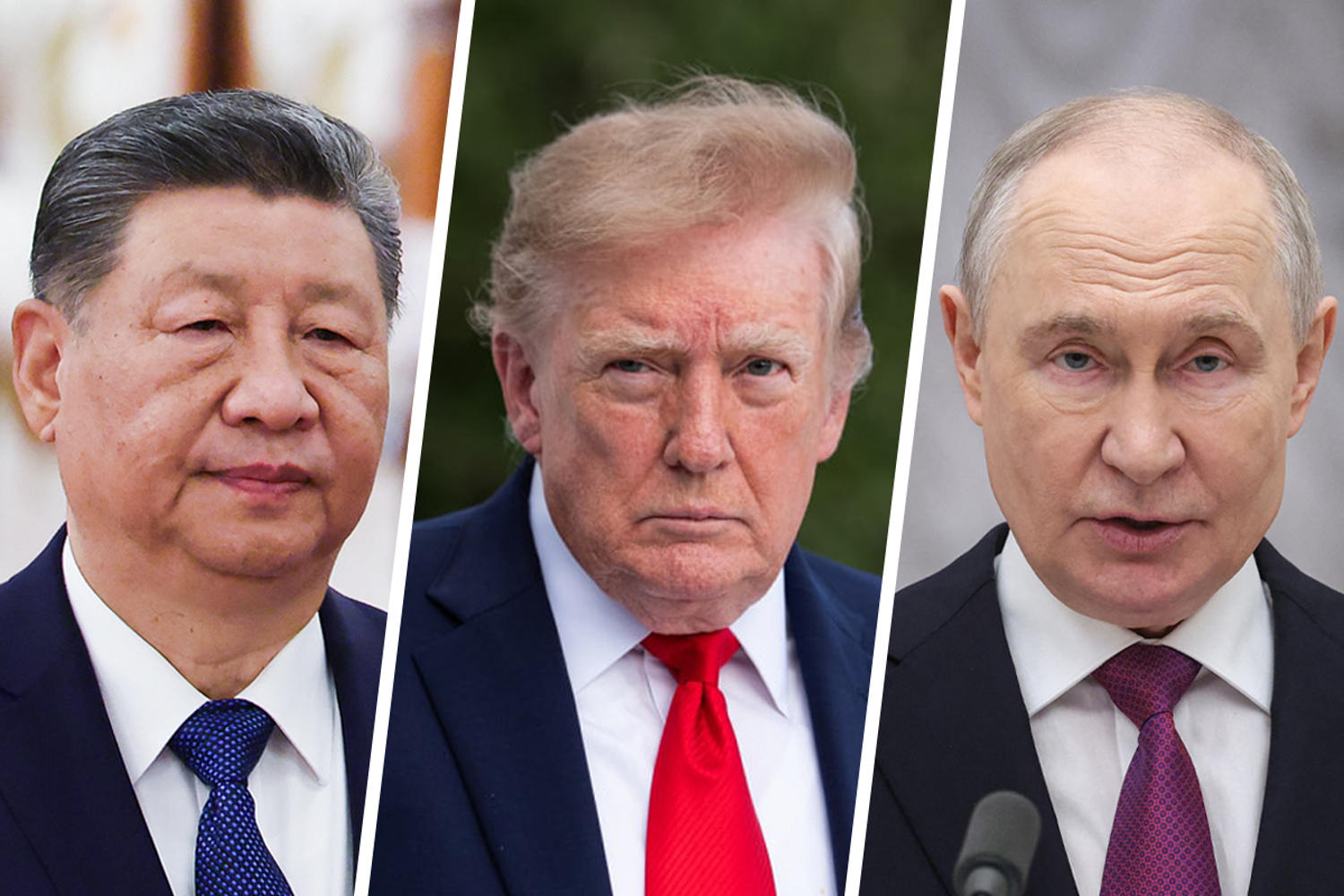
Paper rustles. A fountain pen hovers over a leather-bound binder. Somewhere behind heavy doors in China, three leaders sit across from one another, and the air in the room feels thicker than usual.
Diplomacy often sounds like a crossword puzzle written in cold ink. Summits. Bilateral talks. Nuclear proliferation on the agenda. Words that slide right past the gut and land somewhere near the ear, easily forgotten before dinner. Yet behind every communique sits a pulse. A heartbeat belonging to a shift supervisor in an underground control bunker, a night-shift nurse in a port city thousands of miles away, or a parent tucking a child under a blanket while wondering how far a headline can reach. You might also find this connected story insightful: Why Trump Is Leaving Nvidia and Espionage Off the Table in Beijing.
When news breaks that Donald Trump plans to meet with Vladimir Putin and Xi Jinping in China—with nuclear proliferation on the table—most readers skim the dateline and move on. Big powers talk. Big powers posture. Same story, different backdrop.
Wrong. As discussed in detailed articles by The Washington Post, the results are worth noting.
Not because every summit produces a treaty, and not because a single meeting erases decades of distrust. It matters because nuclear proliferation is not a tidy algebraic equation. It is a chain reaction of human fear, miscalculation, and pride. When the leaders of the United States, Russia, and China gather in the same orbit to discuss nuclear limits and spread, the conversation is never just about warheads sitting in silos or submarines gliding beneath polar ice. It is about whether the guardrails holding back a catastrophic spiral still hold—or whether they are quietly rusting out.
The Quiet Arithmetic of Fear
To understand why a three-way meeting in China carries such weight, strip away the diplomatic jargon and look at how nations actually decide to build, expand, or restrain nuclear arsenals.
They rarely act in a vacuum. They act in mirrors.
Picture a hypothetical analyst—let’s call her Elena—sitting in a windowless room in a mid-sized capital far from Washington, Moscow, or Beijing. Elena does not launch missiles. She reads satellite imagery, defense budgets, and missile-test notices. Her job is to answer one relentless question: Are we falling behind?
If Moscow modernizes its delivery systems, Washington studies the gap and adjusts its posture. If Beijing expands its missile fields or refines its warhead stockpiles, planners in both the United States and neighboring capitals recalculate their own deterrence math. And when a smaller or regional power watches the world’s heaviest hitters openly compete rather than cooperate, a dangerous temptation creeps in: Maybe our only real insurance policy is our own bomb.
That is nuclear proliferation in plain sight. Not a movie plot with a ticking countdown on a screen, but a slow, creeping contagion of insecurity.
Historically, arms control worked best when two giant rivals recognized a shared ceiling—a mutual understanding that an unrestrained race makes everyone less safe, even if it makes everyone poorer and more nervous. Cold War treaties were imperfect, tense, and born out of sheer terror after crises like the Cuban missile crisis. Still, they created predictability. Inspectors knew where to look. Telemetry data meant fewer guesses in the dark.
Today, the geometry is no longer a simple two-player game. Three major nuclear powers—the United States, Russia, and China—now shape the strategic horizon simultaneously, each with distinct histories, domestic pressures, and grievances. Bringing Trump, Putin, and Xi into the same diplomatic frame forces a collision of styles and priorities that no bilateral call can replicate.
I have spent years reporting on security flashpoints and talking to people who live near the fault lines of great-power rivalry. What strikes me most is not the coldness of the strategists; it is their exhaustion. Everyone in that ecosystem knows how thin the margin for error is. A radar glitch. A misread naval maneuver. A rumor that spreads faster than verification. When leaders talk face to face, even fiercely, they at least test whether the other person is reading from the same map.
Why China Is the Room Where It Happens
A meeting in China changes the texture of the conversation before a single word is spoken.
Beijing is not a neutral stage. It is a central actor in its own right, with growing strategic weight, deep economic ties across Eurasia and the Global South, and its own calculus on nuclear forces and regional stability. Hosting a summit that brings the American president and the Russian president onto Chinese soil signals something unmistakable: the center of gravity in global power politics is contested, multipolar, and deeply entangled.
Think about how each leader walks into a room like that.
A leader from Washington arrives carrying domestic political crosscurrents, alliance commitments, and a push-pull between hard bargaining and transactional dealmaking. A leader from Moscow brings years of confrontation with the West, sanctions pressure, energy leverage, and a long memory of strategic disputes. A leader from Beijing brings long-horizon planning, sovereignty sensitivities, and a determination that China’s security interests will not be treated as an afterthought.
When those three currents meet at once, suspicion is high. Every gesture gets dissected. Who sits where? Who speaks first? Does a handshake in Beijing signal a grand bargain, a tactical pause, or pure theater?
Let’s be honest: there is plenty of reason for skepticism. Summits between rivals have produced breakthroughs, and they have also produced photo ops that evaporated six months later. Anyone claiming to know for sure what will come out of a high-stakes meeting involving Trump, Putin, and Xi is selling certainty in a place where almost nothing is certain.
Uncertainty is unsettling. It makes people cynical. You hear "nuclear proliferation on the agenda" and think, Sure, they’ll put a nice line in a statement and keep doing what they were doing anyway.
Perhaps. Cynicism is cheap armor. Yet dismissing a summit entirely misses a crucial truth about human negotiation: leaders sometimes say things in private rooms that they cannot say from a podium back home. A frank exchange about missile defense, arms limits, or regional flashpoints doesn’t solve everything, yet it can lower the temperature just enough to prevent a bad assumption from turning into a worse decision.
The Invisible Stakes for Ordinary Lives
Here is the part that gets lost when coverage treats foreign policy like a sports bracket.
Imagine a hypothetical father—let’s call him Tariq—running a small logistics business in a coastal city that relies on global shipping lanes. Tariq never reads defense white papers. His worry is fuel prices, port delays, and keeping his crew paid.
Now imagine what happens if nuclear restraint unravels globally. Even without a single warhead being fired, a breakdown in nuclear arms control ripples outward. Defense spending balloons. Regional crises become bolder because actors feel shielded by nuclear umbrellas or emboldened by weakened norms. Alliances fray or harden. Trade routes tighten, insurance rates climb, and financial markets jolt at every rumor of escalation.
The cost of nuclear instability is paid in daily life long before it ever becomes a military event. It shows up in higher borrowing costs, frayed international cooperation on everything from pandemics to climate shocks, and a pervasive background hum of dread that makes long-term planning feel fragile.
Conversely, what would genuine progress look like? Not a fairy tale where old rivalries vanish overnight. Real progress in nuclear proliferation talks is quieter and harder to measure. It looks like clear communication channels so a crisis doesn’t spiral out of misunderstanding. It looks like restraint on destabilizing weapons systems. It looks like signaling to smaller states that chasing nuclear weapons will bring isolation rather than security.
Even small steps matter when the stakes are existential. A sailor on patrol, a diplomat in a briefing room, a family watching the evening news—all of them benefit when the biggest players keep a lid on escalation.
What to Watch When the Cameras Roll
If you want to read coverage of a Trump–Putin–Xi meeting in China without getting swept away by spin, watch for three things beneath the headlines.
First, look for specificity over slogans. Broad pledges about "stability" or "peace" cost nothing. Concrete talk about transparency, risk reduction, or specific weapons categories is harder to fake.
Second, watch how allies and neighbors react. A three-way meeting among major powers always sends shockwaves through capitals in Europe, East Asia, and the Middle East. Nervousness or relief in those capitals often tells you more about the real shift in leverage than the official press release.
Third, pay attention to follow-through. Summits are moments; treaties and norms are habits. What happens in the weeks and months after the delegations fly home is where real intentions show up.
History rarely turns on a single dramatic speech. More often, it bends through quiet friction—a stubborn question pushed across a table, a line drawn in pencil, a pause before someone slams a door.
Three men sitting down in China cannot erase decades of rivalry or wish away the nuclear shadows hanging over the world. Still, in a moment when trust is thin and the margin for error feels razor-sharp, the fact that they are talking about nuclear proliferation at all is a reminder of how much hangs in the balance.
The table is set. The cameras will blink. And miles away from the lights, ordinary people will keep living their lives under a sky that belongs to all of us.