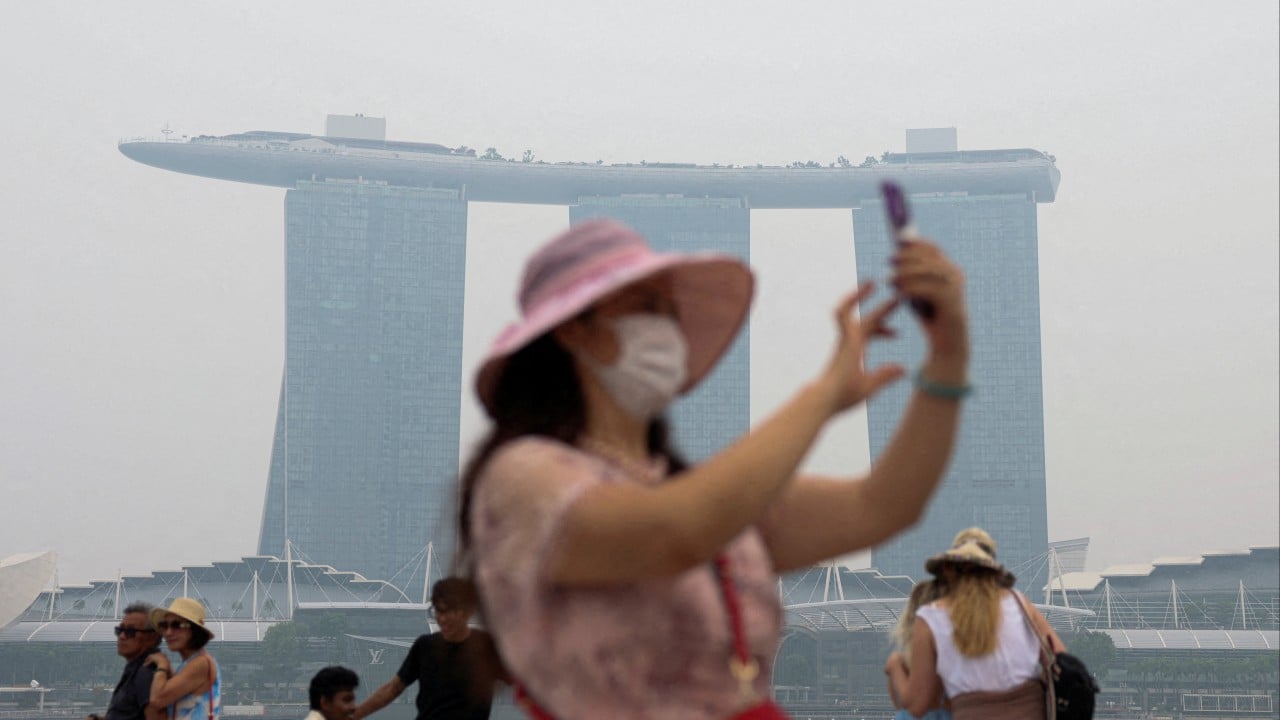
Standard reporting on the October 2026 haze crisis treats Singapore's decision to issue preventive measure notices to seven Indonesian firms as a decisive enforcement breakthrough. That framing mistakes legal signaling for operational control.
When air quality deteriorates across Southeast Asia during dry spells amplified by El Niño, headlines typically trace a simple chain: fires burn in Sumatra or Kalimantan, wind carries smoke to Singapore and Malaysia, and Singapore names companies. Conventional coverage stops at the list of named entities, the statutory ceiling of fines under Singapore's Transboundary Haze Pollution Act (THPA), and ministerial remarks on weather shifts. Missing from that narrative is the structural mismatch between extraterritorial statutory reach and sovereign territorial jurisdiction, alongside the economic incentives that keep peatland fires recurring.
This analysis deconstructs the mechanics behind Singapore's enforcement push against the seven named companies—PT Bumi Andalas Permai, PT Bumi Mekar Hijau, PT Paramitra Mulia Langgeng, PT Sumatera Alam Anugerah, PT SBA Wood Industries, PT Hutan Lestari Raya, and PT Bangkanesia—and evaluates why notices and penalties operate as leverage instruments rather than standalone fire-suppression mechanisms.
Deconstructing the Standard Reporting Logic
Competitor reporting on transboundary haze follows a predictable four-part arc:
- Incident and Symptom: Smoke blankets Singapore and neighboring cities, pushing Pollutant Standards Index (PSI) or PM2.5 readings into unhealthy territory while authorities deploy masks, purifiers, or school precautions.
- Attribution and Naming: The National Environment Agency (NEA) uses concession maps, meteorological trajectories, and satellite imagery to link smoke plumes to land parcels and names specific companies.
- Statutory Deterrence: Articles cite the THPA's penalty structure—up to S$100,000 per day when haze keeps PSI in the unhealthy range for 24 hours—as proof of legal teeth.
- Meteorological Relief: Coverage notes that monsoon transitions in a few weeks may reduce smoke transport, implying that seasonal weather resolves what policy cannot immediately extinguish.
This sequence captures the surface chronology but leaves three analytical gaps. First, it treats a preventive measure notice as equivalent to a judicial finding of liability, even though official statements clarify that notices are investigative and precautionary steps that precede or enable prosecution rather than adjudicating guilt. Second, it treats corporate concessions as monolithic actors without distinguishing direct land occupancy, third-party encroachment, contractor burn practices, or parent-subsidiary corporate structures. Third, it underweights the gap between statutory fine ceilings and the real financial calculus of land management, supply-chain exposure, and cross-border legal enforcement.
The Architecture of Transboundary Haze Causation
Understanding why the same corporate names or concession regions reappear across haze cycles requires separating physical combustion mechanics from institutional governance. This framework rests on three interlocking pillars: Fuel and Hydrology, Attribution and Spatial Geometry, and Jurisdictional Asymmetry.
Fuel and Hydrology
Tropical peatlands in Sumatra and Kalimantan store vast amounts of carbon in waterlogged organic soil. Under normal moisture conditions, peat resists sustained ignition. Drainage canals built to facilitate timber or plantation access lower the water table, drying the upper peat layers. When seasonal dry spells coincide with an El Niño event, dry peat becomes a smoldering reservoir that is notoriously difficult to extinguish from the surface alone. Surface flames can be knocked down while subsurface combustion persists and reignites when wind shifts.
Whether fires originate from deliberate land clearing, poorly controlled agricultural burning, or accidental spread from adjacent plots, the physical outcome is the same: dense particulate emissions (especially PM2.5) that remain suspended in stable atmospheric layers and travel hundreds of kilometers along prevailing winds.
Attribution and Spatial Geometry
Linking a specific concession to unhealthy air in Singapore requires bridging four evidentiary links:
- Spatial coincidence: Satellite hotspots or burn scars fall inside or adjacent to a mapped concession boundary.
- Temporal alignment: Fire activity coincides with wind direction and speed vectors capable of transporting smoke across the Strait of Malacca.
- Control and occupancy: Authorities must establish whether the named entity owned, occupied, or controlled the land where fires occurred or spread.
- Causation threshold: Legal enforcement requires connecting smoke from that specific land to transboundary haze conditions rather than treating regional smoke as an undifferentiated mass.
In practice, concession boundaries rarely map cleanly onto clean legal accountability. Fire can ignite outside a concession and cross into managed blocks, or burn inside a concession where local actors or third parties operate. Furthermore, officials have noted that ownership structures and corporate linkages require separate investigation before being disclosed publicly.
Jurisdictional Asymmetry
The central constraint in transboundary haze governance is sovereignty. Fires burn on Indonesian territory under Indonesian environmental and forestry law, while the health and economic damages—hospital visits, lost productivity, tourism drag, and air-quality interventions—accrue in neighboring states such as Singapore and Malaysia.
Singapore's THPA attempts to close part of that gap by asserting extraterritorial reach over entities linked to transboundary haze affecting Singapore. Yet enforcement faces practical friction whenever a targeted firm's physical assets, operations, and personnel sit outside Singapore's territorial reach, or when diplomatic cooperation on ground firefighting and evidence sharing is still being negotiated.
Known Facts vs. Educated Hypotheses
Rigorous policy evaluation requires separating verified facts from analytical inferences.
Known facts established in public reporting on the October 2026 episode include:
- Singapore's NEA announced preventive measure notices under the THPA for seven companies linked by preliminary findings to fires whose smoke may have contributed to transboundary haze, while keeping investigations into additional firms open.
- The seven named firms are PT Bumi Andalas Permai, PT Bumi Mekar Hijau, PT Paramitra Mulia Langgeng, PT Sumatera Alam Anugerah, PT SBA Wood Industries, PT Hutan Lestari Raya, and PT Bangkanesia, with ministerial remarks noting that several had prior enforcement history in 2015.
- Notices direct recipients to deploy firefighting personnel, halt or refrain from burning on land they own or occupy, and submit action plans to the NEA.
- Separate regulatory scrutiny also touched Singapore-listed agribusiness firms—such as Kencana Agri, Bumitama Agri, and Wilmar International—regarding fire incidents or concessions, alongside subsequent engagement with Singapore-registered companies over voluntary assessments.
- Officials indicated that while atmospheric shifts such as the inter-monsoon could eventually bring relief, air quality could remain volatile and potentially reach hazardous levels.
Educated hypotheses based on institutional incentives and environmental economics include:
- Statutory daily fines under the THPA act primarily as reputational and financial risk multipliers rather than direct operational deterrents for foreign-based subsidiaries unless paired with supply-chain pressure, banking or exchange scrutiny, or domestic Indonesian enforcement.
- Re-appearance of previously noticed concession names points to structural repeat-exposure—either persistent peatland vulnerability and fire-prone land boundaries or weak long-term compliance enforcement across multi-year cycles.
- Offering civilian assistance while issuing formal notices creates a dual-track posture: it preserves diplomatic off-ramps for bilateral cooperation while establishing a public evidentiary record for domestic accountability.
Why Legal Notices Alone Struggle to Stop Smog
A common mistake in public debate is assuming that naming a company and citing a maximum daily fine automatically stops fires within days. In operational terms, enforcement follows a lagged cost function.
First, lagged compliance timelines limit immediate impact. Extinguishing deep peat fires requires water management, heavy equipment, and sustained ground crews—not merely a legal directive to stop burning. Even a compliant operator cannot instantly reverse weeks of dry peat accumulation.
Second, corporate and evidentiary separation complicates liability. Large forestry and plantation ecosystems often involve complex holding structures, subcontractors, or disputed land boundaries. Companies facing allegations frequently contest ownership, point to external ignitions, or emphasize internal suppression efforts. Establishing legal proof beyond reasonable doubt for each day of unhealthy haze is far harder than identifying a hotspot on a satellite map.
Third, cross-border collectability remains a practical hurdle. A penalty written into a domestic statute is most potent when the targeted entity holds attachable assets, financing relationships, or commercial dependencies within that jurisdiction. When an entity is primarily domestic to another state, unilateral notices carry high signaling value but limited direct coercive force unless complemented by bilateral coordination or commercial leverage.
Consider a stylized concession operator managing drained peatland during a dry spell. If fire breaks out along a perimeter or inside a block, the operator weighs three immediate pressures: the cost of mobilizing crews and equipment, the risk of domestic permit or regulatory action at home, and the reputational or financial exposure from foreign notices and buyer scrutiny. When foreign legal pressure is not paired with immediate on-the-ground suppression capacity and domestic enforcement alignment, smoke continues to drift across borders until weather patterns shift.
Operational Playbook for Governments and Enterprises
Addressing transboundary haze effectively requires matching the intervention to the stage of the crisis and the lever available.
For Downstream Regulators and Policymakers
- Separate immediate triage from evidentiary prosecution: Use notices and public disclosures to compel rapid fire-suppression action plans and document non-cooperation, while building a rigorous evidentiary chain (high-resolution imagery, wind modeling, and concession records) for any subsequent legal proceedings.
- Pair public health defense with targeted supply-chain transparency: Protect domestic populations through transparent air-quality thresholds and protective equipment while pressing listed or commercial actors linked to regional supply chains to disclose concession fire status and mitigation steps.
- Keep technical assistance channels open: Maintain clear, practical offers of firefighting or monitoring support that can be activated quickly when host authorities welcome external help, recognizing that ground suppression is the only way to cut emissions at the source.
For Plantation, Forestry, and Commodity Operators
- Audit fire readiness before dry seasons peak: Maintain canal water levels where feasible, pre-position suppression gear and trained teams, and patrol high-risk peat and boundary zones continuously rather than waiting for active smoke alerts.
- Document boundary intrusions and suppression logs: Keep timestamped satellite, patrol, and incident-response records to distinguish internal control failures from external encroachments, and avoid reactive public denials that erode credibility with buyers and regulators.
- Map indirect supply-chain exposure: Even firms without direct operational ties to named concessions face reputational contagion and exchange or buyer inquiries during severe haze episodes, making supplier verification and rapid incident reporting essential.
Limitations and Boundary Conditions
None of these measures is a silver bullet. Satellite attribution cannot always resolve contested land tenure or pinpoint an exact ignition source under heavy smoke cover. Diplomatic sensitivities around sovereignty mean external governments cannot simply enforce orders on foreign soil without host-state cooperation. Most fundamentally, weather remains a dominant force multiplier: severe droughts can overwhelm suppression capacity across vast landscapes regardless of corporate pledges.
Strategic Forecast and Recommendation
Haze crises will continue to recur whenever dry climatic conditions intersect with vulnerable peatland landscapes and fragmented cross-border enforcement. Issuing notices under the THPA is best understood not as a quick cure for smoky skies, but as a pressure-testing mechanism that exposes corporate linkages, raises reputational stakes, and forces documentation.
The highest-leverage strategic move for Singapore and regional stakeholders is to treat traceability and commercial accountability as the primary enforcement engine alongside bilateral firefighting cooperation. By pairing transparent concession-to-market tracking with verifiable ground-suppression standards—and tying market access, financing, and exchange disclosures to documented fire prevention rather than relying solely on post-hoc fines—governments and buyers can shift the cost function of land management before the next dry spell ignites.



