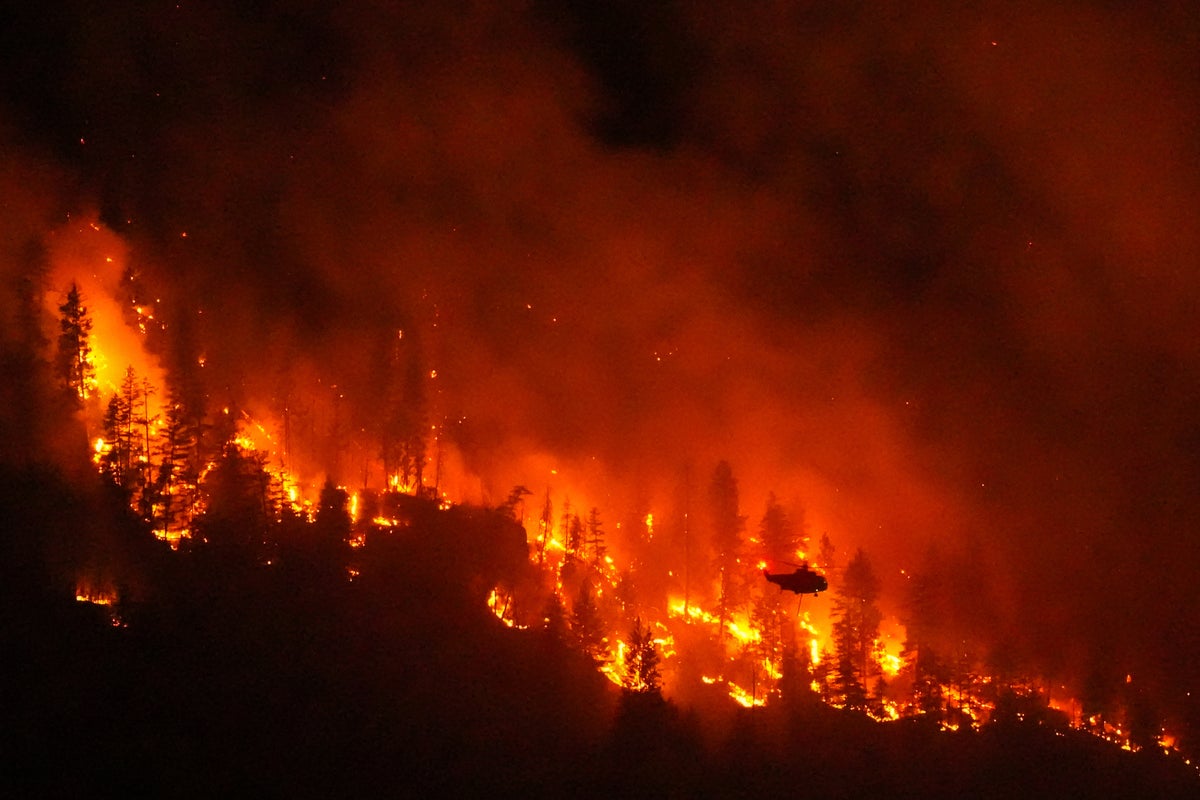
Thick, toxic smoke doesn't care about international borders, but the politicians arguing over it certainly do. When massive summer wildfires turn skies across the American Midwest and Northeast into an eerie, apocalyptic orange, the immediate reaction in Washington is rarely about atmospheric chemistry. Instead, blame gets thrown north.
Donald Trump recently pointed a finger directly at Canadian forest management, claiming the country simply isn't taking care of its trees. It's a convenient talking point. It shifts focus away from global emissions and onto local bureaucracy. But it completely ignores what scientists actually measure in the burn scars of the Northwest Territories and Ontario.
Human-caused climate change doubled the likelihood of the brutal tinderbox weather conditions that fueled Canada's massive blazes, according to a study by World Weather Attribution. Global warming is baking the boreal forest. Yet political leaders keep trying to look everywhere except the mirror.
The Science of the Boreal Spark
Let's look at the data. Canada holds roughly nine percent of the world's total forest cover, spread across millions of acres of remote, northern terrain. Much of this land features dense stands of spruce and pine. When these trees dry out, they burn hard and fast.
Lightning ignites more than ninety percent of the total land area burned in Canada. You can't write a policy to stop lightning strikes. You can't deploy a forest management crew to every single square mile of the remote wilderness where roads don't even exist.
When researchers use peer-reviewed techniques to analyze climate fingerprints, the math is staggering. Compared to a pre-industrial world without the roughly 2.5 degrees Fahrenheit (1.4 degrees Celsius) of warming driven by fossil fuels, today's extreme fire weather is twice as likely.
Jonathan Boucher, a fire scientist with Canada's Forest Service, put it bluntly. In a cooler, pre-industrial climate, these intense conditions would happen maybe once in a lifetime. Now, they are the baseline. Climate change took regular lightning strikes and turned them into unstoppable walls of fire.
Political Posturing Versus Atmospheric Reality
None of this stops political figures from playing the blame game. Trump has publicly complained about Canadian forest oversight, warning about smoke drifting down over cities like New York and Detroit and threatening unspecified actions against America's northern neighbor.
Critics down south love to claim that active logging, clearing, and better brush management would solve the crisis. They frame ecological disasters as administrative failures. It is an appealing narrative because it suggests a simple fix: just clean up the woods.
Real forestry experts know that theory falls apart in the remote boreal zone. You cannot sweep millions of acres of remote tundra and taiga.
Andrew Weaver, a climate scientist at the University of Victoria, notes the obvious irony. Smoke doesn't carry a passport, but carbon pollution has a historical ledger. The United States has historically contributed more cumulative carbon emissions than almost any other nation. Pointing at the smoke while ignoring the systemic driver of the heat is pure deflection.
What Canada is Facing Right Now
Canada has warmed at a rate roughly sixty-five percent faster than the United States over recent decades due to polar amplification. That extra heat pulls moisture right out of the soil and vegetation long before summer even begins.
Lower snowpacks, early thaws, and prolonged droughts create the ultimate recipe for disaster. When dry winds pick up, fires spread faster than any ground crew can construct containment lines.
Friederike Otto, a climate scientist at Imperial College London who works with the attribution group, emphasizes that the consequences are here right now. They aren't projections for 2050. They are happening every single July and August.
If political leaders want to solve the wildfire crisis, pretending it's an issue of sweepers and local governance won't cut it. The atmosphere is reacting to a warming planet, not a lack of local paperwork. Until the conversation shifts from political theater to actual carbon reduction, the skies will keep turning orange.
Climate change contributed to big Canada fires, study says as Trump blames mismanagement
This article breaks down the scientific consensus connecting global carbon emissions to the severe Canadian wildfire season, contrasting it with political claims of forestry mismanagement.


