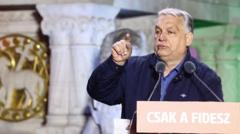
Viktor Orbán is no longer just a prime minister; he is the architect of a locked room. For sixteen years, the Fidesz party has methodically dismantled the mechanisms of Hungarian democracy, replacing them with a custom-built "illiberal" state where the lines between public treasury and private wealth have vanished. Now, for the first time since 2010, the locks are rattling. The 2026 election represents more than a change in government. It is a referendum on whether a member of the European Union can successfully operate as a single-party autocracy in perpetuity.
The challenger is not the usual collection of fractured left-wing intellectuals who have spent a decade losing. Instead, the threat comes from within the house. Péter Magyar, a former Fidesz insider who once moved in the highest circles of the regime’s legal and diplomatic machinery, has turned his intimate knowledge of the party's vulnerabilities into a political battering ram. This is not a battle of ideologies so much as it is a brutal divorce. Expanding on this theme, you can also read: Kinetic Diplomacy and the Mechanics of Credible Deterrence in US Iran Policy.
The Infrastructure of Permanent Power
To understand why Orbán has remained in power for nearly two decades, one must look past the nationalist rhetoric and "family values" campaigning. The true foundation of his rule is a sophisticated economic and legal web designed to make losing an election almost impossible.
Through a series of constitutional amendments, Fidesz rewritten the electoral map. They implemented a "winner-takes-all" logic that rewards the largest party disproportionately, meaning even a narrow lead in the popular vote results in a crushing parliamentary majority. But the control goes deeper than the ballot box. Observers at BBC News have shared their thoughts on this matter.
The "System of National Cooperation" (NER) is the term used to describe the network of loyalist business moguls who have acquired nearly every significant media outlet, construction firm, and energy asset in the country. This isn't just corruption in the traditional sense. It is a deliberate strategy to ensure that even if Fidesz loses a vote, the deep state—the owners of the infrastructure and the heads of the regulatory bodies—remains loyal to Orbán.
The Hungarian state currently functions as a distribution hub for European Union funds, which are then channeled toward these loyalists. This creates a feedback loop: public money funds private empires, which in turn fund the massive propaganda machine required to keep the electorate fearful of "outside forces," whether they be Brussels bureaucrats or migration waves.
The Magyar Factor and the Fracture of the Right
For years, the opposition’s failure was rooted in its inability to speak to the rural heartland. They were seen as urban elites who didn't understand the struggles of the Hungarian countryside. Péter Magyar changed that math overnight.
As a former member of the inner circle, Magyar speaks the language of the Fidesz voter. He doesn't attack the voters for their choices; he attacks the leadership for betraying the original mission of the party. His rise with the Tisza Party has stripped away the "traitor" narrative that Orbán usually applies to his enemies. It is much harder to paint someone as a foreign agent when they were, until recently, helping run the state’s state-owned enterprises.
Magyar’s campaign has focused on the "mafia state" aspect of the current administration. He has utilized leaked recordings and insider testimony to detail how the Prime Minister’s cabinet chief, Antal Rogán, allegedly manages a shadow information empire. This isn't just about policy differences. It is about the fundamental integrity of the Hungarian household budget, which has been squeezed by some of the highest inflation rates in the EU.
The Economic Mirage
The government has long pointed to its "unorthodox" economic policies as the reason for its longevity. By keeping corporate taxes low and courting German car manufacturers and Chinese battery plants, they created a veneer of industrial growth.
However, this growth is brittle. The Hungarian forint has suffered under the weight of geopolitical maneuvering. Orbán’s insistence on maintaining close ties with Moscow while obstructing EU aid to Ukraine has resulted in the freezing of billions in recovery funds. This is the first time the Fidesz model has truly run out of gas. Without the steady flow of Euro-denominated transfers, the government has been forced to take out massive loans from China and squeeze the domestic middle class through hidden taxes.
The working class, once the bedrock of Orbán’s support, is feeling the friction. When the price of basic foodstuffs doubled over two years, the nationalist slogans started to ring hollow. The opposition is now effectively linking high prices to the "corruption tax"—the inefficiency created by awarding every major contract to a handful of well-connected friends of the Prime Minister.
Control of the Narrative
Control of the media remains the regime’s greatest asset. In rural Hungary, many citizens only have access to state television and regional newspapers owned by a Fidesz-aligned foundation (KESMA). These outlets project a reality where Orbán is the sole protector of the nation against a world intent on its destruction.
The Propaganda Playbook
- External Enemies: Framing every critic as an agent of George Soros or the "Brussels Elite."
- Sovereignty Rhetoric: Using the concept of national sovereignty to deflect any investigation into the misuse of funds.
- Fear Advocacy: Suggesting that any change in government would lead to immediate involvement in foreign wars.
Breaking this information monopoly is the primary challenge for the opposition. Magyar has bypassed traditional media by holding massive rallies in provincial towns that haven't seen an opposition politician in a decade, using social media livestreams to reach millions directly. This "analog" approach to campaigning—actually showing up in Fidesz strongholds—has rattled the government's sense of security.
The European Stake
The stakes of the 2026 election extend far beyond Budapest. For the European Union, Hungary is a test case for whether the bloc can survive a "Trojan Horse" member. Orbán has pioneered a model that other leaders in the region have attempted to emulate. If he is defeated, the illiberal wave in Central Europe loses its intellectual and financial headquarters.
If he wins, however, it sends a clear signal that once a leader captures the courts, the media, and the economy, they are effectively untouchable within the current EU framework. The EU has struggled to respond, largely because Fidesz has been adept at using its veto power as a hostage-taking tactic.
The government's recent pivot toward China is a clear backup plan. By positioning Hungary as China’s gateway to Europe, Orbán is attempting to insulate himself from Western financial pressure. This isn't just a trade policy; it is a geopolitical realignment.
The Machinery of the Vote
Winning an election in Hungary is not just about getting more votes; it is about overcoming a structural deficit. The civil service, the police, and the judiciary are now staffed by loyalists with long-term contracts. The National Election Office is headed by appointees who have shown little appetite for investigating Fidesz’s campaign spending.
During election cycles, the line between government "public information" campaigns and Fidesz party advertisements disappears completely. Billboards across the country, paid for by taxpayers, echo party slogans. This creates an environment where the opposition is not just fighting a political party, but the entire state apparatus.
The opposition's strategy relies on a massive turnout in Budapest and the capture of key swing cities in the west and east. They are betting that the desire for a "normal" country—one where a hospital visit doesn't require bringing your own toilet paper—will eventually outweigh the fear of change.
The Internal Collapse
The real danger to Orbán may not be the opposition's strength, but the exhaustion of his own system. Autocracies often fail when the inner circle begins to fight over shrinking resources. With EU funds largely cut off, the "spoils" available to the NER elite are diminishing.
We are seeing the first signs of this internal rot. High-profile resignations and the "Grace Scandal"—which saw the President and a former Justice Minister resign over a pardon given to a child abuse cover-up accomplice—showed that the regime's moral high ground is a fiction. It also showed that the Prime Minister is willing to sacrifice his most loyal lieutenants to save himself.
This creates a climate of paranoia within the Fidesz ranks. If the "Magyar effect" continues to pull away 10% to 15% of the Fidesz base, the party's supermajority vanishes. Without that supermajority, Orbán cannot change the constitution at will. He would be forced to actually govern, rather than simply decree.
The coming months will see an unprecedented level of character assassination directed at Péter Magyar and any other challenger. The state media machine is already shifting into high gear, digging into his past and fabricating narratives of instability. This is the only way the system knows how to respond to a threat: total destruction of the individual.
The Hungarian people are being asked to decide if sixteen years of stability is worth the price of a hollowed-out state. It is a choice between a familiar, stagnant autocracy and a chaotic, uncertain return to democratic norms.
The locks are still in place, but for the first time, the people inside have realized they have the only key that matters. Whether they are brave enough to turn it is a question that will determine the shadow Hungary casts over Europe for the next thirty years.