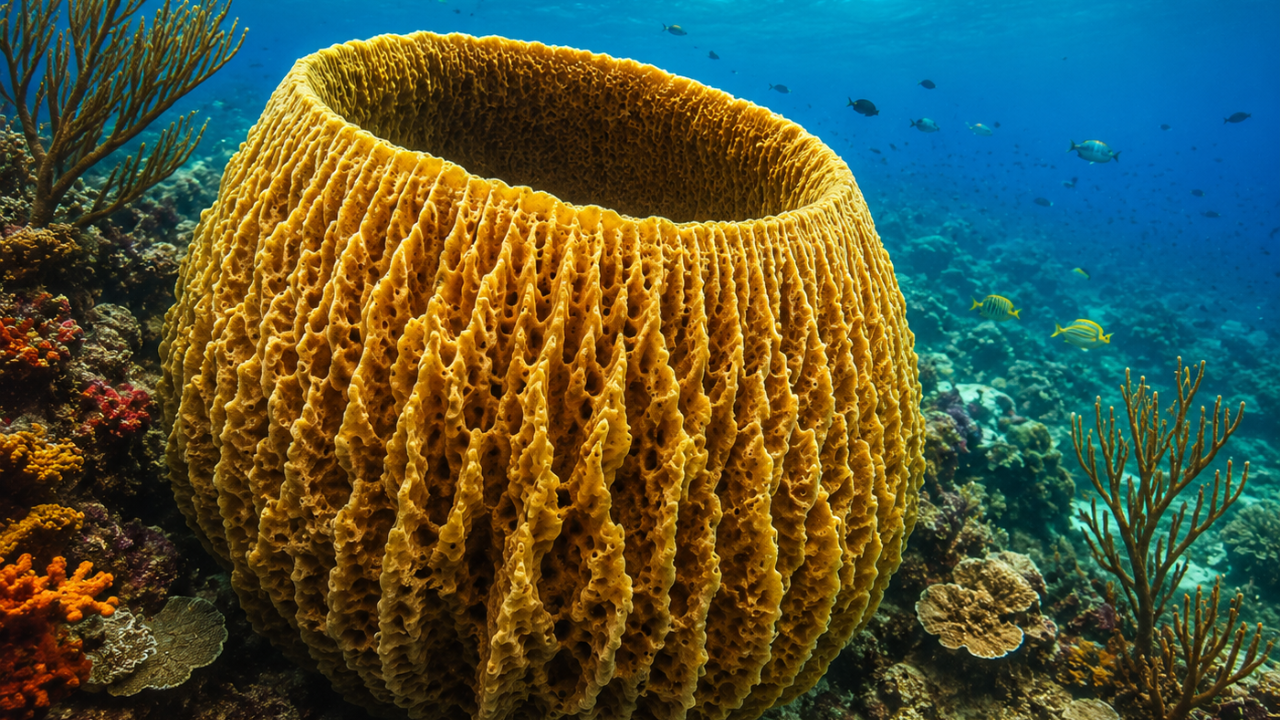
You are looking at an animal that was already a century old when Hannibal marched elephants across the Alps. It didn't move then, and it hasn't moved since. Down in the sun-drenched, high-pressure waters off Curaçao, a single giant barrel sponge (Xestospongia muta) managed to quiet its way through 2,300 years of human history.
No eyes. No brain. No heart. Just a massive, stony structure pumping hundreds of millions of gallons of seawater.
Most people look at coral reefs and focus entirely on the fish or the bright coral branching. That is a mistake. The real anchor of the Caribbean benthic community—the organisms living right at the bottom of the ocean—is often shaped like a massive weathered wine barrel. Marine biologists call them the redwoods of the reef, and honestly, the title fits perfectly. The sheer survival of this single organism upends what we think we know about biological aging.
The Math Behind a Two Thousand Year Lifespan
Sponges do not have tree rings. You cannot just drill a core into their tissue and count the lines to see how long they have been around. To figure out how an animal could possibly be older than the Roman Empire, researchers had to get creative with math and long-term photography.
A groundbreaking study led by Steven McMurray and Joseph Pawlik at the University of North Carolina Wilmington changed the game for tracking marine aging. They spent four and a half years monitoring more than 100 tagged sponges in the Florida Keys. By taking precise digital photos with metric rulers and using a specific formula called the Tanaka indeterminate growth model, they mapped out how these giants grow over time.
What they discovered is that these things grow incredibly slowly. A giant barrel sponge expands by only a few millimeters to centimeters a year. The bigger they get, the slower their specific growth rate becomes. When researchers applied these growth equations to a monster specimen photographed off Curaçao—a sponge measuring roughly 2.5 meters in diameter—the model spit out an astonishing number: 2,300 years old.
There is some margin of error when you extrapolate data for a specimen that massive. The researchers openly acknowledge that. But even with a conservative curve, this individual far outlived the ocean quahog clam, which previously held the non-clonal animal record at 507 years.
How to Exist For Millennia By Doing Absolutely Nothing
How does an animal avoid the standard traps of aging for 23 centuries? The short answer is that it keeps things incredibly simple.
The giant barrel sponge does not have complex organs that can fail over time. It has no muscles to atrophy, no nervous system to degrade, and no complex circulatory system to clog up. Its body is essentially a complex scaffold of tiny glass-like needles called spicules, held together by a specialized arrangement of cells.
Instead of fighting the ocean, the sponge lets the ocean do the heavy lifting. It relies on microscopic cells with whipping tails called choanocytes. These cells line the inner chambers of the sponge, creating a constant current that pulls water through tiny outer pores and pushes it out through the massive opening at the top, known as the osculum.
It is an energy-efficient lifestyle. The sponge filters up to 50,000 times its own volume in water every single day. For the 2,300-year-old Curaçao specimen, that translates to roughly 850 million gallons of water processed on one exact spot. That is enough water to fill more than 1,200 Olympic-sized swimming pools.
Why These Giants Matter for the Rest of the Ocean
If you think these sponges are just passive lumps sitting on the sea floor, you are missing their massive ecological footprint. They are the ultimate water treatment plants of the reef ecosystem.
By cycling thousands of gallons of water daily, they strip out bacteria and small organic particles, maintaining the stark water clarity that coral reefs need to survive. They act as giant nutrient recyclers. The bacteria and cyanobacteria living inside the sponge's tissues fix carbon and nitrogen, releasing vital inorganic nutrients back into the water to feed surrounding marine life.
They are also physical sanctuaries. The deep central cavity of a large barrel sponge provides an immediate home for dozens of species of reef fish, crabs, and brittle stars.
The Sudden Threat to the Ancient Redwoods
The tragedy of the 2,300-year-old Curaçao sponge is that its story has already ended. It managed to survive thousands of tropical storms, shifting sea levels, and centuries of changing ocean currents. Then, in the early 2010s, it died in a matter of weeks.
The culprit was Sponge Orange Band (SOB) disease. This condition causes the sponge's tissue to bleach, die, and crumble away into sediment. While the exact pathogen causing the disease remains a mystery, marine biologists have a prime suspect: rapidly rising ocean temperatures.
When water temperatures spike, the delicate symbiotic relationship between the sponge and its internal cyanobacteria breaks down. The sponge loses its color, its immune defenses fail, and it becomes highly vulnerable to fatal infections.
Your Next Steps for Reef Conservation
You do not have to be a marine biologist to help protect the remaining ancient giants of the Caribbean. If you are diving or snorkeling anywhere from Florida to South America, your personal choices have a direct impact on these multi-century survivors.
First, master your buoyancy control. Because giant barrel sponges look like solid rock, divers often mistake them for sturdy platforms. They are actually brittle. A single misplaced kick from a heavy dive fin can split a 500-year-old sponge right down the middle, opening up a wound that introduces deadly diseases. Never touch, hold, or attempt to sit inside a barrel sponge for a photo.
Second, switch your daily sunscreen to a verifiably reef-safe formula. Look for active ingredients like non-nano zinc oxide or titanium dioxide. Avoid chemicals like oxybenzone and octinoxate entirely. These compounds accumulate in the tissues of filter feeders, lowering their resilience to temperature stress and accelerating the spread of destructive bleaching diseases across the reef floor.