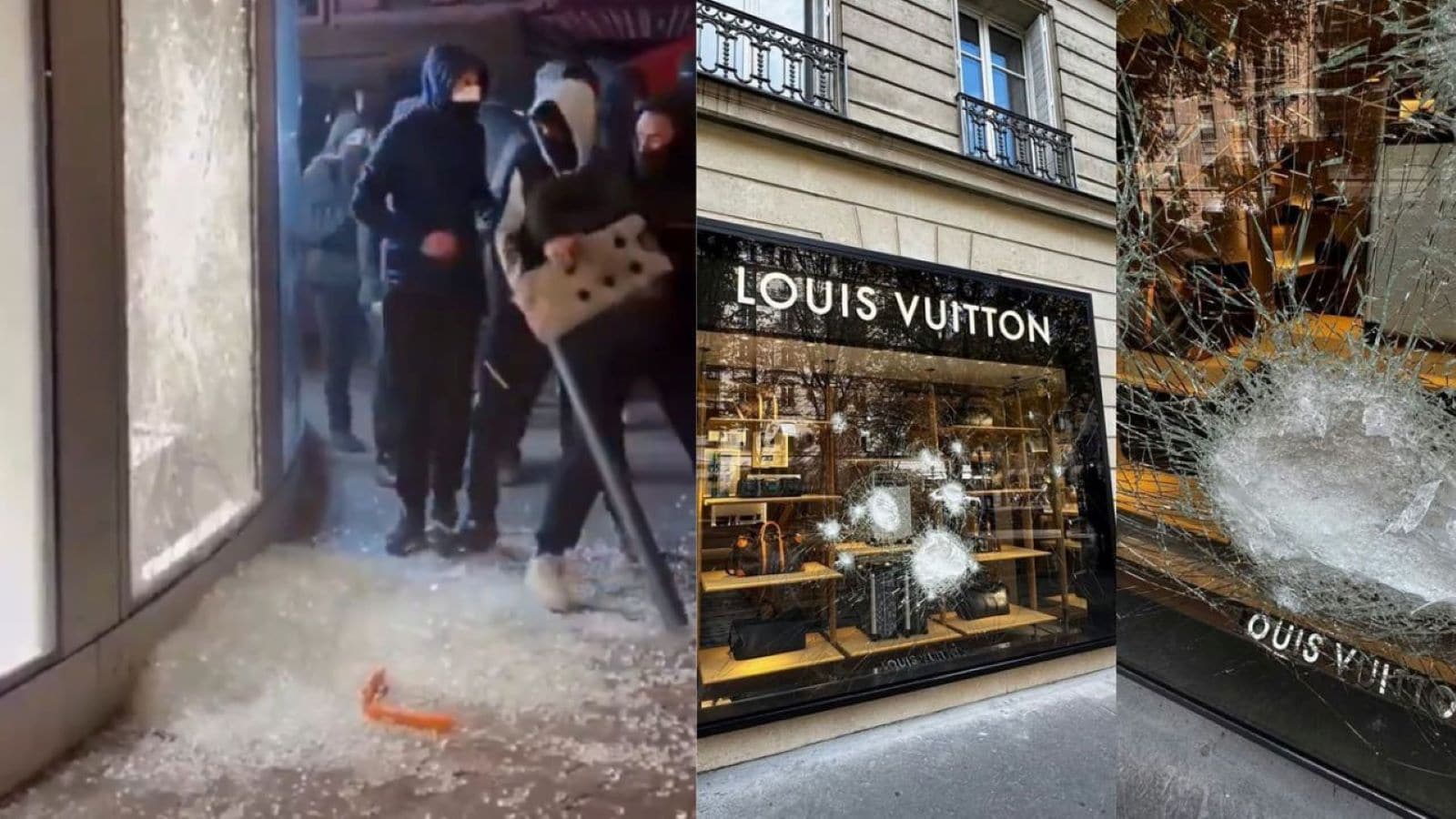
The metal pole swings downward in a blur of black fabric and streetlamp glare, striking the storefront window with a dull, sickening thud that echoes down the stone boulevards of Paris.
If you spent any time scrolling through social media in late October 2026, you saw that clip. You probably watched it twice. In the shaky frame, masked figures surround a luxury boutique amid the chaos of the French street demonstrations, kicking, throwing bricks, and hammering a massive glass facade with steel bars. Under the assault, the pane fractures into a dense, milky spiderweb of white cracks. Yet it refuses to fall. No jagged shards rain onto the pavement. No gap opens for looters to slip through. Eventually, exhausted and defeated by a transparent wall, the attackers simply walk away.
Within hours, that thirty-second video became the ultimate global punchline. Captions declared that the storefront belonged to Louis Vuitton, and that the impenetrable barrier had been engineered by a Chinese security glass manufacturer named Hengxinfeng. The narrative was irresistible. Millions shared the footage, marveling at the poetic irony of "communist glass" surviving an anti-capitalist riot in the heart of European luxury. Comment sections filled with jokes about the Great Wall of China and triumphant declarations that global manufacturing supremacy had officially shifted eastward.
It was a brilliant, intoxicating story. It was also almost entirely fabricated.
The Anatomy of a Viral Mirage
To understand why millions of people eagerly swallowed a fiction, we first have to look at what happens when real-world desperation collides with algorithmic storytelling.
Consider a hypothetical viewer—let us call him Marcus, a thirty-four-year-old supply chain manager sitting on his couch in London on a rainy Tuesday evening. Marcus has spent the last five years watching headlines about Western industrial decline and soaring inflation. When his phone serves him a clip of Parisian demonstrators failing to smash a luxury boutique window, paired with a bold claim that a Chinese firm turned a European crisis into free advertising, Marcus feels an immediate jolt of recognition. The story confirms everything he already suspects about global trade, geopolitical shifts, and the fragility of old institutions. He hits share before he even finishes reading the comments.
Multiply Marcus by ten million, and you have the modern information ecosystem.
When open-source investigators and technical analysts actually examined the viral footage frame by frame, the narrative began to unravel. First, the storefront in the clip was not a flagship Louis Vuitton boutique on Place Vendôme, as several breathless reposts claimed. Architectural markers and street layouts placed the exterior panels at the Westfield Forum des Halles, a massive commercial complex in central Paris.
Second, the "Chinese glass company" at the center of the viral storm—Hengxinfeng Special-Glass Co. Ltd.—barely existed online. Fact-checkers searching for corporate registries, export records, or official social media channels for the brand hit a dead end. Even the QR code embedded at the end of the circulating video did not lead to a factory in Henan province. Instead, it directed curious viewers straight to the Weibo account of a Chinese military blogger who had been aggregating footage of the French unrest.
The viral marketing triumph was a phantom. A social media caption had effectively hijacked an anonymous piece of street footage, slapped an unverified brand name onto it, and watched the internet do the rest of the work.
What Actually Stood Between the Street and the Store
Strip away the geopolitical mythmaking, however, and you are left with something far more fascinating than a clever social media stunt. You are left with the quiet, invisible engineering that keeps modern cities from tearing themselves apart when tempers boil over.
If you have ever stood behind a shop window during a street disturbance, you know the visceral terror of that thin boundary. Glass is supposed to be the ultimate symbol of fragility. We treat it gently. We warn children not to run near it. Yet in high-density urban centers from Paris to London, architects face an impossible mandate: make a storefront look completely invisible so shoppers can admire a handbag or a pair of boots from the sidewalk, while making that exact same surface strong enough to withstand a battering ram.
In the case of the Westfield Forum des Halles in Paris, technical documentation points not to a mysterious foreign startup, but to European industrial giants like Saint-Gobain, whose specialized SGG VISION-LITE and SGG STADIP PROTECT glazing lines have outfitted Parisian retail facades for over a decade.
How does a sheet of clear glass absorb the full-body swing of a steel pipe without collapsing?
Think of standard window glass like a frozen pond in early winter. One sharp blow sends a fracture racing across the entire sheet, and the whole surface gives way at once. High-security laminated glass—often rated under strict European EN 356 standards like P5A or P6B—operates on a completely different principle. Rather than relying on a single rigid slab, engineers bond multiple thick sheets of ultra-clear glass together using elastic, high-strength polymer interlayers, typically made of polyvinyl butyral or ionoplast resins.
Think of it as a microscopic suspension bridge sandwiched between crystal walls.
When a heavy object strikes the exterior pane, the glass does exactly what glass is supposed to do: it breaks. That white spiderweb pattern seen in the viral Paris video is not a sign of failure. It is a deliberate energy-dissipation mechanism. By fracturing into thousands of tiny, interconnected fragments, the outer layer absorbs and spreads the kinetic shock of the blow across a wider surface area. Meanwhile, the flexible plastic core underneath stretches without tearing, holding every single shard locked in place.
To breach a P6B-rated panel, an attacker cannot simply shatter the glass; they have to systematically hack through the tough polymer membrane with an axe or sledgehammer, blow after exhausting blow, often requiring dozens of concentrated strikes in the exact same spot. In the middle of a chaotic street protest, with sirens wailing and police advancing, nobody has twenty uninterrupted minutes to saw through plastic webbing. The barrier buys the one commodity no security guard can manufacture: time.
The Human Cost Outside the Frame
It is easy to marvel at material science from the comfort of a smartphone screen. It is much harder to reckon with what was happening on the other side of that lens.
The October 2026 demonstrations in France did not materialize out of thin air. They began weeks earlier as localized student protests over teacher shortages and crumbling school facilities in the northern suburbs of Paris. Before long, that frustration fused with broader public anger over rising living costs, public spending cuts, and fierce clashes over police tactics. By mid-October, hundreds of thousands had marched, nearly 1,500 people had been arrested, and teenagers had been seriously injured in the crossfire.
When a clip of masked youths hammering a luxury storefront goes viral as an "epic trolling" ad for an unbreakable window, the human reality of the street gets flattened into background scenery.
Consider what that moment actually felt like for the people standing inside the building. Imagine a hypothetical retail manager—let us call her Camille—huddled in a back stockroom thirty feet behind that glass panel as the first metal bar hits the facade. To the internet, the thud is a satisfying sound effect proving product durability. To Camille, listening to the glass crack and groan under repeated blows while checking her phone for updates on whether police lines are holding two blocks away, every second stretches into an eternity. She does not care whether the polymer interlayer was extruded in France, Germany, or Henan. She only cares that the barrier holds until she can go home safely.
At the same time, look at the young men swinging those bars outside. Whatever anger drove them into the streets—whether genuine economic despair or opportunistic thrill-seeking—they were throwing their bodies against an invisible wall of modern engineering, risking up to ten thousand euros in legal liability and years in prison for a smash-and-grab that was physically impossible from the first strike.
Why We Fall for the Shortcut
I will admit something uncomfortable about watching that video myself: for the first ten seconds, I wanted the viral caption to be true.
There is a deep, almost primal satisfaction in a clean David-and-Goliath story, especially one wrapped in commercial cleverness. As observers of modern business and technology, we love the idea that an underdog manufacturer can outmaneuver Western luxury giants without spending a single cent on traditional advertising. We love crisp binaries: East versus West, state-backed industry versus luxury capitalism, unbreakable strength versus decadent fragility.
Real life rarely offers such tidy symmetry.
In truth, global supply chains are hopelessly tangled, architectural glass standards are quiet, bureaucratic triumphs negotiated in European engineering committees, and viral social media accounts routinely invent corporate heroes out of thin air to harvest clicks. The true story—that decades-old French laminated glass technology silently did the exact job it was installed to do during a tragic week of civil unrest—does not fit neatly into a twenty-word tweet. It lacks a villain you can mock and a hero you can applaud.
Yet recognizing that illusion matters more than ever. When we allow fabricated captions to turn real civil unrest into viral marketing fairy tales, we lose sight of both the actual engineering that protects our cities and the actual pain driving people into the streets.
The next time a clip stops your thumb mid-scroll—a dramatic collision, a miraculous survival, an impossible product test caught on a grainy phone camera—pause before you share the legend attached to it. Look closely at the surface. Beneath the bright, seductive reflection of the story you want to believe, there is always a denser, quieter reality holding everything together.