Drop an anchor into the Mediterranean off Rishon LeZion, and you aren't just hitting sand. You are likely dropping it right next to an unexploded mortar shell or a live grenade. Decades of military firing practice have turned large swaths of Israel's coastline into a literal minefield under the waves. It is a messy legacy of war and defense preparation that has locked away nearly half of the country's 120-mile coastline from its own citizens.
Now, a specialized team of divers and marine geologists is trying to take it back.
This isn't just about making more room for beach towels in a crowded country, though expanding the packed sands of Rishon LeZion by tripling its usable coastline is a major driver. It is part of a massive, mostly invisible global scramble to clean up the world's oceans. We are demanding more from our seas than ever before. We need clean water from desalination plants, space for offshore wind turbines, and safe corridors for the millions of miles of underwater fiber-optic cables that power global internet traffic. But you can't build the infrastructure of tomorrow when the seafloor is littered with the explosive remnants of yesterday.
The Brutal Reality of Searching For Deep Sea Explosives
Finding unexploded ordnance on land is hard enough. Doing it underwater in shifting sands and murky currents is a logistical nightmare.
"It's like looking for a needle in a haystack," says Israel Faintuch, head of the Maritime Division at Israel's Ministry of Defense National Mine Action Authority.
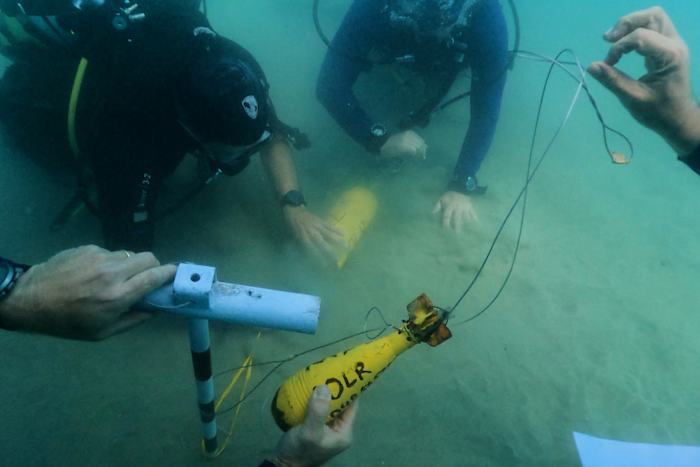
The joint research project, backed by the Rishon LeZion municipality, the National Mine Action Authority, and the National Institute of Oceanography, isn't even clearing the live weapons yet. Right now, they are just trying to figure out how underwater explosives move. Divers have been dropping mock munitions—painted bright yellow and stuffed with motion sensors—at depths ranging from 16 to 59 feet, stretching nearly a mile out to sea.
The goal is to map the patterns of how currents, storms, and tides shift these heavy metal objects. When the research team went down for their fifth diving trip to retrieve dummy shells planted months earlier, the sea showed its teeth. They found absolutely nothing. The seafloor had swallowed them, covering the yellow markers with thick blankets of shifting sand.
Why Smaller Munitions Present the Biggest Danger
Most international marine clearance projects target massive scuttled warships or heavy aerial bombs from World War II. Those are relatively easy to spot with sonar. The project off Rishon LeZion is tackling a completely different beast: smaller munitions.
- Mortar shells that sink deep into localized sand pockets.
- Hand grenades tossed during decades of coastal defense drills.
- Small artillery rounds that mimic the size and shape of ordinary rocks.
Because these objects are small, they get tossed around by shallow-water waves. Or worse, they stay exactly where they are and slowly decay. Seawater eats through the metal casings over time. When the protective shells erode, toxic chemicals, heavy metals, and explosive compounds leak directly into the marine ecosystem.
Why the Tech Boom is Forcing Our Hand Underwater
This sudden urgency to clean up the ocean floor isn't happening in a vacuum. The global explosion of data infrastructure is a massive factor. Every single Zoom call, financial transaction, and text message relies on a vast network of submarine cables resting on the seabed.
With the massive expansion of infrastructure needed for processing power, tech companies are laying underwater fiber-optic lines at a staggering pace. You cannot drop a multi-million-dollar data cable onto a seabed covered in live artillery. Renewable energy plays a role too. Offshore wind farms require massive structural columns driven deep into the ocean floor. If a pile-driver hits a submerged, forgotten 100-pound shell, the results are catastrophic.
The preliminary data from the Haifa University and Oceanography researchers offers a small glimmer of hope. Early findings suggest that once these smaller munitions settle into the sand, they actually move far less than scientists originally feared. If the explosives aren't wandering miles away from the original firing zones, the actual high-risk cleanup zones can be narrowed down significantly. That saves time, money, and lives.
The Steep Cost of Reclamation
Reclaiming these coastal waters is an incredibly slow, expensive gamble. The Israeli Defense Ministry wants enough solid data to begin actual clearance operations by the end of next year. They hope to push the safe shoreline out by an initial 492 feet within the first few months of active clearing.
But actually finishing the job will take years and drain tens of millions of dollars.
Then there is the geopolitical reality. You cannot send scientific dive teams into the water when rockets are flying. Recent conflicts involving Hamas in Gaza, Hezbollah in Lebanon, and direct missile exchanges with Iran have repeatedly halted operations. When air-raid sirens wail on the mainland, diving boats have to scramble back to port. A missile landing in the water while a diver is handling a sensitive sensor or examining a piece of rusted ordnance could trigger an acoustic shockwave strong enough to kill.
What Needs to Happen Next
If you think this is just a local issue for beachgoers in Rishon LeZion, you are missing the bigger picture. The data gathered from these Mediterranean test runs will likely form the blueprint for shallow-water clearance operations worldwide.
Governments and private maritime industries need to take specific steps to handle this growing crisis:
- Stop treating marine clearance as an afterthought. Coastal municipalities and national defense agencies must co-fund baseline mapping projects before commercial development begins.
- Invest in specialized sonar technology. Standard side-scan sonar struggles to detect small mortars buried under feet of sand. We need better magnetic and sub-bottom profiling tech.
- Establish international data-sharing protocols. The lessons learned about how small-caliber weapons migrate in sandy environments should be openly shared with international maritime bodies to speed up cleanups in other post-conflict zones.
The era of using the world's oceans as a giant, forgotten dumping ground for live ammunition is over. We simply run out of room, and the risk to global connectivity and local ecosystems is too high to ignore. Tripling a city's beachfront is a great local perk, but securing the seafloor is a global necessity.