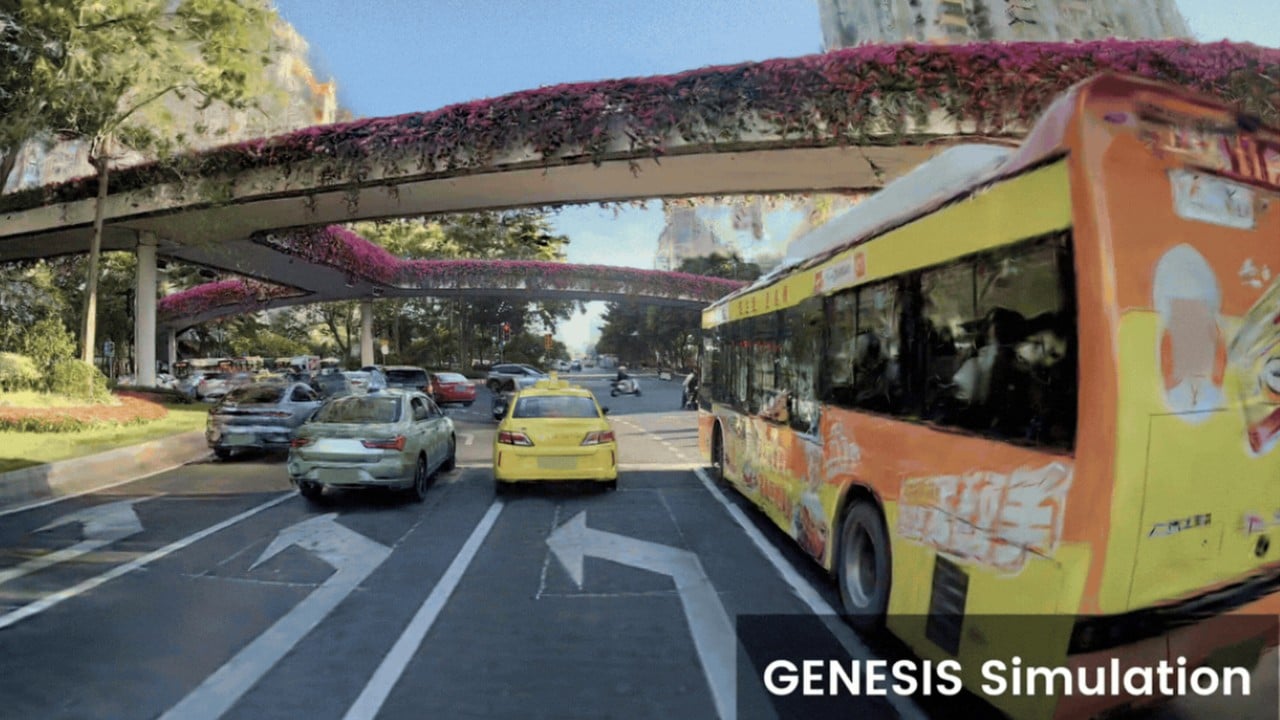
The viability of a robotaxi entity depends not on the sophistication of its neural networks, but on its ability to drive the marginal cost per mile below that of a human-operated rideshare vehicle while maintaining a utilization rate that amortizes high sensor-suite costs. WeRide’s recent public maneuvers and technical disclosures reveal a strategy aimed at bypassing the "pilot-program trap" by diversifying hardware across five distinct product lines: robotaxis, robobuses, robovans, robosweepers, and advanced driving systems for consumer vehicles. This multi-modal approach is a hedge against the massive capital expenditures required to solve the long-tail edge cases of urban navigation.
The CAPEX Bottleneck and Sensor Suite Depreciation
A primary hurdle for WeRide and its peers is the initial vehicle cost. A standard internal combustion engine or battery electric vehicle (BEV) undergoes a transformation into an autonomous platform through the integration of a sensor stack that often doubles the vehicle's base price. For another view, check out: this related article.
- Hardware Redundancy: WeRide’s "Sensor Suite 5.1" utilizes a combination of solid-state LiDAR, high-definition cameras, and millimeter-wave radar. This redundancy is mandatory for safety but creates a steep depreciation curve.
- Computational Load: Processing several terabytes of data per hour requires onboard liquid-cooled computing units. The power draw of these units reduces the effective range of the BEV platform, increasing the frequency of non-revenue-generating charging cycles.
The competitive advantage in this sector shifts to the firm that can achieve Sensor-Agnostic Software. If WeRide can port its "WeRide One" platform across different vehicle form factors without bespoke recalibration for every new chassis, it reduces the engineering man-hours per deployed unit. This is the difference between a boutique robotics project and a scalable transportation utility.
The Operational Reality of Remote Assistance
The term "driverless" is a misnomer in the current regulatory and technical environment. Every Level 4 (L4) operation currently relies on a Remote Operations Center (ROC). The logic of the business model dictates that the ratio of "Remote Overseers to Vehicles" must be maximized. Related coverage on the subject has been shared by TechCrunch.
- Phase 1 (Current): 1:1 or 1:2 ratio. Humans monitor every movement. This is more expensive than a traditional Uber because it requires both a vehicle and a high-paid technician in an office.
- Phase 2 (Target): 1:20 or 1:50 ratio. The AI handles 99.9% of scenarios. Humans only intervene when the vehicle enters a "Minimum Risk Condition" (MRC), such as a police officer using hand signals or an undocumented construction zone.
WeRide’s expansion into markets like Abu Dhabi and Singapore serves as a stress test for these ratios. By operating in diverse geographic "OEDs" (Operational Design Domains), the company gathers data on local driving cultures—a critical variable for the "social intelligence" of the driving algorithm. A robotaxi that drives too conservatively in a high-density environment like Guangzhou will be bullied by human drivers, leading to perpetual stalls and zero customer retention.
Diversification as a Risk Mitigation Framework
The "Robotaxi-only" model is a high-risk gamble on regulatory speed. WeRide’s decision to develop autonomous buses (Robobus) and street sweepers (Robosweeper) addresses three structural problems:
- Speed Constraints: Robobuses often operate on fixed routes or in dedicated lanes. Lower speeds and predictable paths drastically simplify the path-prediction algorithms, allowing for faster commercialization.
- Labor Scarcity: Urban sanitation is a high-turnover industry. The ROI on an autonomous sweeper is easier to calculate than a taxi because the "customer" is a municipal government with long-term contracts rather than a fickle consumer.
- Data Flywheel: Every mile driven by a Robosweeper at 5 mph contributes to the mapping and localization data used by the Robotaxi at 35 mph.
The Geography of Regulation
WeRide’s pursuit of a US IPO while maintaining its core operations in China creates a unique geopolitical and technical friction. The data sovereignty laws in China (Data Security Law) and the scrutiny from the US Department of Commerce regarding Chinese-made LIDAR and software create a fragmented development environment.
To survive, the company must maintain Bifurcated Data Stacks. This means developing separate cloud infrastructures for international and domestic operations. The cost of this duplication is significant. It prevents a truly global "brain" for the AI, as the edge cases learned in San Jose cannot easily be integrated into the models driving in Beijing without rigorous data scrubbing and regulatory compliance checks.
The Path to Positive Contribution Margin
For WeRide to outpace rivals like Waymo or Tesla’s proposed Cybercab, it must solve the Deadhead Mileage Problem. In a traditional ride-hailing network, drivers choose where to wait. In an autonomous fleet, the central orchestrator must predict demand to minimize the miles driven without a passenger.
$$Cost_{Total} = (C_{V} + C_{S}) / L + (M_{O} + M_{M}) + E$$
Where:
- $C_{V}$ = Base Vehicle Cost
- $C_{S}$ = Sensor and Computing Suite Cost
- $L$ = Operational Lifespan in Miles
- $M_{O}$ = Operations/Remote Monitoring Cost per Mile
- $M_{M}$ = Maintenance and Cleaning Cost per Mile
- $E$ = Energy/Charging Cost per Mile
The goal is to reach a point where $Cost_{Total}$ is less than the local rate for a human driver, which in major global cities fluctuates between $1.50 and $2.50 per mile. Currently, most L4 operators are estimated to be at $5.00 to $10.00 per mile when accounting for the full R&D overhead.
Strategic Infrastructure Integration
The final barrier is not the car, but the city. WeRide’s success is tethered to V2X (Vehicle-to-Everything) communication. If a city’s traffic lights "talk" to the car, the need for complex visual processing of intersections is reduced.
However, relying on V2X is a double-edged sword. It limits the ODD to "Smart Cities." WeRide’s heavy involvement in the Middle East suggests a preference for "Greenfield" cities—new developments where autonomous infrastructure is baked into the asphalt. This is a pragmatic shortcut compared to the "Brownfield" challenge of San Francisco or New York, where the AI must contend with 100-year-old infrastructure and unpredictable human behavior.
The transition from a venture-funded research entity to a sustainable transport giant requires a pivot from Feature Engineering (making the car drive better) to Operational Engineering (making the fleet move cheaper). The companies that survive will be those that view the vehicle as a depreciating commodity and the orchestration software as the primary asset. WeRide’s multi-platform approach suggests they understand this, but their ability to execute depends on maintaining a massive capital runway in an increasingly fractured global market.
The strategic play for the next 24 months is the aggressive pursuit of "Fixed-Route Municipal Contracts." By locking in long-term revenue via autonomous buses and sweepers, a company can subsidize the high-variance R&D required for the "anywhere-to-anywhere" robotaxi dream. Investors should ignore the flashy "no-steering-wheel" demos and look at the "Cost per Service Hour" on municipal contracts. That is where the war for autonomy will be won or lost.


