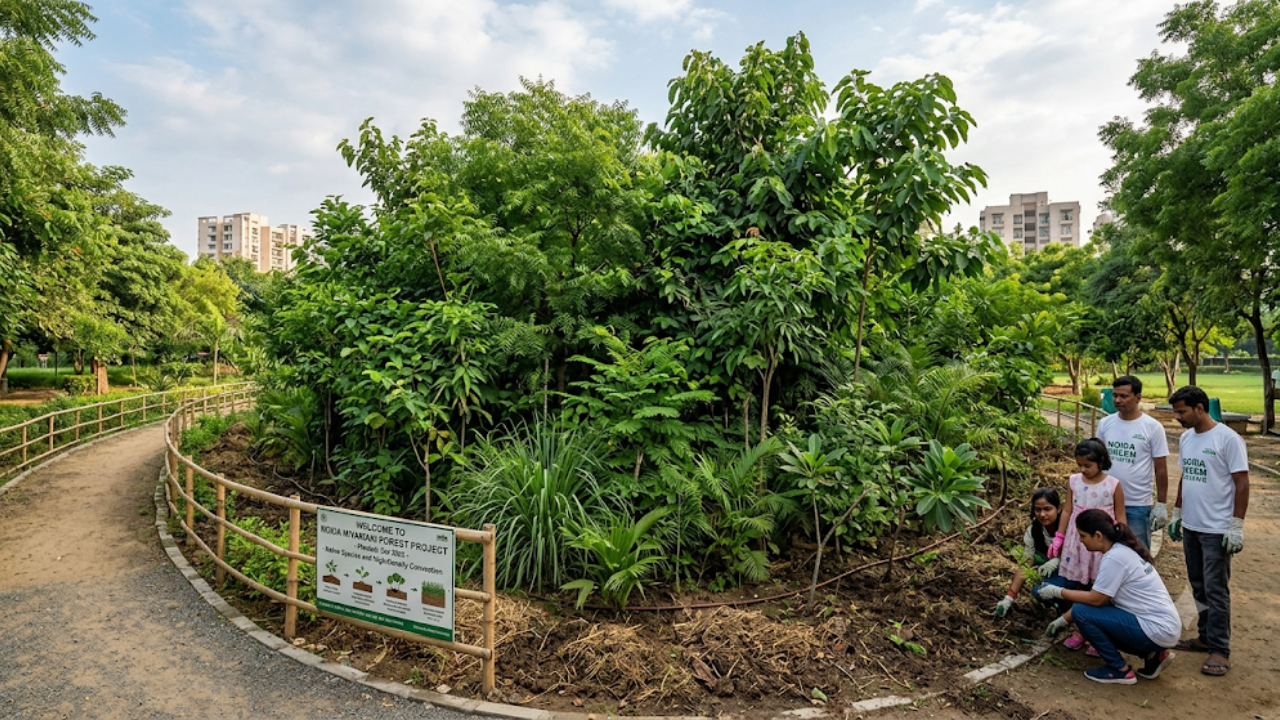
Cities are suffocating, and municipal planners have found their favorite new security blanket. It is called the Miyawaki method.
From the concrete expanses of Tokyo to the choking smog of Delhi, the narrative is identical. Plant a hyper-dense pocket of native trees, watch it grow ten times faster than a traditional forest, and congratulate yourself on engineering a self-sustaining ecological miracle in the middle of a traffic roundabout. It sounds elegant. It sounds efficient. Read more on a related subject: this related article.
It is mostly a marketing gimmick.
As an environmental scientist who has spent fifteen years analyzing urban canopy data and watching city councils burn through green-infrastructure budgets, I can tell you that the current obsession with Miyawaki forests is a classic case of good intentions meeting bad math. We are treating a structural, systemic urban crisis with a series of high-density botanical band-aids. Further analysis by The Verge highlights related perspectives on the subject.
The lazy consensus claims these mini-forests are a silver bullet for urban heat islands and carbon sequestration. The reality is far more complicated, expensive, and ecologically fragile.
The Mechanics of the Illusion
To understand why the Miyawaki method is failing our cities, you have to understand how it works. Developed by Japanese botanist Akira Miyawaki in the 1970s, the technique involves preparing a deep layer of heavily amended soil, planting three to four native tree species per square meter, and maintaining the plot intensely for the first three years.
The trees engage in fierce competition for sunlight. This competition forces them to shoot upward at a breakneck pace. To a casual observer or a politician looking for a photo-op, it looks like a roaring success. Look at how fast it grew. Look at how dense it is.
But this rapid vertical growth is a stress response, not a sign of a thriving ecosystem.
The Problem of Stunted Architecture
When you force trees into an artificial cage match for survival, you alter their structural integrity. True forest dynamics rely on a balance of vertical growth, root expansion, and lateral canopy development. Miyawaki forests prioritize the vertical at the expense of everything else.
- Weakened Root Systems: Because the trees are jammed together, their root systems frequently lack the space to spread horizontally. They intertwine into a shallow mat. In an urban environment hit by increasingly severe storms, these top-heavy, shallow-rooted dense plots are highly vulnerable to windthrow.
- Zero Structural Understory: The dense canopy closes so fast that it completely blocks out light to the ground level within forty-eight months. This does not create a biodiverse forest floor; it creates a dark zone where nothing else can grow.
Imagine a scenario where a city replaces a degraded patch of soil with a hundred-square-meter Miyawaki plot. The initial metrics look phenomenal. By year five, however, the weaker trees begin to die off exactly as the method predicts. But in a confined urban pocket, that dead biomass doesn't decompose the way it does in a vast wilderness. It becomes a compact tinderbox of dry fuel, sitting right next to urban infrastructure.
The Economics Do Not Clean Cleanly
Let us talk about the money, because this is where the urban forestry narrative completely falls apart. The advocates love to boast about how low-maintenance these plots are after year three. What they conveniently leave out of the brochure is the exorbitant upfront cost.
The Cost Per Square Meter Insanity
Preparing a Miyawaki plot requires digging up the soil to a depth of up to one meter, mixing in massive amounts of organic matter, and purchasing an astronomical number of saplings. Planting three to four trees per square meter means a tiny plot requires thousands of plants.
+---------------------------+-----------------------+-----------------------+
| Metrics                   | Miyawaki Method       | Standard Urban Canopy |
+---------------------------+-----------------------+-----------------------+
| Planting Density          | 3-4 saplings / m²     | 1 tree / 10-15 m²     |
| Initial Soil Engineering  | Extreme (Deep dig)    | Moderate (Pitting)    |
| Capital Expenditure (CapEx)| Sky-High              | Low to Moderate       |
| 3-Year Water Demand       | Intense               | Low to Moderate       |
| Scale Potential           | Micro-localized       | Macro-citywide        |
+---------------------------+-----------------------+-----------------------+
I have seen municipal governments spend tens of thousands of dollars on a Miyawaki plot the size of a tennis court. For that same budget, they could have planted hundreds of street trees across low-income neighborhoods that actually suffer from systemic canopy deficits. Instead, they choose a high-density novelty project that looks great on Instagram but has a negligible impact on the city’s macro-climate.
Dismantling the "People Also Ask" Falsehoods
When you look at public discussions around urban greening, the same flawed assumptions appear repeatedly. Let us answer them with actual data.
Do Miyawaki forests fix urban air pollution?
Hardly. This is a profound misunderstanding of fluid dynamics and particulate matter. For trees to filter air pollution effectively, you need airflow. A Miyawaki forest is designed to be an impenetrable wall of vegetation.
Air currents do not pass through a mature Miyawaki plot; they hit it and lift over it. This means the particulate matter ($PM_{2.5}$ and $PM_{10}$) simply bypasses the dense canopy entirely, settling on the streets around it. To scrub a city's air, you need dispersed, mature street trees with open structures that allow wind to filter through the leaves, not a solid block of green concrete.
Can they solve the urban heat island effect?
Only within their immediate, microscopic footprint. A micro-forest will absolutely lower the temperature directly beneath its leaves. But its cooling effect drops off precipitously just a few meters outside its perimeter.
To cool a blistering metropolis like Delhi or Phoenix, you need continuous shade over asphalt. You need linear canopies over sidewalks and roads to prevent the pavement from absorbing heat during the day and radiating it at night. A self-contained pocket forest in a suburban park does nothing for the commuter walking down a barren, unshaded avenue two blocks away.
The Ecological Lie of "Instant" Ecosystems
True ecosystems are built on time, not speed. Akira Miyawaki’s original work was designed for restoration in specific Japanese climates, often around shrines and industrial sites where native topsoil was completely gone. Exporting this template as a universal urban styling choice is ecological hubris.
When you force a forest to grow at 10x speed, you are accelerating the life cycle of the vegetation without accelerating the colonization of the necessary fauna.
- Microbiome Lag: The complex network of mycorrhizal fungi that supports a healthy forest takes decades to establish a resilient, adaptive matrix. Artificially pumping the soil with compost and fertilizer creates a temporary spike in growth, but it doesn't replicate the slow, deep resilience of an evolved soil food web.
- The Pest Paradise: Monolithic density in a tiny footprint creates a highly vulnerable target for pests. If a localized disease or insect infestation hits a Miyawaki plot, the proximity of the hosts allows the pathogen to tear through the entire installation in weeks.
Stop Planting Pockets. Shade the Streets instead.
If we want to fix our cities, we have to abandon the obsession with cute, isolated green experiments. The Miyawaki method is a luxury for wealthy corporate campuses wanting to check an ESG box. It is not a scalable strategy for municipal survival.
We must pivot our capital toward structural urban forestry.
Instead of spending $50,000 on a single dense pocket of trees, that capital should be deployed to plant and maintain continuous lines of resilient, structurally sound canopy trees along our arterial roads. We must invest in structural soils beneath sidewalks that allow roots to grow safely beneath the concrete without destroying infrastructure.
This approach is harder. It requires coordination with utility companies, civil engineers, and traffic planners. It doesn't yield a dense jungle in twenty-four months. But in twenty years, it results in a cooler, breathable, resilient city.
The Miyawaki method promises a shortcut through nature’s timeline. But nature does not take shortcuts, and when cities try to buy one, they end up with a very expensive, very fragile illusion. Stop building botanical showcases. Plant trees where people actually walk.