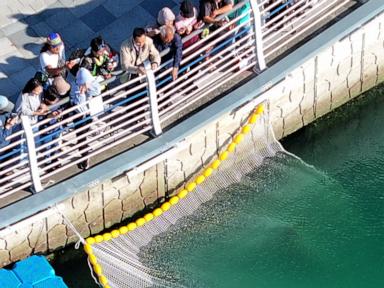
Conventional incident reporting treats a shark trapped in an urban canal as a human-interest oddity or a straightforward wildlife rescue. That framing misses the structural reality of the September–October 2026 entrapment of a female dusky shark—named Bukangi by the public after North Port (Bukhang)—in Busan's North Port Waterfront Park canal. When an apex or large coastal predator enters a hard-edged concrete waterway surrounded by dense foot traffic and port infrastructure, the problem is neither purely biological nor purely municipal; it is a coupled system failure involving hydrodynamic confinement, thermal and metabolic stress, and an unexpected surge in civic attention.
A rigorous examination of the Busan episode shows why ad-hoc herding maneuvers stall, why public spectacle complicates operational control, and how coastal cities must re-architect marine response protocols when warming seas shift species distributions northward.
Deconstructing the Standard Incident Narrative
Standard wire and feature coverage of the Busan canal shark centers on three recurring motifs: the contrast between Jaws-style fear and affectionate public curiosity, a tally of visitors exceeding 1.6 to 1.7 million people, and a chronological log of rescue attempts involving boats, water jets, and nets. While those observations capture surface drama, they leave critical causal links unexamined.
First, standard coverage treats "struggling to free" the shark as a simple matter of technical difficulty or animal stubbornness. In reality, an unrestrained large elasmobranch operating inside a narrow, reflective concrete basin responds to stimuli differently than a terrestrial animal in a paddock or a small teleost in an open estuary. Dodging vessels or clearing a barrier is not proof of malice or "refusal"; it is an evasive response to acoustic, visual, and hydrodynamic disturbances inside a confined volume.
Second, standard reporting often separates the crowd phenomenon from the operational timeline, treating civic enthusiasm as a warm backdrop rather than an active operational variable. High daily visitation—spiking to an average of roughly 120,750 visitors per day during the Chuseok holiday window compared with a typical holiday baseline near 2,000—changes shoreline monitoring requirements, night-time lighting and noise exposure, and political incentives around public messaging.
Third, early optimistic health snapshots can mask delayed physiological deterioration. Daily visual or basic assessments early in the entrapment that found no obvious acute crisis operated on a different time horizon than cumulative caloric deficit, declining autumn water temperatures, and skin abrasions from contact with hard surfaces or gear.
Known Facts Versus Educated Hypotheses
Separating verified observations from analytical inference is essential when reconstructing an unfolding wildlife-infrastructure event.
Verified Facts from the Busan Episode
- A large shark—identified as a female dusky shark roughly 3 meters (about 9.8 feet) in length—was first spotted in mid-September 2026 in the canal at Busan's North Port Waterfront Park and remained in the waterway area for roughly a month.
- City authorities and local observers nicknamed the shark Bukangi (or Bukang-i) after Bukhang (North Port), and the city leaned into the cultural moment with official mascot/ambassador framing and public livestreams.
- Public attendance surged dramatically, surpassing 1 million visitors by early October and reaching approximately 1.6 to 1.7 million visits across the episode, with a sharp Chuseok holiday spike between September 24 and September 27.
- Authorities conducted multiple extraction/guiding operations—including efforts on September 29 using five vessels spraying water streams, an October 2 operation involving a large net (reported around 50 meters long by 6.8 meters high) that snagged on the canal bottom, and a third major net-and-pontoon guiding operation in mid-to-late October—with the shark initially evading boats or passing over barriers and later reappearing near the area even after release efforts.
- Fisheries researchers and marine specialists flagged risks tied to autumn cooling (with canal temperatures around 21°C near the lower end of the species' preferred range), lack of observed feeding since September, balance/abrasion concerns, and broader northward shifts of warm-water prey and subtropical/temperate sharks associated with ocean warming.
Educated Hypotheses and Analytical Inferences
- Orientation and exit-cue ambiguity: Concrete canals with vertical walls, artificial lighting, and complex harbor mouth hydraulics likely weaken or distort the natural environmental gradients a pelagic or coastal shark uses to orient toward open water.
- Escalating energetic cost of repeated herding: Each unsuccessful drive or net deployment likely imposes an acute metabolic spike (burst swimming, stress hormones, potential minor abrasions) that compounds baseline fasting and cooler water temperatures.
- Return behavior after release: When a large mobile marine predator reappears near a harbor or canal shortly after being coaxed outward, the cause may be incomplete disorientation at the harbor threshold, lingering prey or thermal cues, or simply wide coastal ranging that intersects the same high-visibility port corridor.
The Four Pillars of Urban Canal Entrapment
To move beyond anecdote, an urban marine entrapment can be analyzed across four interlocking pillars: Spatial-Hydraulic Geometry, Physiological & Thermal Budgets, Intervention Mechanics, and Civic-Institutional Dynamics.
Spatial-Hydraulic Geometry
A modern waterfront canal is engineered for pedestrian access, aesthetic reflection, and sheltered boat movement—not for effortless two-way navigation by a 3-meter shark. Vertical concrete walls eliminate gentle shoaling slopes that allow animals to sense edges gradually. Where a canal meets a busy port basin like North Port, tidal exchange, vessel wakes, and breakwater geometry create complex flow boundaries. A shark that enters on a favorable current or while pursuing schooling fish may find the outward exit path less obvious than the inward path, especially if noise and boat traffic concentrate near the mouth.
Physiological and Thermal Budgets
Every hour inside a confined urban waterway alters an ectothermic or regionally endothermic predator's energy balance. Dusky sharks are active, large-bodied swimmers adapted to temperate and tropical waters. When autumn arrives in the Northern Hemisphere, surface and nearshore water temperatures fall. Even if an animal appears vigorous during early checks, prolonged periods without confirmed feeding combined with cooler temperatures narrow its physiological margin for error. Contact with abrasive concrete, floating pontoons, or netting introduces secondary infection risks if skin integrity is compromised.
Intervention Mechanics
Guiding a large shark out of a narrow channel is fundamentally a fluid-dynamics and behavioral-response problem rather than a brute-force capture problem. Heavy nets deployed across a canal can snag on uneven benthic debris or canal bottoms, halting progress mid-operation. Conversely, if a net does not span the full water column or is set too low relative to surface space, a determined swimmer can pass over or around it. High-pressure water streams from multiple boats can create walls of turbulence and acoustic clutter, yet if the stimulus feels threatening from all directions—or lacks a clear, calm corridor toward open sea—the animal may dart past vessels rather than funnel toward the exit.
Civic-Institutional Dynamics
Municipal authorities rarely plan for a stranded shark to become an overnight cultural icon. An initial safety alert meant to encourage caution can backfire by driving mass foot traffic to the railings. Once a nickname sticks, merchandise appears, and officials participate in mascot framing or high-profile visits, the incident acquires a dual track: biological triage on one side, and public expectations on the other. That dual track creates subtle pressure to stage visible "rescue" operations even when environmental conditions or gear readiness are still being worked out.
Cause-and-Effect Chains the Standard Story Misses
The first missed cause-and-effect chain links ocean warming to urban crowding. Rising sea temperatures and shifts in coastal prey distribution make encounters between large sharks and nearshore waters more probable—as illustrated by fisheries records showing a sharp year-over-year rise in large sharks recorded off the east coast in the first half of 2026. When that ecological shift intersects a high-density urban waterfront park, a rare biological event turns into a mass-attendance spectacle.
The second missed chain links repeated partial interventions to behavioral learning and fatigue. When an early attempt uses boats and water jets or a net that snags, the shark experiences disruption without completing exit transit. Subsequent operations face an animal that has already associated vessel noise or barriers with disturbance, while simultaneously having fewer energy reserves in reserve.
The third missed chain links mascot branding to operational friction. Turning a distressed wild animal into a civic emblem boosts short-term tourism and local commercial buzz, yet it raises the stakes of any setback. If an extraction attempt is delayed, or if the shark returns near the harbor after release, public emotion can swing rapidly from celebration to frustration or anxiety.
Operational Playbook for Urban Marine Entrapments
Practitioners managing port and coastal incidents—harbormasters, fisheries biologists, coast guard units, and municipal emergency teams—can treat a confined-waterway large-marine-fauna event as a structured five-phase operation.
- Establish a Perimeter and Acoustic-Light Discipline Immediately. Secure railings to prevent accidental falls without turning the site into an unmonitored late-night spectacle. Restrict unnecessary spotlights, loud public-address systems, and non-essential vessel idling near the canal mouth so the animal is not boxed in by sensory noise.
- Map Bathymetry and Flow Before Deploying Gear. Survey canal depth profiles, bottom obstructions, and tidal flow direction prior to rigging any net. A net that catches on submerged debris wastes critical operational time and risks entangling or injuring the animal.
- Design a Single-Vector Funnel Rather Than a Surround. Position vessels and guiding lines to create a clear, low-turbulence exit lane toward open water rather than encircling the animal with aggressive streams from every angle. Keep herding speeds measured so the shark is guided rather than panicked into high-speed collisions with walls or gear.
- Track Cumulative Condition Metrics, Not Just Daily Snapshots. Pair routine observations with explicit tracking of water temperature trends, estimated fasting duration, swimming posture/balance, and any visible abrasions. Set pre-agreed veterinary and fisheries decision thresholds for when intervention urgency rises or when conditions become unfavorable.
- Decouple Public Communication from Mascot Incentives. Provide transparent, calm updates on marine science and safety while avoiding over-promising quick outcomes or turning a vulnerable wild predator into a commercial promotional centerpiece.
Limitations and Trade-Offs of These Measures
No tactical playbook eliminates uncertainty in open coastal environments. Even a well-executed guiding operation cannot control what a shark does once it clears a harbor breakwater into deeper, open water. Physical capture and transport by barge or crane—sometimes suggested by lay observers—carry severe risks of capture myopathy, gill/spine trauma, and equipment failure for a large, heavy elasmobranch. Conversely, leaving an animal completely alone in a dead-end basin risks progressive energetic depletion as seasonal temperatures drop. Every choice involves trading one risk against another under incomplete information.
Strategic Recommendation for Coastal Port Cities
Coastal municipalities and national fisheries agencies should treat the Busan canal episode as an early warning rather than a one-off novelty. The highest-leverage strategic move is to pre-authorize a joint Port-Fisheries Rapid Response Protocol with pre-staged, snag-tested guiding gear and clear public-communication rules before the next seasonal warming spike arrives. Rather than improvising multi-agency tactics mid-crisis while crowds gather by the hundreds of thousands, port authorities should define command authority on day one, integrate real-time water temperature and prey-shift monitoring into harbor risk assessments, and keep public messaging grounded in ecological stewardship rather than novelty entertainment.