Brussels gets mocked for endless red tape, slow-moving committees, and speeches full of technocratic jargon that sound like they were generated by an algorithm trying to bore humanity to death. The lazy consensus across financial capitals and editorial desks is that the European Union is a lumbering bureaucratic dinosaur, paralyzed by its own consensus-driven design, slowly sliding into geopolitical irrelevance between an aggressive Washington and a predatory Beijing.
Everyone misses the actual mechanics.
I have watched policy shops in Brussels and corporate boardrooms across Frankfurt blow millions trying to outrun European regulation, only to watch those exact regulations become global gold standards three years later. The European project does not win by moving fast and breaking things. It wins by institutionalizing friction.
The Brussels Effect is Not an Accident
Let us dismantle the primary myth: that European bureaucracy is a tax on innovation. It is actually the most aggressive commercial weapon deployed in the twenty-first century.
When the Commission rolls out privacy frameworks, AI rulebooks, or carbon border adjustments, Silicon Valley and Wall Street scream about protectionism and red tape. Then they quietly rewrite their global product lines to comply with Brussels standards because the European single market is too rich to ignore. Once a multinational builds the infrastructure to comply with EU rules for five hundred million wealthy consumers, applying those same rules globally costs them zero marginal effort.
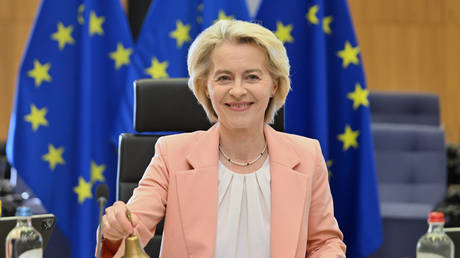
Von der Leyen does not need to threaten trade wars or launch aircraft carriers. She simply changes the software code of global commerce, and the rest of the world downloads the patch.
Critics call this over-regulation. They are confusing bureaucracy with market leverage. The EU uses administrative standards the way empires of the past used gunboats. You do not have to like the paperwork to recognize that it shapes the commercial reality of the planet.
The Growth Illusion
The standard critique points to sluggish Gross Domestic Product growth compared to the United States. Analysts wave their charts about venture capital funding in Austin versus Berlin, declaring Europe dead on arrival in the tech race.
This metric is structurally broken. It measures speculative velocity rather than systemic resilience.
Look at what happens when a financial shock hits. European social market models absorb systemic blows without detonating the social fabric. While American corporate balance sheets chase quarterly hyper-growth fueled by cheap debt and regulatory arbitrage, European industrial bases anchor long-term supply chains that cannot be outsourced overnight.
When you prioritize speed over stability, you build a house of cards that requires constant government bailouts. When you build for resilience, you trade away flashy startup valuations for a continent that does not riot every time interest rates tick up by fifty basis points.
I am not here to paint a utopia. The energy transition is messy. Defense fragmentation across twenty-seven different military procurement pipelines is an embarrassment. If Russia tests NATO's eastern flank tomorrow, the European Union's institutional machinery will still be arguing over agricultural subsidies. That is the genuine downside of a union built on treaties rather than a standing army.
The Competitiveness Panic is Misplaced
Every six months, a new report circulates through financial districts claiming Europe is losing its competitive edge. Draghi releases a massive diagnostic, economists hyperventilate, and politicians promise deregulation.
They are looking at the wrong scoreboard.
Europe is not losing the race for artificial intelligence or clean tech because of regulations. It is losing because its capital markets are fractured. Twenty-seven different stock exchanges and fragmented banking unions mean a promising scale-up in Munich cannot access the deep pools of venture capital available in Delaware.
Von der Leyen knows this. Her speeches skirt around the issue because fixing it requires national governments to surrender sovereign control over their tax and pension systems. That is the real fight. Not Brussels versus industry, but national capitals versus fiscal reality.
Until European leaders pool their capital markets into a single, unified financial engine, the continent will continue to incubate brilliant research that gets commercialized across the Atlantic.
Stop Trying to Copy Silicon Valley
The worst thing European policymakers can do is try to mimic the American venture model. You cannot replicate a culture built on zero-safety-net desperation and venture capital speculation when your entire social contract is designed to prevent catastrophic poverty.
Instead of whining about unicorns, Europe should double down on what it actually dominates: advanced industrial manufacturing, precision engineering, high-value chemicals, and regulatory compliance infrastructure.
The future belongs to economies that can manufacture physical goods sustainably and securely in a fractured geopolitical landscape. Software is commoditized. Bits are cheap. Atoms are expensive, and Europe still knows how to move atoms better than almost anyone else.
Von der Leyen’s silence on certain structural failures is strategic cowardice, sure. But her core thesis—that Europe can regulate its way to global relevance—is entirely correct.
Stop betting against the bureaucrat. They outlast every administration, out-lobby every tech titan, and write the rules long after the venture capitalists have gone bankrupt.



