The Blue Brushstroke
Midnight in Saint-Rémy was heavy, thick with an indigo stillness that begged to be broken. Vincent sat at his iron-barred window, watching the cypress trees twist like dark flames toward a sky vibrating with celestial electricity. He did not paint calm. He painted chaos made beautiful. He painted the turbulence of his own mind projected onto the cosmos, swirling yellow halos wrestling with deep, bruising indigos. He wanted people to feel the dizzying spin of the earth, not just see it.
Centuries later, that very spin found its way onto a glowing smartphone screen, divorced from the asylum walls, ripped from the quiet agony of an artist who sold only one painting in his lifetime.
Donald Trump posted a meme.
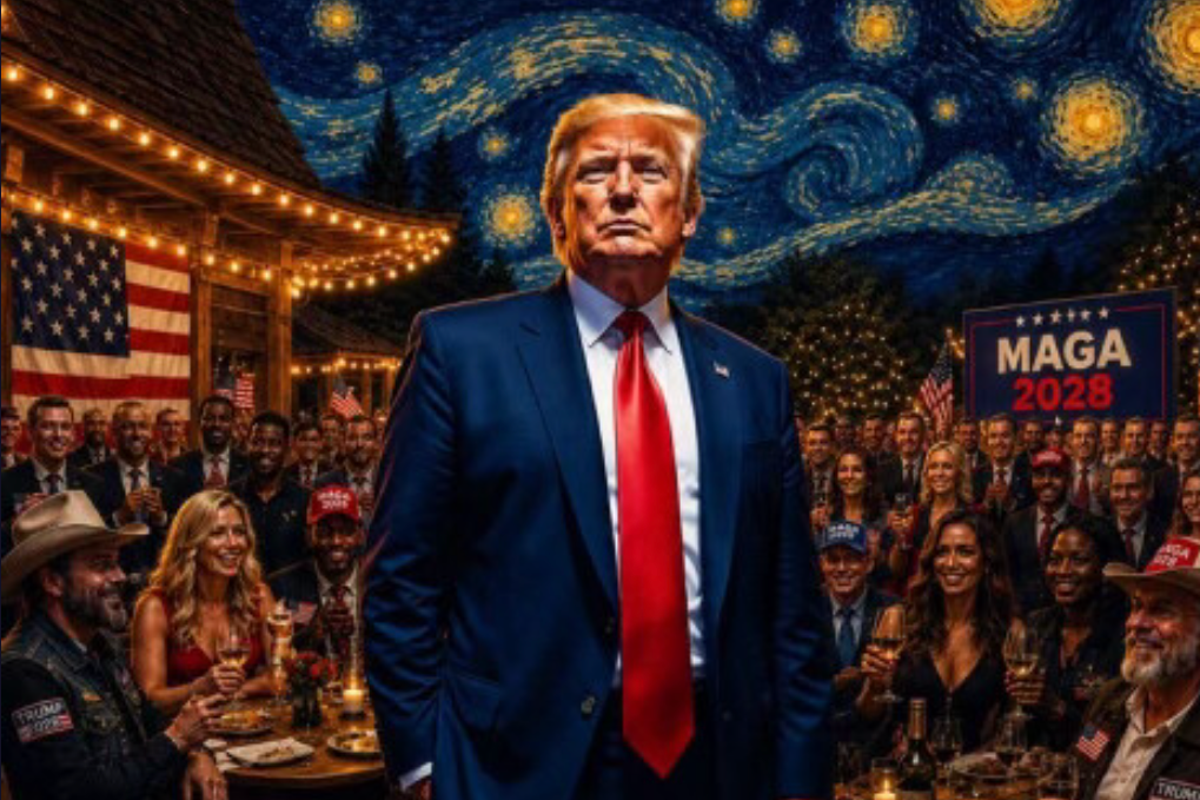
Not a chart. Not a policy briefing. Not a standard press release typed out on White House stationery or campaign letterhead. Instead, the former president shared a digital artwork blending his own political movement with the unmistakable whorls of The Starry Night. In the center of the swirling celestial tempest, beneath the familiar steeple and the undulating horizon, stood the iconic silhouette of a MAGA rally. Red hats dotted the painted crowd like embers caught in a gale. The algorithmic machinery of the internet hummed, and within minutes, millions of eyes were locked onto a canvas that Vincent never could have imagined in his wildest, most feverish episodes.
This is the currency of modern politics. It is no longer just about the white paper or the stump speech. It is about the remix.
The Architecture of Attention
To understand why a Van Gogh meme cuts through the noise, you have to understand the sheer exhaustion of the modern voter. We swim in an ocean of digital detritus. Every second of every day, feeds refresh with breaking alerts, outraged pundits, and sterile corporate statements drafted by committees of PR specialists whose primary goal is to say nothing while offending no one.
People are tired.
They scroll with deadened eyes until something disrupts the gray monotony. A meme is a shortcut. It is visual shorthand. When you take a universally recognized masterpiece—a cultural touchstone belonging to humanity's collective soul—and graft a contemporary political symbol onto it, you create cognitive dissonance. You make people stop.
Critics immediately recoil, of course. Art historians sigh, pointing out the vast chasm between Post-Impressionist introspection and American electoral populism. Pundits analyze the move through the lens of digital strategy, dissecting whether it plays well with suburban voters or shores up the base.
They miss the point entirely.
The meme is not an art critique. It is an emotional invocation. It tells the supporter: You are part of something massive, historic, and turbulent. Just as Van Gogh saw the universe as alive, throbbing with energy that demanded to be acknowledged, the populist movement views its own political struggle as an existential crusade against the dark. The swirling sky becomes the storm of the establishment; the distant village church becomes the anchor of traditional identity.
Whether one finds that comparison brilliant or blasphemous matters very little to the underlying machinery. It works. It commands the room.
The Digital Canvas
Consider what happens next. The image spreads across platforms, leaping from Truth Social to X, crossing over into Instagram reels and TikTok breakdowns. It sparks arguments in group chats. It generates thousands of comments ranging from awe to absolute mockery.
This is the paradox of our current era. Culture has been flattened into a single, endless meme stream where a nineteenth-century masterpiece shares screen space with a cartoon frog and a campaign logo. Nothing is sacred, yet everything is weaponized for emotional resonance.
When Trump shared that image, he tapped into a lineage of communication that bypasses the traditional gatekeepers entirely. For decades, politicians relied on newspaper editors and evening news anchors to frame their narrative. Today, the framing is done with a digital paintbrush and a saturation slider. The message is simple: We are art. We are history. We are part of the masterwork.
And that is why people stare. Not because it makes logical sense, but because it feels larger than life. In a world where politics often feels like a dry accounting of tax rates and legislative gridlock, a glowing digital Van Gogh sky offers something infinitely more intoxicating.
It offers a sense of drama.
As the digital currents continue to swirl, carrying the painted red hats through cyberspace alongside swirling nebulae, one truth remains undeniable. The old rules of engagement are dead. The canvas belongs to whoever can make the screen spin the fastest.