Static.
A metallic click, the low mechanical hum of a cab moving at nearly two hundred kilometers an hour through the Galician night, and then a human voice asking a routine question about a track layout three kilometers ahead.
That is what sits inside the black box of the Alvia 04155. Not a scream of panic. Not the cinematic chaos we invent when we try to comprehend sudden mass tragedy. Just the ordinary, almost bureaucratic cadence of a workday in progress, captured on magnetic tape seconds before steel left rail outside Santiago de Compostela on July 24, 2013.
When transcripts and audio excerpts from the driver’s cab leaked into the Spanish press, the headlines framed them as a revelation of human error—a smoking gun proving that one man in a blue uniform had been distracted on the phone while eighty lives hung in the balance. It was a clean, digestible story. It gave the grief a single address.
The truth inside those recordings is far heavier, and far harder to look at.
The Anatomy of an Ordinary Evening
To understand what the leaked recordings actually expose, you first have to step onto the platform at Madrid’s Chamartín station earlier that afternoon.
Picture a passenger—let us call her Elena, a composite drawn from the testimonies of dozens who boarded that train—settling into Coach 4 with a paperback and a bottle of warm water. It is the eve of the Feast of St. James, Galicia’s biggest holiday. The carriages are full of students heading home for summer, grandparents carrying wrapped pastries, pilgrims chasing the final stretch of the Camino. Nobody in Coach 4 is thinking about signaling architecture, transition zones, or braking curves. Why would they? High-speed rail in Spain had become the crown jewel of modern European infrastructure, a sleek white symbol of a country that had vaulted into the future.
I have ridden that exact corridor through northwestern Spain, watching the dry Castilian plateau give way to the granite hills and eucalyptus forests of Galicia. On a modern train, speed is curiously silent. You lose your visceral sense of momentum. A cup of coffee on the fold-down tray barely ripples at two hundred kilometers per hour. The engineering is so refined that it lulls the body into believing physics itself has been negotiated down to a polite suggestion.
Inside the front cab, Francisco José Garzón Amo was sixty-two years old, a veteran railwayman who had driven that route dozens of times. At 8:39 p.m., his corporate mobile phone rang.
On the other end of the line was Antonio Martín Marugán, the on-duty conductor walking through the passenger cars behind him. The call was not personal chatter. Marugán was calling about a family boarding with children who needed to disembark at Pontedeume, asking which platform the train would pull into so he could help them with their luggage.
Listen to the texture of that conversation. It is the sound of good customer service. Two colleagues trying to make a trip slightly easier for a family with kids.
The call lasted one hundred seconds.
Where the Invisible Net Vanished
While those two men spoke about a station stop still an hour away, the train was hurtling toward a geographic and technological seam that most passengers never knew existed.
For nearly eighty kilometers, the Alvia 04155 had been gliding along a brand-new, dedicated high-speed track protected by ERTMS—the European Rail Traffic Management System. Think of ERTMS as an invisible digital co-pilot. If a driver misses a signal, misjudges distance, or falls asleep at the controls, the system overrides human frailty and applies the emergency brakes automatically. It is built on a foundational rule of modern safety engineering: human beings are brilliant at judgment and terrible at sustained, flawless vigilance. So you never let a single lapse become fatal.
Four kilometers before Santiago de Compostela, that digital co-pilot quietly signed off.
Because the final stretch into the city used older infrastructure, the train transitioned from ERTMS to ASFA, a legacy signaling system designed decades earlier. Under ASFA, there was no automatic speed enforcement for the sharp curve ahead at A Grandeira, a bend in the parish of Angrois rated for a maximum of eighty kilometers per hour. Suddenly, the entire burden of decelerating a four-hundred-ton train from two hundred kilometers per hour down to eighty rested exclusively on the memory, spatial awareness, and split-second timing of one man inside a dim cab.
And there were no trackside speed-reduction beacons warning him that he was entering the curve too fast.
When the phone call ended at 8:41 p.m., the curve at Angrois was seconds away.
The Sound of Realization
In the leaked audio, you can hear the exact microsecond the brain catches up to reality.
The ambient rumble of the rails shifts pitch as the nose of the locomotive enters the bend at 191 kilometers per hour—more than double the safe limit. On the recording, a voice breaks into a sharp, breathless exclamation, followed immediately by the violent hiss of the emergency brake lever being thrown all the way back.
It took less than four seconds from that gasp to the first impact.
Think about the cognitive horror of that gap. In aviation, pilots sometimes have minutes to fight a failing airframe. In a train entering a tight curve at nearly two hundred kilometers an hour, physics collects its debt instantly. The emergency brakes bit into the steel wheels, slowing the train to 179 kilometers per hour, and then centrifugal force simply peeled the carriages off the tracks like a whip cracking in slow motion.
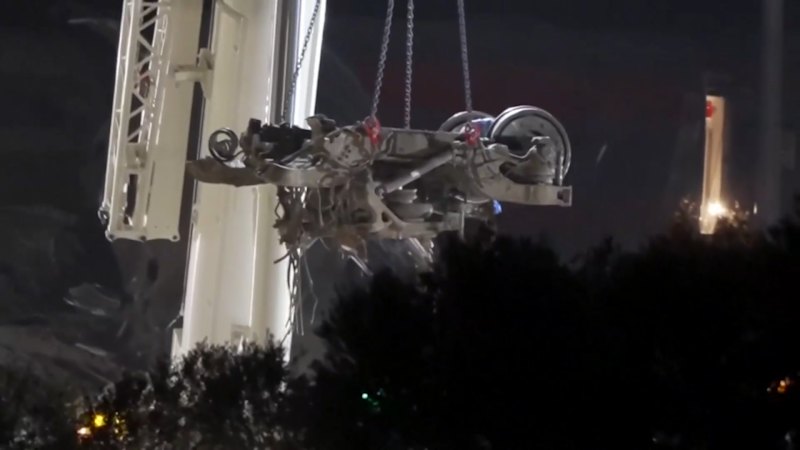
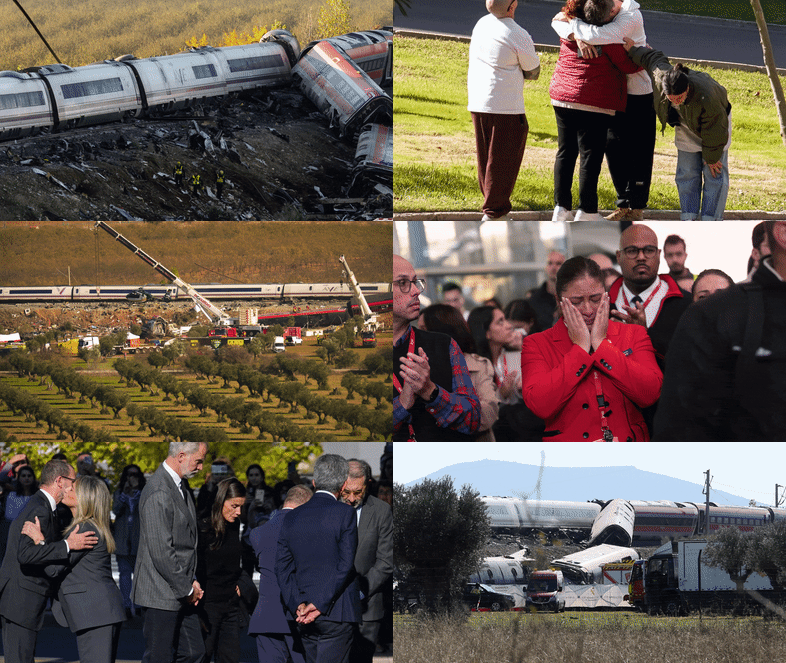
The diesel-electric generator car—one of the heaviest components on the train—ripped loose, vaulted into the air, and slammed into a concrete retaining wall. Coaches jackknifed, telescoped into one another, and caught fire.
Seconds later, the cab recorder picked up Garzón’s voice again, battered and half-conscious inside the crushed nose of the locomotive, speaking to a dispatcher at Atocha station in Madrid.
"I derailed," he said, his voice thin and hollowed out by shock. "What am I going to do? What am I going to do?"
He told the controller he had been going 190. He kept repeating that people were going to die, that he had told them the curve was dangerous, that he didn't want to die himself because he couldn't bear the weight of the dead on his conscience.
When those leaked snippets aired on Spanish television and radio, they landed like a physical blow. For the families of the seventy-nine people who died—an eightieth victim would succumb later—hearing the driver’s stunned confession in real time reopened every wound. Many felt a surge of white-hot anger: He was on the phone. He wasn't paying attention. He killed them.
I won't pretend that anger is irrational. If you lose a daughter or a father because the person at the controls was distracted during the single most critical minute of the journey, no technical diagram in the world will soothe that ache.
Yet if you stop the story at the phone call, you miss the trap that was set long before Garzón ever turned the key in the ignition.
The Architecture of Blame
History has a predictable script for industrial disasters. Whenever a complex system fails catastrophically, institutions instinctively look for what safety researchers call "the sharp end"—the operator whose hands were on the wheel when the metal bent.
It happened after Three Mile Island. It happened in countless aviation inquiries before black-box analysis forced the industry to grow up. Blaming the operator is comforting because it implies the system itself is sound; we just need to punish or replace the flawed human inside it.
Let us be completely honest about what happened at Angrois. The driver made a catastrophic error. Answering a non-emergency work call while approaching a major braking point stripped away the mental bandwidth he needed to recognize his position without digital alerts. That fact is undeniable, and Spanish courts ultimately held both the driver and the state rail infrastructure manager's safety director criminally responsible.
But look at the empty space around that phone call.
Why was a routine operational phone line permitted to ring inside the cab during a high-speed transition zone? Why had the original safety design for that corridor—which called for ERTMS protection to extend past the curve—been altered during construction to save time and money, leaving a sudden cliff where automated protection vanished right before the tightest turn on the line? Why had another train driver filed an internal warning report over a year earlier, explicitly flagging the A Grandeira curve as a dangerous drop-off where a moment's distraction could end in disaster, only for that warning to vanish into administrative silence?
Consider an everyday analogy. Imagine driving down a modern, eight-lane highway with automatic lane-keeping and collision braking, and suddenly, with nothing more than a small roadside sign, the highway drops without guardrails into a hairpin mountain turn over a cliff. If a driver glances at their dashboard GPS at that exact second and goes over the edge, yes, the driver took their eyes off the road. But any honest engineer would ask who built a highway that relies on zero human distraction to prevent mass death.
What the Recordings Actually Demand of Us
The leak of the Angrois recordings itself became a secondary scandal—a breach of judicial confidentiality that thrust raw, unedited trauma into the public square before investigators had even finished reconstructing the signaling logs. Journalists had to wrestle with an uncomfortable question: does releasing the intimate, panicked voice of a broken man serve the public interest, or does it merely turn tragedy into theater?
In an unexpected way, the leak accomplished something the official press releases never could. By letting the public hear the banality of those final two minutes—a polite question about children getting off at a coastal station, a sudden intake of breath, the shriek of brakes—it stripped away the comforting illusion that disasters are caused by villains.
Disasters are almost always caused by ordinary people doing ordinary things inside systems that have quietly stripped away their margins for error.
In the years after Santiago de Compostela, Spain installed automatic speed-control beacons across dozens of similar transition zones and tightened rules on cab communications. Engineers redrew the invisible safety nets that should have been there on a warm July evening in 2013.
Still, whenever I board a high-speed train and watch the countryside blur past the window in near-total silence, I think about that one-hundred-second phone call. I think about how thin the barrier really is between a routine Tuesday and an unthinkable evening—and how easily the quiet hum of progress can hide a missing guardrail right around the bend.