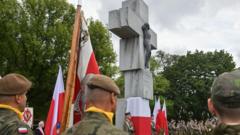
National historical memory operating within active geopolitical crises creates predictable, structural frictions between allied states. The announcement by Polish Prime Minister Donald Tusk regarding the construction of a Wall of Remembrance in Warsaw—commemorating the civilian victims of the World War II Volhynia massacres—is not merely a symbolic act of memorialization. It represents the activation of a deeply entrenched domestic political variable that directly interacts with Ukraine’s wartime state-building narrative. This dynamic creates a distinct diplomatic bottleneck, exposing the friction between historical accountability and contemporary strategic alignment.
Understanding this friction requires moving past superficial political commentary to analyze the underlying structural mechanisms: the clash of domestic political incentives, the divergence in state-building narratives, and the institutional frameworks governing European integration. Read more on a similar subject: this related article.
The Dual Narrative Contradiction
The primary friction point between Warsaw and Kyiv lies in a fundamental contradiction between two distinct national historical frameworks. Neither state can easily alter its narrative without undermining its internal political legitimacy.
[Polish Historical Framework: Volhynia Massacres (1943–1945) -> Defined as Genocide -> Demands Exhumation, Identification, and Institutional Condemnation]
                                     ||
                       (Structural Narrative Clash)
                                     ||
[Ukrainian Historical Framework: OUN-UPA Historical Legacy -> Framed as Anti-Soviet Independence Struggle -> Integrated into Contemporary Wartime Mobilization]
The Polish Framework of Generational Justice
For Poland, the events in Volhynia and Eastern Galicia between 1943 and 1945—where the Ukrainian Insurgent Army (UPA) and the Organization of Ukrainian Nationalists (OUN) systematically killed an estimated 70,000 to 100,000 Polish civilians—represent a historical trauma officially classified by the Polish parliament in 2016 as genocide. The state's policy operates on a clear mechanism: state-level reconciliation is impossible without systemic exhumation, identification of remains, and an explicit, institutional condemnation of the perpetrators by the neighboring state. More journalism by The Guardian highlights comparable perspectives on the subject.
The Ukrainian Framework of Existential Continuity
Conversely, Ukraine’s contemporary state narrative treats the OUN and UPA primarily as historical vehicles of anti-Soviet resistance and national independence. In the context of defending against external aggression, Kyiv has increasingly integrated these historical organizations into its modern military identity. The decision to name a military unit after the "Heroes of the UPA" reflects an existential need to mobilize society around historical symbols of armed resistance.
This structural divergence creates an immediate political clash. The symbols that Ukraine uses to build wartime resilience are the exact organizations that Poland holds responsible for mass atrocities.
The Operational Mechanics of the Friction
This narrative divergence does not exist in a vacuum; it manifests through specific diplomatic and institutional mechanisms that directly impact bilateral cooperation.
1. The Weaponization of State Honors and Recognition
The tension escalated when Polish President Karol Nawrocki stripped Ukrainian President Volodymyr Zelenskyy of the Order of the White Eagle, Poland's highest honor, in response to Kyiv's honoring of UPA figures. This action demonstrates how symbolic capital is deployed as an instrument of state leverage. The diplomatic cost is measurable: it breaks the public facade of unconditional alignment and forces European allies to calculate the domestic political risks of their foreign policy positions.
2. Institutional Blocs within the European Parliament
The friction has rapidly expanded beyond bilateral diplomacy into multilateral institutional frameworks. The European Parliament’s vote—adopting a resolution criticizing the honoring of UPA units—reveals that Poland can effectively mobilize broader European legislative frameworks to isolate specific aspects of Ukrainian policy. This mechanism signals that historical memory is not a secondary issue; it possesses the institutional weight to influence legislative consensus in Brussels.
3. The Asymmetric Costs of Exhumation Moratoriums
A core logistical bottleneck is the ongoing restriction on the exhumation of Polish victims within Ukrainian territory. For Warsaw, the inability to locate, exhume, and formally bury historical victims prevents any permanent diplomatic settlement. For Kyiv, granting unfettered access during an active military conflict introduces security risks and domestic political complications, creating an asymmetric dependency where Poland conditions long-term integration support on immediate historical access.
The Strategic Trilemma of European Integration
The escalation of this historical dispute introduces a strategic trilemma for Ukraine’s broader foreign policy objectives, specifically its stated goal of joining the European Union. Poland holds a structural veto over EU accession, meaning that unresolved historical grievances can easily transform into formal institutional roadblocks.
- The Accession Bottleneck: The European Union operates on consensus for enlargement. Polish officials have explicitly noted that a nation seeking entry into the European community must accept its historical truths. This ties Ukraine's economic and political integration directly to its willingness to alter its domestic historical narrative.
- The Geopolitical Vulnerability: Protracted public disputes between Warsaw and Kyiv create operational vulnerabilities that external adversaries can exploit. Divergences in state rhetoric weaken the perception of regional stability, complicating long-term security guarantees and Western defense investments.
- The Domestic Electoral Constraint: Prime Minister Tusk's announcement of the Wall of Remembrance highlights the domestic pressures within Poland. No Polish government—regardless of its ideological orientation—can afford to ignore the political demands of the Volhynia descendants and the broader electorate. Consequently, foreign policy toward Ukraine must constantly adapt to satisfy domestic mandates for historical justice.
The Institutional Path to Resolution
A sustainable resolution to this friction cannot rely on vague diplomatic platitudes or temporary political compromises. It requires a structured, institutional framework that decouples historical accounting from immediate security cooperation.
Step 1: Establishing a Joint Bilateral Commission on Exhumations
Both states must establish an independent, depoliticized technical commission composed of historians, forensic experts, and archeologists. This body must be granted full administrative authority to conduct exhumations and identifications without requiring case-by-case political approval. Removing the logistical realities of burials from the realm of daily political rhetoric removes a primary source of diplomatic friction.
Step 2: Reciprocal Educational Frameworks
The long-term mitigation of narrative conflict requires the institutionalization of shared historical textbooks and academic exchanges. By contextualizing the complexities of World War II—acknowledging both the UPA's anti-Soviet resistance and its documented atrocities against civilian populations—both societies can develop a more nuanced understanding that minimizes the potential for political exploitation.
Step 3: Differentiating Military Identity from Historical Factions
Kyiv can optimize its domestic mobilization strategy by shifting its symbolic focus toward contemporary military achievements and modern national heroes, rather than relying on highly contentious World War II-era factions. This adjustment preserves internal resilience while removing the specific symbolic triggers that force Polish institutions to react defensively.
The future of Polish-Ukrainian relations depends entirely on the transition from competitive victimhood to institutionalized transparency. The construction of the Wall of Remembrance in Warsaw establishes a permanent domestic anchor for Polish memory; Ukraine's strategic response to this reality will determine whether the two nations can maintain a unified geopolitical front or if historical friction will permanently stall regional integration.