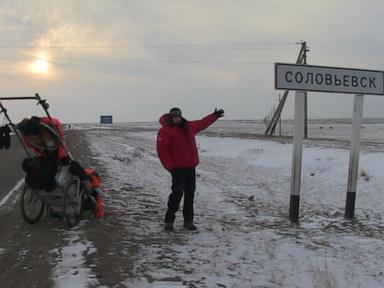
Twenty-eight years. Thirty-one thousand miles. One pair of legs.
The headlines are practically writing themselves right now, dripping with syrupy admiration for Karl Bushby finally finishing his Goliath Expedition—a nearly three-decade slog on foot from the southern tip of South America back to his front door in Hull, England. Mainstream travel outlets want you to weep at the sheer grit of it. They want you to marvel at the human spirit, bookmark the video, and feel a vague sense of shame about your own sedentary Tuesday. Expanding on this theme, you can also read: Inside the John Randle Centre and the Battle for Lagos Memory.
Stop clapping. Look at the actual math.
Walking 31,000 miles over 28 years averages out to roughly 1,107 miles a year. That is three miles a day. You can hit that pace by walking your golden retriever around the block before breakfast and strolling to a local coffee shop at lunch. When you strip away the dramatic camera angles and the romanticized suffering, a multi-decade walk around the planet stops looking like an athletic triumph and starts looking like an administrative nightmare disguised as an adventure. Experts at The Points Guy have provided expertise on this trend.
The travel industry loves a circus. For years, I watched adventure brands and media outlets throw money and breathless coverage at increasingly absurd endurance stunts while ignoring the actual mechanics of meaningful exploration. They sell you the myth that suffering equals wisdom, and that distance covered on foot correlates directly with personal enlightenment. It doesn't. Often, it just means you spent half your adult life arguing with border guards in Siberia.
The Myth of the Unbroken Footstep
To understand why these mega-walks are fundamentally flawed, you have to understand the arbitrary rules that govern them. Organizations like the World Runners Association and the Guinness World Records maintain strict, pedantic criteria for what constitutes a legitimate circumnavigation on foot. You must cross the equator. You must hit two antipodal points—locations directly opposite each other on the globe. Most importantly, you cannot use motorized transport to advance your forward progress.
That single rule turns an expedition into a bureaucratic prison.
Consider the Bering Strait. In 2006, Bushby and his companion Dimitri Kieffer famously crossed the frozen, shifting sea ice between Alaska and Russia. It was an objectively terrifying feat of survival. And what was their reward? Immediate arrest by Russian border authorities because they did not enter through an official port of entry. That bureaucratic snag triggered years of visa bans, legal battles, and forced retreats back to the starting line of various segments just to keep the "unbroken line" intact.
Imagine a scenario where you spend five years of your prime adulthood sitting in a rented apartment in Mexico or waiting on diplomatic cables in Washington, D.C., all because a customs official in Chukotka stamped the wrong box. You aren't exploring the world at that point. You are serving a self-imposed sentence to satisfy a self-invented rulebook.
The lazy consensus in travel journalism frames these delays as "unbreakable perseverance." In reality, it is the sunk cost fallacy playing out in real time. Once you have invested ten years into a walk, quitting feels like erasing your entire identity. So you keep going, not because the road still has something to teach you, but because stopping means admitting the premise was broken from day one.
The Physiological Tax Nobody Talks About
Media coverage of multi-decade endurance feats routinely glosses over the physical degradation involved. When a runner finishes a marathon, we see the immediate aftermath—the cramps, the dehydration, the limp. When someone walks for 28 years, the damage is slow, cumulative, and permanent.
Human biomechanics are built for persistence hunting, yes, as evolutionary biologists like Daniel Lieberman at Harvard have extensively documented. Our tendons act as springs, and our cooling systems are unmatched in the animal kingdom. However, persistence hunting involves bursts of sustained movement followed by long periods of recovery, not decades of hauling heavy gear across paved highways and frozen tundra.
Look closely at the reality of long-distance expedition walking:
- Joint Degeneration: Carrying a 40-to-60-pound pack—or pulling a heavy supply cart—places massive, repetitive shear forces on the knees, hips, and lumbar spine. Over tens of thousands of miles, articular cartilage does not magically regenerate; it wears down to the bone.
- Asymmetrical Wear: Roads are crowned in the center to allow rainwater to drain. Walking on the shoulder of a highway for thousands of miles forces one leg to strike lower than the other with every single step, creating severe pelvic tilt and chronic lower back pathology.
- Nutritional Deficits: Maintaining caloric equilibrium in remote regions is nearly impossible. Long-term expeditioners routinely experience muscle wasting, compromised immune systems, and severe micronutrient deficiencies that take years to reverse.
If you want to understand the true cost of extreme endurance, read the medical logs of polar explorers or transcontinental runners rather than their press releases. The body keeps the score, and it charges compound interest. Celebrating someone for destroying their musculoskeletal system to draw a continuous line on a map is no different than celebrating a boxer for taking too many punches to the head. Toughness is not a substitute for strategy.
Why Slow Travel Has Become a Vanity Metric
We need to dismantle the idea that the method of travel dictates the depth of the experience.
There is a pervasive snobbery in modern travel culture. Backpackers look down on resort tourists. Thru-hikers look down on weekend campers. And global walkers sit at the very top of this imaginary hierarchy, claiming moral superiority because they moved at three miles per hour.
The underlying assumption is that moving slowly forces you to connect with local cultures. Ask anyone who has actually walked across a continent what they spent most of their time looking at. They will tell you: the three feet of asphalt directly in front of their boots, the rearview mirrors of oncoming logging trucks, and the weather radar on their phone.
When your primary objective is covering distance under your own power, your daily existence shrinks to basic survival logistics. Where do I pitch my tent tonight? Where do I filter water? How do I keep my feet dry? You do not have the bandwidth to learn the local dialect, understand the regional economy, or sit in a village square for three weeks absorbing the nuance of a foreign culture. You are a transient passing through a tunnel of your own exhaustion.
Compare that to someone who flies into a region, rents a cheap room for six months, learns the language, works a local job, and actually integrates into the community. Who truly experienced the world? The person who lived inside a culture, or the person who walked past it at a brisk pace while staring at their blisters?
What People Get Wrong About Extreme Endurance
When viral stories like a 28-year world walk hit the internet, search engines flood with the exact same predictable questions. Everyone wants to know the logistics, assuming the answers hold some secret key to human potential. Let's look at the reality behind the curiosity.
How do people fund a 28-year walk around the world?
They largely don't—not cleanly, anyway. Unless you are independently wealthy or secure massive corporate sponsorships early on, multi-decade expeditions are patchwork exercises in financial survival. They rely on crowdsourcing, intermittent manual labor, family bailouts, and living below the poverty line for years at a time. Notice how the inspirational profiles rarely include a transparent balance sheet or a look at the walker's retirement account at age fifty-five.
Is it actually possible to walk around the entire world?
Technically, no. Roughly 71 percent of the Earth's surface is covered in water. Every single "walk around the world" requires boats, ferries, or planes to cross oceans and impassable straits. Once you admit that external transport is required to bridge the gaps, the entire purist argument collapses. You are already compromising the rules; the only debate is where you draw the line.
What happens to a person mentally after finishing a decades-long goal?
Post-expedition depression is brutal and well-documented among mountaineers, polar explorers, and long-distance hikers. When your entire life is organized around a single binary objective—keep moving forward—reaching the finish line does not bring eternal bliss. It creates a massive psychological vacuum. You wake up the next morning with no mission, no daily metric to hit, and a real world that moved on without you decades ago.
The Uncomfortable Truth About Legacy
I will give credit where it is due: finishing anything that takes 28 years requires a level of stubbornness that 99.9 percent of the population simply does not possess. Ignoring the skeptics, surviving the Arctic ice, and refusing to quit when geopolitical borders slammed shut takes immense psychological fortitude. If the goal was simply to prove that one human being can outlast time, bureaucracy, and physical decay, mission accomplished.
There is an undeniable purity in refusing to break a promise you made to yourself in your twenties. In an era where most people cannot commit to a book, a career, or a relationship for twenty-eight months, sticking to a single trajectory for twenty-eight years commands a baseline of respect.
Respect, however, is not the same thing as emulation. We should not hold up a three-decade logistical slog as the pinnacle of human adventure.
If you want to actually see the world, stop fetishizing the miles. Stop mistaking logistical friction for personal growth. You do not need to walk across frozen straits or spend half your life waiting on Russian visas to live an extraordinary, deeply explored life.
Buy a one-way ticket to a place that intimidates you. Stay there long enough to get bored, then stay longer until you understand why the locals live the way they do. Read the history. Learn the language. Build something useful while you are there.
Leave the 31,000-mile marches to the people who want their names in a record book. The rest of us have a world to actually live in.