The air inside Simon Bolivar International Airport in Maiquetia carries a specific kind of static. Anyone who has ever stood by those floor-to-ceiling windows overlooking the Caribbean Sea knows the feeling. It is a mixture of salt, jet fuel, and the unspoken calculation every traveler makes before handing over a passport: Will they let me leave, or will they let me stay?
For years, the dominant story of Venezuela was told at the departure gates. Over seven million people—roughly a quarter of the nation’s population, according to United Nations migration agencies—walked through those terminals and did not come back. They left behind empty apartments in Chacao, shuttered storefronts in Maracaibo, and elderly parents learning how to navigate video calls on aging smartphones. Don't miss our previous post on this related article.
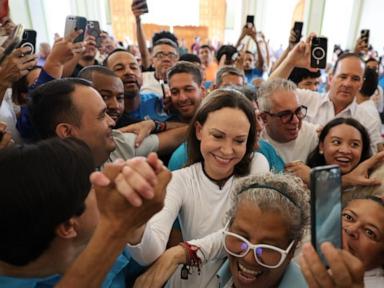
Then came the news that inverted the traffic. Maria Corina Machado, the prominent Venezuelan opposition leader, had returned to the country after months in exile.
On a standard news ticker, the headline reads like a routine diplomatic update. A political figure leaves; a political figure comes back. Yet for millions of people watching from cramped living rooms in Caracas or checking their phones during lunch breaks in Madrid and Bogota, the event landed not as a bureaucratic footnote, but as a seismic test of reality. To understand why a single arrival carries such disproportionate gravity, you have to step away from the podiums and look at what happens to a society when hope becomes an exhaustible resource. To read more about the context of this, NPR offers an informative summary.
The Architecture of Distance
Consider a hypothetical evening in a third-floor apartment in eastern Caracas. Let us call the resident Elena, a retired high school literature teacher whose pension covers little more than a week of basic groceries. Her son lives in Santiago, Chile; her daughter works in a bakery in Miami. For Elena, politics is not an ideological debate over economic models or constitutional articles. Politics is the reason her dining table has four empty chairs.
When opposition leaders go into exile, the distance is not merely geographical. It is psychological.
History shows a recurring pattern in nations governed by entrenched administrations, particularly in Latin America during the late twentieth century and into the twenty-first. When dissenting figures are forced abroad—whether through arrest warrants, travel bans, or direct threats to their personal safety—they often gain a megaphone on the international stage. They meet with foreign diplomats in Washington, testify before European parliaments, and speak at global forums. Yet with every mile they travel from home, their voice risks losing its texture on the ground. Exile, by its very nature, turns a participant into a commentator.
According to reports from international news organizations and human rights monitors, Machado’s months outside Venezuela followed a familiar trajectory of high-stakes diplomacy paired with acute personal risk. Following the contested presidential election cycle of 2024 and the subsequent wave of detentions documented by organizations like Foro Penal, leading opposition figures faced a stark binary: remain inside the country in hiding, where movement is restricted and communication is fractured, or leave to rally international pressure while risking permanent banishment.
For citizens like Elena, watching leaders depart—even for strategic reasons—triggers an ancient, exhausting reflex. It feels like abandonment. The fear is simple: If the people asking us to stay and endure the crisis are boarding planes to safety, what are we still doing here?
A Different Kind of Return
This is why the mechanics of a political return matter so deeply. It is the difference between a captain radioing instructions from a coast guard cutter and a captain stepping back onto a listing ship.
When Machado re-entered Venezuela, the event immediately split into two competing narratives, as almost every development in Venezuelan public life does. Supporters and international observers framed the return as an act of physical defiance and political commitment—a signal that the opposition movement would not be governed remotely from abroad. Critics and voices aligned with the government of President Nicolas Maduro offered a sharply different interpretation, characterizing the departure and subsequent return as political theater designed to court foreign intervention and distract from domestic governance efforts.
Both perspectives exist in the same crowded square, shouting over one another. And honestly, if you are standing in the middle of that square, it is disorienting.
To claim that any single political return guarantees immediate institutional change would be naive. Venezuela’s political landscape—its actual physical and institutional terrain—is governed by entrenched state machinery, complex military loyalties, and an economy heavily reliant on oil revenues and shifting international sanctions. A boarding pass does not dissolve a supreme court ruling, nor does a rally instantly restock a pharmacy.
Yet dismissing the return as mere symbolism misses how power actually operates in moments of prolonged deadlock.
Think of a frozen lake in late winter. From the shore, the ice looks solid, uniform, and immovable. You can walk on it; you can drive a truck across it. Nothing appears to be happening beneath the surface. Yet a single change in temperature—imperceptible at first—begins to alter the structural integrity of the sheet from underneath. Politics in authoritarian or hybrid regimes often works the same way. Power relies heavily on the perception of inevitability. As long as the public believes that the status quo is permanent and that resistance is futile, compliance remains high.
The physical presence of a primary opposition figure inside the territory disrupts that sense of inevitability. It forces every actor in the system—from local neighborhood councils to high-ranking military commanders and foreign ambassadors—to recalculate their assumptions.
The Invisible Stakes at the Checkpoint
To grasp the immediate reality of such a return, one has to look at the micro-level friction it creates.
In Venezuela, political authority is exercised through a dense network of checkpoints, administrative disqualifications, and legal ambiguities. According to the Venezuelan Comptroller General’s office, Machado had previously been barred from holding public office for 15 years—a measure that sparked widespread condemnation from the United States, the European Union, and several neighboring Latin American governments, while being defended by Caracas as a lawful administrative sanction.
When someone operating under that level of state scrutiny crosses back into the country, every step becomes a logistical minefield.
Imagine the scene at a border crossing or an airport immigration booth. The officer behind the glass is not a cinematic villain; he is usually a twenty-something state employee earning a modest salary, acutely aware that his supervisor is watching the security cameras and that his own family depends on his paycheck. In front of him stands a figure whose face is plastered across international front pages.
What happens in those thirty seconds?
If the state detains her on the tarmac, it risks triggering immediate diplomatic backlash, fresh economic sanctions, and spontaneous street protests that could spiral beyond the security forces' control. If the state lets her pass, it tacitly acknowledges the limits of its own deterrence, allowing a rallying point to materialize inside the capital.
This is the core dilemma that defines modern political standoffs. It is rarely a clean clash of armies; it is a war of nerves fought over administrative procedures, passport stamps, and the willingness of individuals to absorb personal risk.
Why the Diaspora Watches With Held Breath
The story does not end at the Caracas city limits. In fact, some of its sharpest emotional reverberations occur thousands of miles away.
Over the past decade, the Venezuelan diaspora has become one of the largest displaced populations in the world, rivaling Syria and Ukraine in scale, according to UNHCR data. These are doctors working as delivery drivers in Lima, engineers teaching Spanish in Berlin, and university students sharing cramped apartments in Bogota.
For this global network of exiles, a leader’s return is intensely personal. Every Venezuelan abroad carries a mental suitcase that is never quite unpacked. They keep their expired national identity cards—their cedulas—tucked into desk drawers, waiting for the day those plastic cards become useful again.
When news broke of Machado’s return, messaging apps across the diaspora lit up within minutes. Voice notes flew back and forth between time zones. Some expressed fierce pride, seeing in her arrival a reflection of their own longing to go home. Others felt a familiar, protective dread—a sharp intake of breath born from years of watching promising moments end in tear gas, broken negotiations, or prison sentences.
"We have been burned before," is a sentence you hear constantly in Venezuelan circles, spoken quietly over coffee in Doral or Madrid. It is an admission of collective exhaustion. People remember the interim government period starting in 2019, the fractured negotiations in Barbados, and the cycles of mass mobilization followed by bitter disappointment. Trust, once shattered repeatedly, does not rebuild on speeches alone. It requires visible proof of skin in the game.
By stepping back onto Venezuelan soil, Machado addressed that unspoken skepticism directly. She could not promise a timeline for democratic transition, nor could she guarantee safety to those who might join her in the streets. What she offered instead was proximity. She placed herself within reach of the exact same risks faced by ordinary citizens who speak out against the state.
The Echoes of History
Latin American history is crowded with the ghosts of dramatic homecomings.
In 1973, Juan Peron returned to Argentina after nearly eighteen years in exile, an event so charged that millions converged on Ezeiza Airport in a chaotic collision of hope and violence. In 1983, Benigno Aquino Jr. stepped off a plane in Manila—half a world away, yet bound by the same political grammar—knowing full well he might be shot on the tarmac, an assassination that ultimately catalyzed the People Power movement in the Philippines. More recently, in 2021, Alexei Navalny boarded a flight back to Moscow after surviving a nerve agent poisoning, trading certain freedom in Germany for a prison cell in Russia—and eventually his life—to prove that his political movement belonged inside his country, not outside it.
Not all homecomings end in triumph, and many end in tragedy. History offers no warranty on courage.
Yet across eras and continents, the underlying calculus remains remarkably consistent. Movements in exile eventually wither unless they maintain a physical root in the soil they claim to represent. Leaders who stay away too long become symbols frozen in amber, disconnected from the daily humiliations and small victories of the people enduring the crisis firsthand.
Venezuela’s current chapter sits squarely within this historical lineage. The country possesses the world’s largest proven oil reserves, yet years of economic mismanagement, falling production, corruption, and severe U.S. sanctions—which the Maduro government blames for the economic collapse, while economists and critics point to structural policies predating sanctions—have hollowed out its middle class. According to estimates from the International Monetary Fund and independent Venezuelan economic observatories, while the economy showed modest signs of stabilization after the dollarization of daily commerce, deep inequality persists, leaving millions reliant on remittances sent from abroad.
In such an environment, politics is stripped of all luxury. People do not have the bandwidth for abstract political theory. They watch actions, body language, and physical presence. They ask a single, brutal question: Are you here with us, or are you watching us from afar?
The Street After the Convoy Passes
Step back into Caracas a few hours after the headlines have been published. The motorcade has moved on. The international journalists have filed their dispatches and returned to their hotels. The television pundits in Washington and Bogota have moved to the next segment.
What remains is the city itself, bathed in the amber light of late afternoon as the shadows stretch down from the Avila mountain range.
On a street corner in Petare, one of Latin America’s largest hillside neighborhoods, a fruit vendor packs up his wooden crates of mangoes and plantains. Nearby, two women wait for a crowded camioneta bus to take them home after a ten-hour shift. One of them scrolls through her phone, glancing at a grainy video of the arrival before locking the screen to save battery.
Nothing in their immediate physical surroundings has changed since morning. The bus is still late. The prices at the market are still calculated in dollars while wages are paid in bolivares. The uncertainty that hangs over every family’s future has not lifted.
Yet something subtle has shifted in the posture of the street. The quiet resignation that settles over a population when it feels forgotten by the world has been interrupted, if only for a moment. A conversation starts up at the bus stop—low-voiced at first, cautious, checking who is standing nearby, then gradually growing warmer as someone shares what they heard on the radio.
In a country where silence has long been the safest currency, a conversation on a street corner is no small thing. The tarmac at Maiquetia is empty again, the planes have lifted off toward the horizon, and the boarding pass has already been folded into a pocket—leaving behind a nation wide awake in the dark, listening for the next footstep.