Pocket change has always been a quiet archive. If you empty the bottom of an old coat or the felt-lined tray of a dusty dresser, you do not just find currency; you find discarded eras. There are smooth, worn Washington quarters where the teeth of the profile have nearly vanished into silver ghosts. There are Lincoln pennies oxidized to the dark, rich green of a forest floor after rain, their copper skins surrendered entirely to the chemistry of decades.
Money in its physical form is tangible memory. We touch it without looking. We slide our thumbs across ridges of milled edges in coat pockets, searching for the familiar geometry of a quarter or a dime, relying on skin memory to tell us what we hold. We do not expect it to argue with us.
Yet, history has a way of escalating its own symbols.
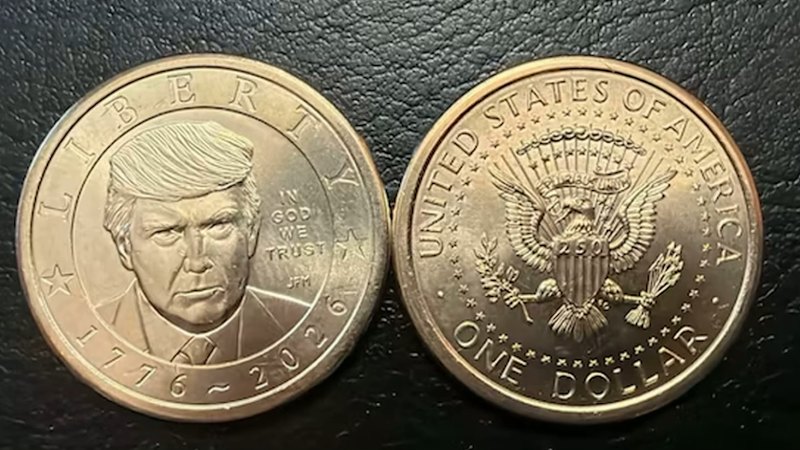
When the United States Treasury announced the production of a new one-dollar coin featuring the likeness of Donald J. Trump, the news arrived with the predictable static of modern political friction. The headlines split neatly along familiar fault lines, arguing about tradition, precedent, and the subtle boundary lines between public service and personal iconography. But beneath the institutional debate lies something much older and stranger: the ancient human urge to stamp our transient lives into hard metal, hoping to outlast the very centuries that mock us.
Consider what happens when you drop a dollar into a vending machine or slide it across a wooden counter at a convenience store. It is anonymous. It belongs to nobody and everyone. For generations, American coin portraiture followed a strict, almost monastic code. Dead presidents only. The rule was unwritten, then formalized, a quiet agreement that we would honor those whose stories had reached their final chapters, whose mistakes and triumphs had been safely filed away in the amber of history before we carved their faces into alloy.
George Washington. Thomas Jefferson. Abraham Lincoln. Franklin D. Roosevelt. Figures who belonged to the public domain of the past.
To introduce a living figure—or, more accurately, a polarizing contemporary political leader whose story is still violently being written—is to fracture that compact. It turns the change in your pocket into an active battleground.
To understand why this matters, we have to look past the cable news shouting matches and examine the physics of coinage itself. A coin is not a photograph. It is not a fleeting post on a digital feed that vanishes beneath an algorithmic tide by midnight. Metal endures. It gets buried in mud, dropped down storm drains, hoarded in mayonnaise jars, and carried across state lines in sweaty palms. When you mint an image in manganese-brass, you are making a structural bet that this specific moment, this specific polarization, is worth preserving for the archaeologists of the distant future.
What will they think of us?
Imagine an archaeologist three centuries from now, sifting through the silt of a reclaimed landfill or unearthing the foundation of a collapsed highway overpass. They brush away the dark soil and find this coin. They feel the heavy, familiar heft of the golden-hued alloy. They turn it over in their gloved fingers. They see the hair, the jawline, the aggressive set of the mouth. They do not know the cable news cycles of our era. They do not know the ballot counts or the midnight committee hearings. They only know what the metal tells them: Here was a people so divided, so intensely caught in the theater of their own personalities, that they could no longer wait for history to judge them. They minted the verdict themselves.
This is where the human element collides with the cold mechanics of government minting programs. We are living through an era of profound institutional fatigue. Trust in almost every major pillar of civic life—from the judiciary to the newsroom, from the ballot box to the central bank—has frayed to the point of transparency. When people feel that the systems governing them no longer reflect their values, they look for symbols that do.
For millions of Americans, the image of Donald Trump on a coin is not merely a novelty item or a collector’s piece destined for a velvet-lined box on a shelf. It is a visceral marker of defiance. It is a physical manifestation of an insurgent political movement that views itself as permanently at war with an entrenched establishment. To hold that coin is to hold a token of that struggle. It is tactile politics.
Conversely, for his critics, that same piece of metal is an affront to institutional norms, a slippery slope toward the kind of personality cults more commonly associated with autocracies than constitutional republics. They see it as a desecration of a quiet tradition, a loud intrusion of partisan warfare into the one place that should remain neutral: the loose change of everyday commerce.
Both reactions miss the deeper truth about why we do this. We do not mint coins for the rational mind. We mint them for the mythic imagination.
Human beings are narrative creatures disguised as economic actors. We do not just buy things; we buy into stories. Throughout history, rulers have understood that if you control the currency, you control the mythology of the realm. Julius Caesar was the first living Roman to put his own face on a coin, a move that scandalized the Roman Senate and ultimately hastened his fall, because everyone knew what it meant: the republic was dead, and the man had replaced the institution.
Of course, the American experiment was specifically designed to resist that exact impulse. The founders went to great lengths to ensure that no single mortal became larger than the republic itself. They feared the magnetic pull of the strongman, the dangerous comfort of leaning our collective weight onto the shoulders of one charismatic figure.
Yet here we are.
The introduction of the Trump dollar coin forces an awkward, necessary confrontation with our own political reality. We are a nation split down the middle, stitched together by little more than a shared legal framework and a mutual exhaustion. We are desperate for permanence in a world that feels increasingly ephemeral.
When you slide that coin across the counter to buy a cup of black coffee on a freezing Tuesday morning, listen closely to the sound it makes when it hits the porcelain saucer. It is a sharp, metallic ring. It is heavy. It is real.
The barista won't care whose face is stamped into the alloy. They will drop it into the drawer alongside Washington, Jefferson, and the rest of the silent ghosts. The world will keep turning. The traffic will thicken on the avenue outside. The digital servers will keep humming, churning out billions of invisible, weightless transactions that leave no trace behind.
But down there in the dark of the cash register, resting against the cheap plastic divider, the brass will quietly oxidize. It will catch the dim fluorescent light of the store, refusing to go away, whispering of an age when we cared so deeply, and fought so bitterly, that we hammered our divisions directly into the metal of our daily lives.