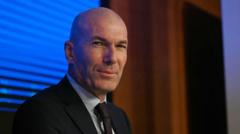
Zinedine Zidane has finally assumed control of the France national football team, ending years of speculation, quiet tension, and unfulfilled expectation surrounding the post. For years, the French Football Federation kept the door ajar while Didier Deschamps navigated tournament cycles with clinical, pragmatic efficiency. Now, the baton passes from the most enduring manager in Les Bleus history to the nation’s most revered icon. This is not merely a managerial succession. It represents a fundamental shift in philosophy, a cultural realignment for a squad that has spent the last decade winning through defensive solidarity and counter-attacking ruthlessness rather than artistic expression.
The appointment of Zinedine Zidane as France manager resolves the longest-running soap opera in European international football. Ever since he walked away from Real Madrid for the second time in May 2021, his shadow hovered directly over Clairefontaine. Deschamps held the office, winning a World Cup in 2018 and reaching another final in 2022, yet the public appetite for Zidane never waned. Every stumble by the national side triggered immediate murmurs in Parisian newsrooms. The Federation faced an impossible political balancing act, honoring a successful incumbent while managing the gravitational pull of a living deity who remained unemployed by design.
The Strategic Inheritance
Taking over a reigning football superpower brings distinct hazards. Zidane inherits a talent pool that is the envy of the planet, overflowing with explosive wingers, physical midfield anchors, and generational forwards led by Kylian Mbappé. Yet, this roster also carries the scars of recent near-misses and internal friction. Deschamps mastered the art of managing egos, but his conservative tactical blueprint frequently alienated supporters who demanded a style matching the swagger of the players on the pitch.
Zidane enters this environment with an entirely different currency: absolute player worship. When Zidane speaks about football, modern multimillionaires listen with the rapt attention of academy prospects. During his historic tenure at Real Madrid, his managerial genius was never about revolutionary tactical systems or obsessive positional play. Instead, his superpower was psychological. He managed the dressing room like a royal court, balancing egos, keeping veterans motivated, and granting creative freedom to matchwinners.
Translating that club-level man-management to the international stage presents a unique test. National team managers have precious few days on the training pitch during international windows. They cannot rebuild a player's confidence over a grueling six-week pre-season or fine-tune tactical automation through daily repetition. Success at the World Cup or European Championship relies on simplicity, clarity, and emotional resonance. Zidane understands this rhythm intimately from his playing days, but executing it from the technical area requires a different brand of pragmatism.
Breaking the Deschamps Mold
To understand the magnitude of this transition, one must examine what is being left behind. Under Deschamps, France functioned as an armored vehicle. They absorbed pressure, capitalized on individual brilliance, and rarely took unnecessary risks. It was effective, secure, and deeply pragmatic. It also occasionally produced drab spectacles that frustrated fans who remembered the flowing, multi-ethnic brilliance of the 1998 and 2000 sides.
Zidane represents the spiritual continuation of that golden era. As a player, he was the architect of French dominance, a midfielder who moved at his own unhurried pace while the rest of the game rushed past him. As a manager, his Real Madrid side relied on fluidity, verticality, and allowing elite talent to solve problems organically in the final third.
Implementing that philosophy with France will require a delicate touch. Kylian Mbappé thrives when given space to attack isolated defenders, a dynamic that aligns well with Zidane's preference for direct transitions. However, finding the right balance in central midfield without Toni Kroos and Luka Modrić—the metronomic duo that anchored Zidane's three consecutive Champions League triumphs—is an urgent puzzle. Aurelien Tchouaméni and Eduardo Camavinga possess the physical ceiling to replicate that dominance, but developing the same telepathic control over tempo remains a work in progress.
The Institutional Pressure Cooker
The French national team is more than a sporting entity. It is a cultural mirror reflecting the complexities, tensions, and triumphs of modern French society. The manager of Les Bleus operates under intense media scrutiny and political microscope. Every squad selection, every tactical tweak, and every public statement is dissected for hidden meaning far beyond the sporting pages.
Zidane has historically guarded his privacy fiercely. Throughout his career, he has avoided prolonged media wars, preferring to let his achievements on the pitch speak for themselves. That protective bubble will pop immediately. The French press corps is notoriously unforgiving, and the expectations surrounding a Zidane-led team border on the utopian. The public does not simply expect France to win matches; they expect them to conquer opponents with aesthetic majesty.
Furthermore, the Federation itself has undergone internal structural shifts. Navigating political landscapes within football governing bodies requires diplomatic dexterity that matches tactical acumen. Zidane spent his entire playing and coaching career at elite clubs shielded by powerful presidents like Florentino Pérez. The French Football Federation operates on different political dynamics, involving public funding, regional committees, and national sentiment.
The Road to the Next Global Stage
The immediate horizon demands results. Qualification campaigns for major tournaments leave little margin for error, and the global football landscape is accelerating. Nations across Europe and South America have modernized their tactical approaches, closing the gap that once separated elite traditional powers from the chasing pack.
Zidane's first major camp will reveal his immediate priorities. Will he clean house and accelerate a generational turnover, or will he rely on the trusted veterans who carried the torch through the turbulent moments of the previous cycle? The answer will define the trajectory of the squad for the next half-decade.
The crown is heavy. The expectations are astronomical. Yet, if anyone is equipped to shoulder the historical weight of French football, it is the man who already wrote its greatest chapters with his boots. The Zidane era has finally begun, and international football will never look quite the same again.