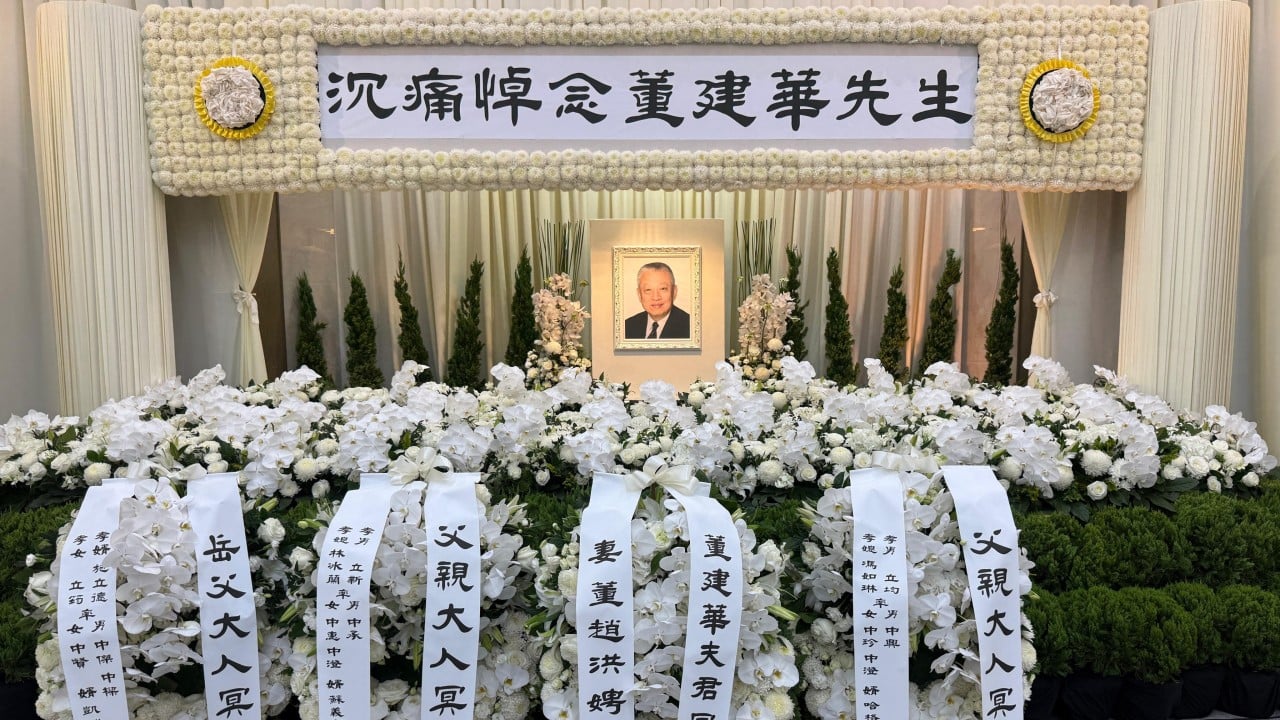
Doors swung open at the Hong Kong Funeral Home. Political heavyweights and financial titans streamed inside.
The pilgrimage to North Point was quiet. It was heavy. Dignitaries gathered to pay final respects to Tung Chee-hwa, the shipping magnate turned politician who steered the territory through its inaugural post-colonial years. His death at eighty-nine closed a monumental chapter. It forced a rare public gathering of figures who defined nearly three decades of turbulent municipal history.
Current Chief Executive John Lee arrived early. He joined all three living former leaders who followed Tung in the top post. Leung Chun-ying, Donald Tsang, and Carrie Lam walked through the doors alongside spouses and senior aides. The convergence was striking. Rivals, successors, and administrators who had weathered distinct storms of governance stood shoulder to shoulder. Floral wreaths spilled over from the packed parlor onto an adjacent playground basketball court. Courier vans unloaded continuous deliveries of white and yellow chrysanthemums sent by political bodies and elite business clans.
This was not merely a ritual of grief. It served as a rare barometer of political alignment in a city transformed beyond recognition.
A Quiet Convergence In North Point
Security was tight outside Fuk Hoi Hall. Police officers managed crowds under the September heat while traffic crawled along Java Road. Inside, the atmosphere felt suspended between personal mourning and public theater.
Tung represented an era that feels impossibly distant yet foundational. Appointed by Beijing in nineteen ninety-six, he took the helm at midnight on July first, nineteen ninety-seven. British rule ended. Chinese sovereignty resumed. The transition occurred under intense international scrutiny. Financial markets held their breath. Global media outlets broadcasted the handover worldwide. Tung stood at the center of that historic turning point without having sought political office previously. His background was corporate. He was a shipping heir who spent decades managing fleets across global oceans before his father's maritime empire faced near-collapse in the nineteen eighties.
When Beijing rescued Orient Overseas Container Line through billionaire Henry Fok, Tung’s trajectory shifted permanently. He moved from boardrooms into the corridors of statecraft.
That corporate pedigree shaped his governing style. He viewed administration through the lens of family business management and familial harmony. Yet municipal governance proved vastly more volatile than maritime commerce.
The Weight Of Firsts And Fractured Beginnings
History handed Tung an impossible hand. Almost immediately after taking office, the Asian Financial Crisis struck. Speculative attacks battered the Hong Kong dollar. Property values plummeted overnight. Negative equity trapped thousands of homeowners. The economic shock shattered the sense of invincible prosperity that had defined the final decades of Omni-present colonial confidence.
Then came nineteen ninety-nine and the Falun Gong proscription debate, followed by the devastating blow of the SARS epidemic in two thousand three. Hospitals strained under the invisible threat. Tourism evaporated. Streets emptied. Public anxiety reached a fever pitch.
Tung faced mounting criticism from a public unused to economic vulnerability. The tipping point arrived on July first, two thousand three. Half a million residents marched through the streets. They protested against proposed national security legislation under Article twenty-three of the Basic Law. The sheer scale of dissent stunned the establishment. It revealed a deep fissure between public expectations and administrative policies.
He resigned in March two thousand five. Official reasons cited health concerns. The political reality was undeniable. The pressure cooker of post-colonial governance had consumed his energy.
Yet time softened public judgment. As subsequent decades brought sharper political clashes and sweeping legal overhauls, retrospectives began to view Tung’s era through a different lens. Observers noted his earnest intentions. He pushed for long-term housing initiatives and technological development investments that faced institutional resistance at the time. His proposals for digital infrastructure and innovation hubs were arguably ahead of their municipal curve. They faltered not from lack of vision, but from entrenched bureaucratic inertia and opposition lawmakers who gridlocked legislative chambers.
The Architecture Of Elite Allegiance
The presence of Hong Kong’s current and past leadership at the vigil underscored a deeper institutional reality. Power in the territory relies on a delicate alliance between administrative officialdom and dynastic capital.
Business leaders turned out in force. Representatives from major property conglomerates, banking dynasties, and judicial benches filled the condolence registry. Names synonymous with Hong Kong’s economic bedrock—executives from Sun Hung Kai Properties, the Bank of East Asia, and prominent legal circles—offered personal tributes. These families and institutions built fortunes across generations. They learned early to adapt to shifting sovereign tides.
Their attendance at the funeral home was a statement of continuity. Regimes change. Chief executives rise and fall. Legislative frameworks evolve. Yet the core alliance between capital and government remains the anchor of the territory's stability. Tung embodied that bridge. He understood the language of shipping contracts and international trade routes. He also understood the imperative of maintaining absolute alignment with Beijing.
Critics often argued that his administration deferred too heavily to traditional business elites, failing to address deep-seated wealth inequality. Housing affordability worsened during his tenure. The land supply system remained constrained by vested interests. Those structural challenges persist today, continuing to bedevil every successor who has occupied the office.
Echoes Across A Transformed City
Outside the funeral home, ordinary residents lined up to sign public condolence books. Their motivations varied. Some remembered him as a well-meaning patriarch who tried his best during unprecedented crises. Others viewed his tenure as the opening act of a complex political evolution that reshaped civil liberties and civic participation.
History rarely offers neat resolutions. Tung's life spanned the dramatic arc of modern Chinese capitalism. He witnessed the rise of Shanghai, the expansion of global maritime trade, and the geopolitical chess match of the handover. He stepped onto a stage where failure was guaranteed by expectations and success was measured in survival.
The crowd of dignitaries filing past his portrait on that Saturday afternoon understood those stakes intimately. They live inside the system he helped inaugurate. Every policy debate over land reclamation, economic integration with the Greater Bay Area, and international financial competitiveness traces its lineage back to the foundational compromises struck in nineteen ninety-seven.
As the floral wreaths were cleared and the state funeral approached, the city returned to its relentless rhythm. Markets opened. Ferries crossed the harbor. Neon signs flickered against the evening sky. Tung Chee-hwa’s journey ended, but the machinery of governance he helped set into motion continues to grind forward, leaving its imprint on millions of lives.


