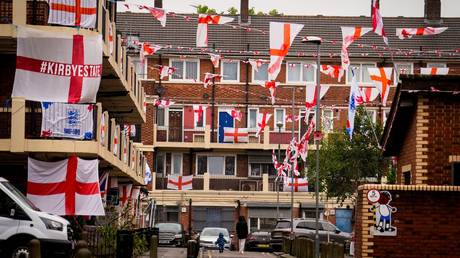
The wind outside the pub window was biting, the kind of damp British cold that gets into your bones and stays there. Inside, the air smelled of stale ale, fried chips, and anticipation. It was June. The World Cup was about to begin.
Every four years, a strange alchemy happens across England. Terraced streets suddenly erupt in a sea of red and white. Crimson crosses drape from bedroom windows, flutter from car antennas, and stretch across the brick facades of suburban estates. To millions, this is the visual shorthand of summer, hope, and collective identity.
But step back from the pub window. Walk down the pavement. Look up at those identical flags through a different set of eyes.
For someone who arrived in this country in the back of a lorry, or stepped off a plane fleeing a regime where flags were symbols of enforcement, that same red cross can evoke a completely different visceral reaction. It can feel heavy. It can feel exclusive. To some, it feels intimidating.
This is not a theoretical debate. It is a quiet, simmering friction that fractures communities long before the first whistle blows. We are trapped in a cultural stalemate, fundamentally misunderstanding what a flag does to the human psyche.
The Two Faces of the Red Cross
Symbols are chameleons. They do not possess inherent morality; they absorb the energy of whoever holds them.
Consider a hypothetical resident named Tariq. He lives on a street in Birmingham where, ahead of the tournament, nearly every house has hoisted the St. George’s Cross. Tariq loves football. He watches the Premier League every weekend. Yet, walking down his own street, the sudden density of the national flag triggers a subtle, defensive crouch in his shoulders.
Why? Because for decades, the St. George’s Cross was successfully hijacked.
During the late twentieth century, far-right political factions effectively claimed the flag as a boundary marker. It became a weaponized emblem displayed at marches designed to terrify immigrant communities. If you saw that flag coming down your street in the 1980s or 1990s, it often meant trouble. It meant you should lock your door.
Memory has a long half-life. Trauma has an even longer one.
When a stadium or a neighborhood floods with that symbol overnight, the brain’s amygdala does not check the calendar to see if it is a sporting event or a political rally. It remembers the historical context. The sudden ubiquity feels less like an invitation to a party and more like a declaration of ownership over the space.
Now look across the street. Consider another hypothetical resident, Mark. Mark is a plasterer who saved up for months to buy tickets to a group-stage match. To him, hanging the flag from his window is an act of pure, unadulterated joy. It is a connection to his grandfather, who took him to his first match. It represents community, regional pride, and a rare moment where a fractured nation feels like it is pulling in the same direction.
When Mark hears that his flag is viewed as intimidating, he feels defensive. Misunderstood. Angry. He wonders why his genuine affection for his country is automatically equated with bigotry.
Both men are reacting to the exact same piece of nylon. Both experiences are entirely valid, grounded in different realities of British life.
The Tournament Effect
Sporting events possess a unique power to distort normal social boundaries. During a tournament, patriotism is subsidized and encouraged. Corporate sponsors plaster the flag on milk cartons, beer cans, and billboard advertisements.
This hyper-visibility accelerates the tension. The flag is suddenly everywhere, unavoidable.
For a migrant trying to integrate into a new society, the sudden nationalistic fervor can feel like a shifting of the goalposts. One week, the emphasis is on multiculturalism and shared civic values. The next week, the landscape is painted in a singular, stark color palette that seems to demand a binary choice: are you with us, or are you separate?
The real problem lies elsewhere. It is not the presence of the flag itself that creates the chill factor. It is the silence that surrounds it.
We rarely talk about what the flag means before we wave it. We assume everyone shares our definition. When those definitions collide in the media or on street corners, the conversation instantly devolves into shouting matches about political correctness versus patriotism.
Reclaiming the Canvas
The narrative does not have to remain broken. A symbol can be populated with new meaning, but it requires deliberate, repetitive action.
Look at the modern England football team itself. The squad is a living, breathing contradiction to the old, exclusive definition of the St. George’s Cross. It is a team built from the sons of immigrants, players from working-class estates, and young men who speak openly about racism, poverty, and social justice.
When Bukayo Saka or Jude Bellingham steps onto the pitch with that crest over their heart, the meaning of the symbol shifts. It expands. It becomes large enough to accommodate both Mark’s nostalgic pride and Tariq’s lived experience.
But that expansion cannot only happen on a pitch in front of millions of television viewers. It has to happen on the ordinary streets where the flags actually hang.
True integration is not achieved by asking one group to hide their symbols, nor is it achieved by forcing another group to accept them without question. It happens when the people behind the windows start talking to each other.
The damp cold outside the pub window eventually gave way to a pale summer evening. The match began. Inside, people shouted, groaned, and cheered in unison. On the street outside, the flags fluttered in the evening breeze, caught between the history that weights them down and the future that might finally set them free.


