The air in the Kashmir Valley does not just carry the scent of pine and crushed ice. It carries a heavy, familiar dread. For decades, the families living along the Line of Control—the jagged border splitting India and Pakistan—have known a specific kind of geometry. They know the exact angle of the nearest ditch. They know how many seconds it takes for a mortar shell to travel across the valley after the initial thud echoes through the mountains.
In late February 2019, that geometry almost collapsed into history. For a closer look into this area, we suggest: this related article.
A suicide bombing in Pulwama had left dozens of Indian paramilitaries dead. Days later, Indian fighter jets crossed the border, striking deep into Pakistani territory for the first time in nearly half a century. Pakistan retaliated, scrambling its own jets. Dogfights erupted in the morning sky. An Indian pilot was shot down and captured. The world held its breath, waiting for the inevitable third thump—the one that would signal a full-scale war between two nations armed with nuclear warheads.
Then, suddenly, the escalatory spiral stopped. The pilot was returned. The artillery fell silent. For broader background on this topic, extensive coverage can be read on Al Jazeera.
For years, the mechanics of that sudden deceleration remained locked in the quiet backrooms of international diplomacy. We were left with the cold, official press releases. But a recent, remarkable public admission by Pakistani Prime Minister Shehbaz Sharif has pulled back the curtain, revealing just how close the world came to the edge, and exactly who was pulling the strings from across the Atlantic.
A Thank You Across the Atlantic
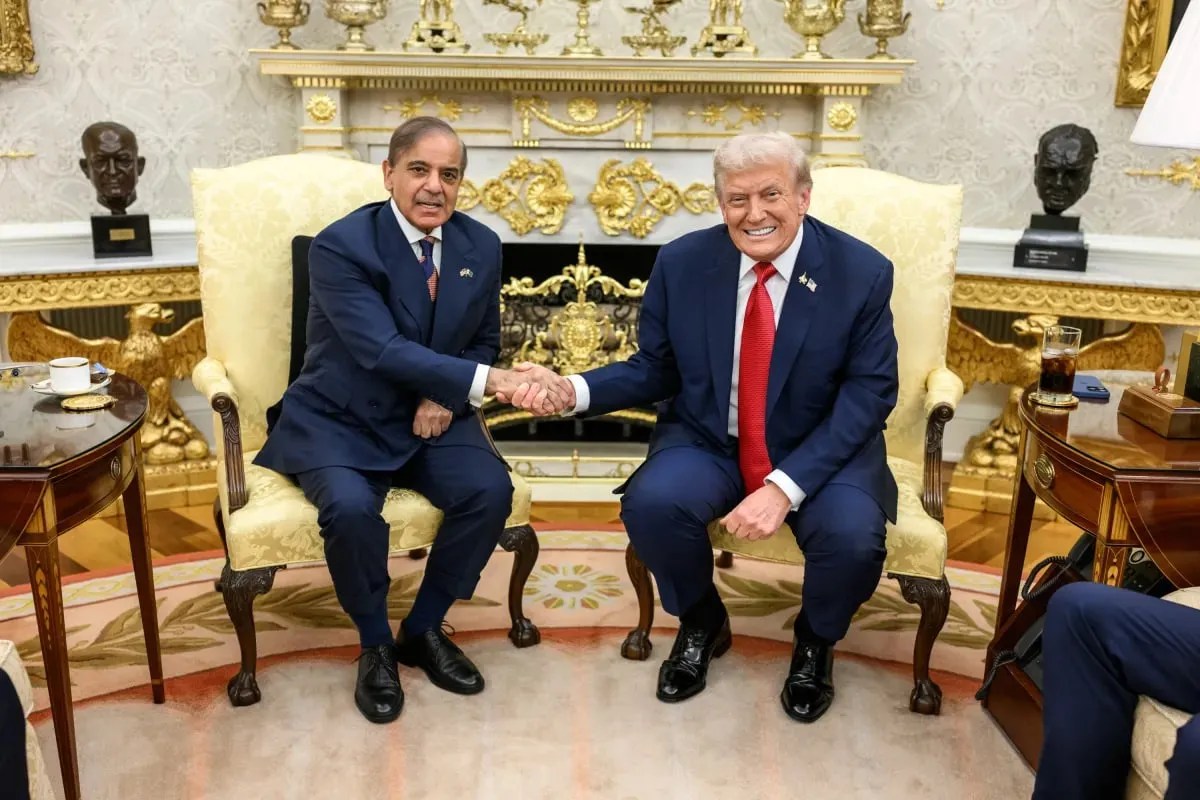
It happened during a high-profile address, a moment where standard diplomatic script usually dictates self-praise and nationalistic pride. Instead, Shehbaz Sharif chose to look backward, directly addressing the shadow of Donald Trump.
Sharif did not mince words. He credited the former American president with single-handedly de-escalating the 2019 crisis, preventing what many feared would become a catastrophic regional war. "We will always be grateful," Sharif noted, a phrase that caught seasoned diplomats by surprise. It is rare for a Pakistani leader to openly hand the crown of peacemaker to a foreign leader, let alone one as unpredictable as Trump.
But to understand why this gratitude runs so deep, you have to understand the sheer weight of what was avoided.
Imagine sitting in a bunker beneath Islamabad or New Delhi during those forty-eight hours. On paper, the data points are sterile: troop movements, alert levels, readiness states. In reality, it is a room filled with sweating generals, ringing phones, and the terrifying knowledge that a single miscalculation—a radar operator mistaking a flock of birds for an incoming missile, a rogue commander firing without orders—could trigger an atomic chain reaction.
When two nuclear-armed neighbors lock eyes, they cannot easily back down without losing face domestically. Political survival often demands a show of force. That is the fatal flaw of deterrence; it requires a theater of willingness to destroy everything. To break the deadlock, you need an outside force. A circuit breaker.
The Art of the Backchannel
During the height of the 2019 standoff, Donald Trump was in Hanoi, Vietnam, preparing for a high-stakes summit with North Korean leader Kim Jong Un. The American press corps was entirely focused on East Asia. Yet, behind the scenes, the White House was fighting a fire on a completely different front.
Trump dropped a hint during a press conference in Hanoi that went largely unnoticed at the time. He mentioned that the U.S. was mediating between India and Pakistan, teasing that "reasonably attractive news" was coming. Hours later, the captured Indian pilot was released by Pakistan as a "peace gesture."
The traditional foreign policy establishment has long criticized Trump’s transactional, direct style of diplomacy. They prefer the slow, grinding gears of state department memos and multi-lateral committees. But the subcontinent in 2019 did not have weeks for committees to meet. It had hours.
Consider the mechanics of leverage in that moment. The United States holds immense economic and military sway over both nations, albeit in vastly different ways. For Pakistan, struggling with financial instability, American influence within international lending bodies is a matter of economic life and death. For India, building a strategic partnership with Washington is a cornerstone of its long-term strategy in Asia.
When Washington calls both capitals simultaneously and says, stop, right now, the calculation changes. The external pressure gives both leaders a golden bridge to retreat across. They can tell their domestic audiences that they didn't back down out of weakness, but out of respect for global diplomacy.
The Heavy Price of Permanent Anxiety
Statistics can tell us the cost of war, but they rarely capture the cost of the fear of war.
Consider the economic reality of the region. Together, India and Pakistan house more than 1.6 billion people. Millions of them live below the poverty line. Every dollar spent on an advanced missile system or a stealth fighter jet is a dollar taken away from a rural clinic, a clean water project, or a primary school.
The defense budgets of both nations have swollen over the decades, driven entirely by the mutual distrust symbolized by the 2019 dogfights. Pakistan spends a massive portion of its federal budget on defense, a burden that cripples its ability to invest in infrastructure and human capital. India, facing a complex security environment, continues to be one of the world's largest arms importers.
This is the invisible tax that every citizen of the subcontinent pays for the unresolved ghost of the 1947 Partition. It is a tax paid in missed opportunities, crumbling schools, and futures cut short by austerity. When Sharif expresses eternal gratitude for a stopped war, he isn’t just talking about saved soldiers. He is talking about saving his country from total financial collapse under the weight of a wartime footing.
The Friction That Remains
The artillery along the Line of Control is quiet today, but the silence is fragile. It is the silence of a crowded room where everyone is holding their breath.
The underlying issues that brought the two nations to the brink in 1947, 1965, 1971, 1999, and 2019 have not vanished. The dispute over Kashmir remains an open wound. Trade between the two countries is virtually non-existent. Cultural exchanges have withered. A border that can be crossed by a train in a matter of minutes remains one of the most impenetrable iron curtains on Earth.
Diplomats often talk about "confidence-building measures"—cricket matches, bus routes, religious pilgrimages. But these are superficial bandages on a deep structural fracture. The reality is that the peace achieved in 2019 was not a resolution; it was an intervention.
And that is the core vulnerability of the current status quo. If peace requires a specific personality in the White House, or a specific alignment of geopolitical interests in Washington, then it is not a sustainable peace. It is a temporary lease on survival.
The next time a spark ignites in the region—and history guarantees there will be a next time—the global landscape will look different. The leaders will be different. The level of patience in Washington or Beijing may be vastly diminished.
True security cannot be imported from Washington or gifted by a foreign president, no matter how grateful a prime minister might be in retrospect. It can only be built across the border, through the grueling, unglamorous work of direct dialogue, economic integration, and the shared realization that a war between neighbors leaves no winners, only survivors wandering through the ash.
Until that happens, the people living along the border will keep watching the sky, knowing exactly how many seconds they have to run when the silence finally breaks.