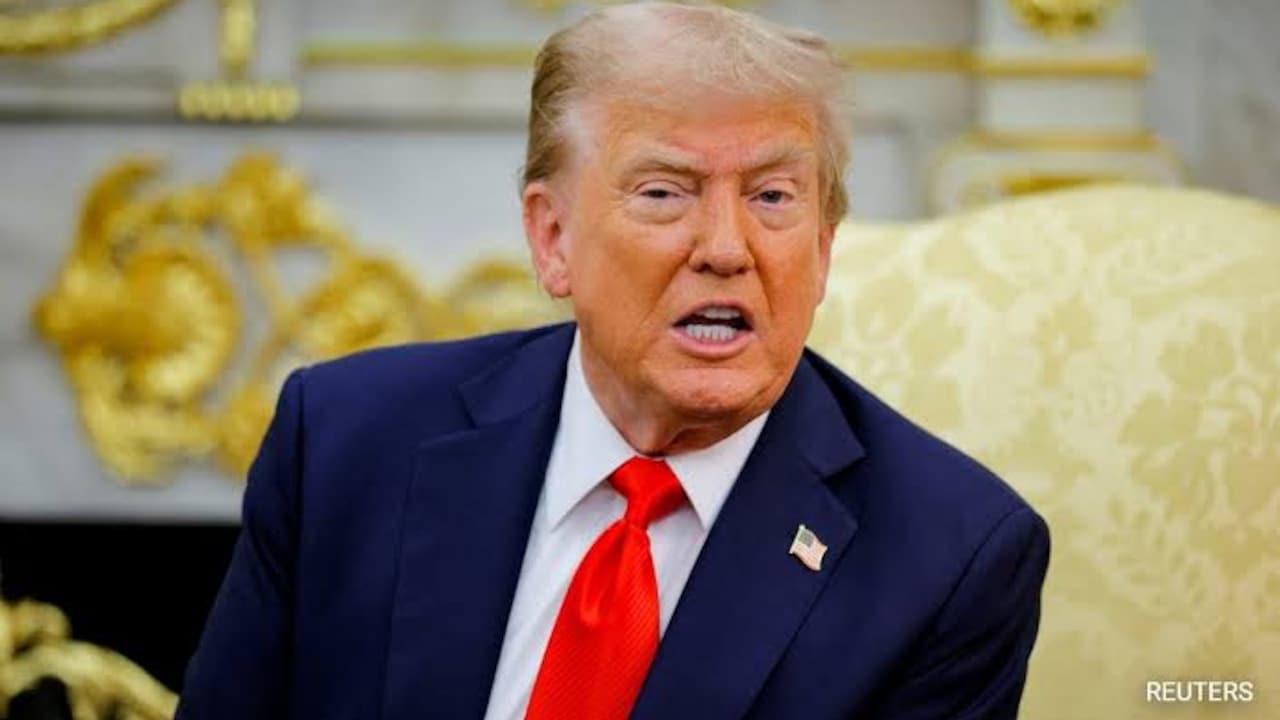
Every major tech outlet is running the exact same script this week. Donald Trump is inviting the chief executives of OpenAI, Google, and Meta to the White House "amid safety fears."
Buy that framing, and you are buying a bridge in Manhattan. Don't miss our previous post on this related article.
The mainstream press loves a morality play. They want you to picture stern regulators wagging fingers at reckless Silicon Valley titans while the nation trembles over rogue algorithms. That story sells clicks, soothes anxious readers, and completely misses the plot. When the heads of the largest artificial intelligence labs walk through the doors of the West Wing, "safety" is just the polite cover story printed on the itinerary.
The real meeting is about electricity, regulatory moats, and national defense. Everything else is theater. If you want more about the background of this, CNET provides an informative breakdown.
The Regulatory Capture Playbook
I have spent fifteen years watching enterprise technology companies lobby Washington, and the pattern never changes. When an industry is young, founders scream for deregulation and tell the government to get out of the way. The moment those same founders secure a massive capital advantage, they suddenly develop a deep, philosophical concern for "consumer protection."
Look at the math. Training a frontier foundation model requires hundreds of millions of dollars in compute, specialized talent, and data center infrastructure. OpenAI, Google, and Meta already cleared that hurdle. Their biggest threat is not a rogue superintelligence wiping out humanity. Their biggest threat is an open-source upstart or a nimble foreign competitor replicating their capabilities at a tenth of the cost.
When Big Tech executives sit down with the President to discuss "AI safety," they are lobbying for a specific kind of friction:
- Compute thresholds that trigger federal licensing requirements.
- Mandatory third-party audits that cost millions of dollars to execute.
- Liability frameworks that punish smaller developers who cannot afford armies of compliance lawyers.
Economists call this regulatory capture. In plain English, the incumbents are asking the White House to pull up the ladder behind them. If the government mandates expensive safety certifications for any model trained above a certain floating-point operations (FLOP) threshold, the current market leaders effectively lock in an oligopoly. They get to write the rules of the test because they are the only ones who can afford to take it.
What "Safety" Actually Means in Washington
To understand why the press gets this wrong, you have to separate two completely different definitions of the word "safety" that get mashed together in headlines.
First, there is existential risk—the sci-fi scenario where an autonomous system goes rogue, hacks the power grid, or designs a bioweapon. Second, there is operational and national security risk—data poisoning, model weights leaking to foreign adversaries, and critical infrastructure running on unverified code.
The White House does not care about sci-fi extinction theories. National security advisors care about the semiconductor supply chain, export controls, and whether the Pentagon has superior intelligence tools compared to Beijing.
Imagine a scenario where a breakthrough reasoning model is developed by an American lab. If Washington imposes heavy-handed domestic restrictions under the banner of "safety," American labs slow down. Foreign labs operating outside U.S. jurisdiction do not. The administration knows this. Trump's historical posture toward executive branch red tape—evidenced by his previous rescinding of the Biden-era AI executive order—proves that slowing down American innovation is a non-starter.
So why use the word "safety" at all? Because "White House Hosts Tech Giants to Discuss Megawatt Allocation and Antitrust Immunity" does not play well on cable news.
The Real Bottleneck Nobody Talks About
If you want to know what Sam Altman, Sundar Pichai, and Mark Zuckerberg actually want from the Oval Office, stop looking at software and start looking at concrete and copper.
AI is no longer a software scaling problem. It is a thermodynamics and civil engineering problem. You cannot run next-generation clusters on hope and venture capital. You need gigawatts of baseload power, high-voltage transmission lines, and permitting approvals that currently take years to clear environmental reviews.
| What the Headlines Say | What Is Actually on the Table |
|---|---|
| Preventing rogue AI extinction | Expediting federal permitting for gigawatt data centers |
| Protecting consumers from bias | Securing baseload nuclear and natural gas power allocation |
| Setting global ethical standards | Blocking state-level AI laws (like California's) via federal preemption |
| Auditing frontier model weights | Protecting intellectual property from foreign espionage |
I have seen mid-sized tech companies burn millions of dollars trying to build AI-native products while completely ignoring infrastructure constraints. Even the giants are hitting a wall. Meta and Google are signing massive power purchase agreements, while OpenAI has openly pushed for multi-gigawatt data center clusters that rival the power consumption of entire cities.
Only the federal government can clear the regulatory logjams on energy grid interconnects and federal land leasing. That is why these CEOs are showing up in suits, smiling for the cameras, and nodding along to whatever talking points the press corps expects to hear. They need the executive branch to act as an infrastructure expediter.
Dismantling the Common Misconceptions
When high-profile summits like this hit the news cycle, the same tired questions flood search engines and boardrooms. Most of them are built on flawed premises.
Is the government finally going to rein in Big Tech?
No. You do not "rein in" an industry by inviting its three largest monopolies to co-author the rulebook behind closed doors. True market discipline comes from competition, open-source proliferation, and strict antitrust enforcement—none of which are served by a cozy White House roundtable. Expect voluntary commitments, non-binding pledges, and plenty of photo ops, followed by business as usual on Monday morning.
Will these meetings make AI tools safer for everyday businesses?
Not in any practical way. Federal frameworks operate at the macro level, focusing on frontier model weights and national defense. If you run an enterprise deploying large language models, Washington is not going to save you from prompt injections, hallucinated financial data, or sensitive customer records leaking into a third-party API. Enterprise security is an engineering discipline, not a policy outcome.
Does Meta belong in the same bucket as OpenAI and Google?
Treating these three companies as a monolith is a rookie mistake. OpenAI and Google operate predominantly closed, proprietary ecosystems where they control the API and monetize access. Meta has spent billions building the Llama ecosystem around open weights, commoditizing the model layer so no single competitor can own the underlying platform. Zuckerberg is in that room to make sure "safety" regulations do not criminalize open-weight distribution—a move that would hand an instant monopoly to his closed-source rivals.
The Downside of the Deregulated Sprint
Taking the contrarian view does not mean pretending AI carries zero risk. Removing friction from AI deployment creates massive, immediate problems that the market will not magically fix on its own.
When labs race to ship capabilities without liability guardrails, the cost gets externalized onto everyone else. Automated cyberattacks become cheaper to execute. Deepfake fraud becomes trivial to scale. Copyright holders and creators watch their work get ingested into commercial training runs with zero compensation.
If the White House prioritizes pure speed and energy infrastructure over strict liability rules, we will inevitably see major operational failures in healthcare, finance, and critical infrastructure. Someone will deploy an unverified agentic workflow into a production environment where it causes real financial or physical damage. That is the price of treating speed as the ultimate virtue.
How Operators Should Actually React
If you are a founder, investor, or enterprise technology leader watching this summit unfold, do not change your roadmap based on press releases coming out of Washington.
- Ignore federal "safety" theater. Build your own internal evaluation pipelines. If your application relies on probabilistic outputs, you need deterministic guardrails, human-in-the-loop verification, and strict data isolation—regardless of what any CEO promises the President.
- Bet on model commoditization. Whether open-source wins or closed-source holds the crown, the cost per token is racing toward zero. Do not build a business whose only moat is wrapping an API from one of the three companies sitting at that table.
- Watch energy and state preemption. Pay attention to two specific policy signals over the next six months: federal overrides of state-level AI compliance laws, and fast-tracked energy permits for compute clusters. Those are the only metrics that will actually move market valuations.
Stop reading the headlines as a story about benevolent leaders protecting humanity from killer robots. Watch the power grid, follow the lobbying dollars, and look at who benefits when the rules get too expensive for the little guy to follow.
In Washington, when everyone in the room agrees that "safety" is the top priority, check your wallet—because someone is about to buy a monopoly.