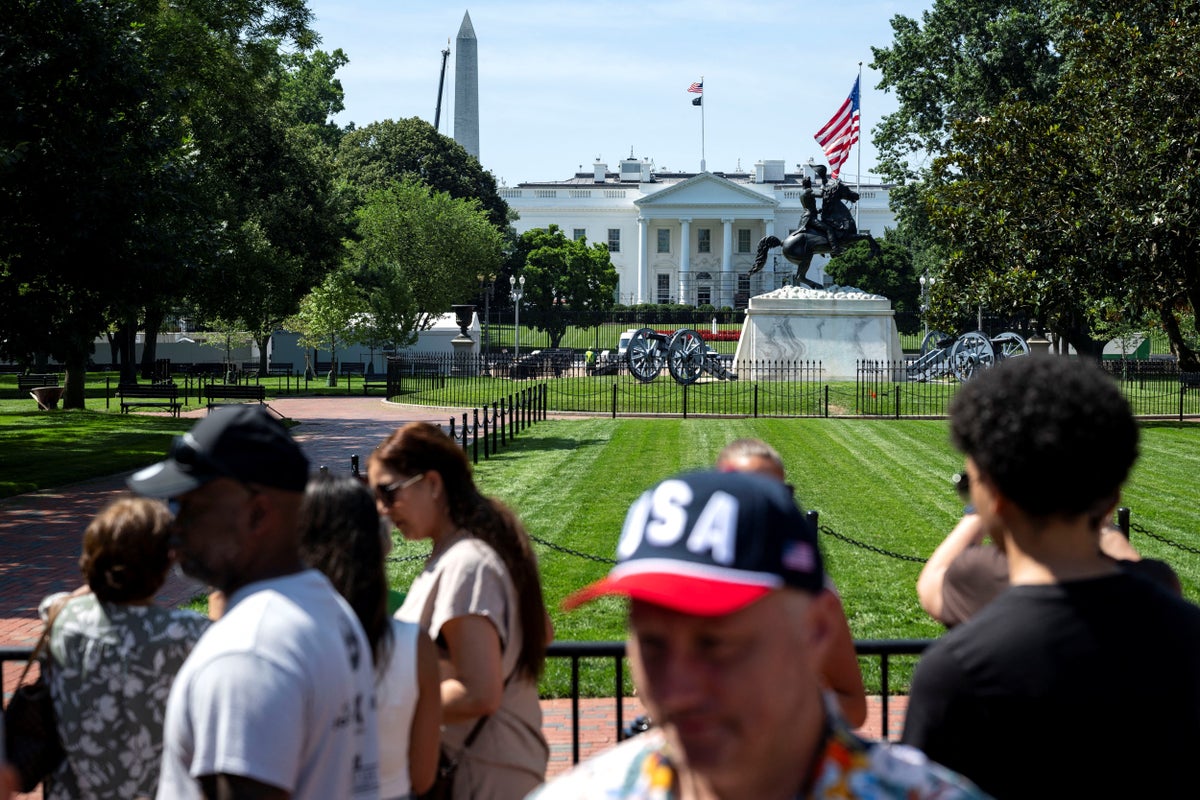
The media is panicking over a few hundred feet of steel mesh. When news broke that Donald Trump wanted to push crowds back by installing new fencing around the White House perimeter, the predictable commentators immediately predictably fell into line. One camp decried it as the visual manifestation of an autocrat hiding from the public; the other defended it as a common-sense measure to protect the leader of the free world.
Both sides missed the point. They are arguing about a physical manifestation of an obsolete security playbook.
Pivoting to physical barriers in an age of asymmetric, decentralized threats is like building a castle moat to stop a drone strike. It feels reassuring to the bureaucrats signing the procurement orders, but it fundamentally misunderstands how modern asset protection works. I have spent years analyzing high-stakes risk management for corporate infrastructure and executive defense, and the reality is stark: if you are relying on a fence to save you, your security apparatus has already failed.
The Lazy Consensus of Perimeter Defense
The baseline assumption of traditional security is simple: distance equals safety. The further back you push a crowd, the more reaction time your tactical teams have. This logic worked beautifully in 1990. Today, it is a dangerous security theater that creates a false sense of complacency while introducing new, unquantified vulnerabilities.
When you push a protest or a crowd back by an extra fifty or one hundred yards, you do not eliminate the threat. You change its geometry.
- Crowd Compression: Forcing crowds into tighter, harder-to-monitor corridors outside the new perimeter increases the risk of crowd crushes and chaotic stampedes. A compressed crowd is significantly more difficult for intelligence assets to read, filter, and neutralize.
- Optics as a Vulnerability: A fortress mentality signals structural instability. In the world of geopolitical risk, perception dictates reality. When a state capital looks terrified of its own citizenry, it invites external opportunism from foreign adversaries who smell systemic weakness.
- The Maginot Line Effect: Static barriers breed cognitive laziness. The moment a physical wall goes up, human sentries subconsciously lower their operational awareness, assuming the barrier will do the heavy lifting.
The Secret Service does not need better fences; it needs better predictive analytics and decentralized crowd management. Physical barriers are a low-tech solution to a high-concept problem.
Dismantling the Secret Service Playbook
Let us address the question the mainstream press refuses to ask: Is a physical perimeter even designed to keep people out anymore?
Historically, the White House fence was an aesthetic boundary. Over successive administrations, it evolved into a heavy-duty, anti-climb barrier. Yet, every single high-profile breach over the last two decades occurred not because the fence was too short, but because internal systems broke down.
Consider Omar Gonzalez in 2014. He hopped the old fence, sprinted across the lawn, entered the front doors, and made it deep into the East Room before being tackled. The fence did its job by delaying him for a few seconds; the internal alarms, the canine units, and the static guards failed theirs. Raising the fence or pushing it back does not fix a broken internal command loop.
Security is a function of layers, not walls. The most critical layers are entirely invisible to the public eye.
[Layer 1: Signal Intelligence / Threat Monitoring]
                     │
                     ▼
[Layer 2: Behavioral Analysis & Direct Intercept]
                     │
                     ▼
[Layer 3: Physical Obstruction (The Fence)]
                     │
                     ▼
[Layer 4: Lethal Inside Countermeasures]
When an administration obsesses over Layer 3, it is usually because they are failing at Layers 1 and 2. True executive protection relies on behavioral anomaly detection, real-time signal monitoring, and immediate, non-lethal intercept capabilities far outside the visible perimeter. By the time a bad actor touches a piece of painted iron on Pennsylvania Avenue, the security grid has already suffered a catastrophic failure.
The Hidden Cost of Tactical Isolation
There is a distinct downside to this contrarian view that any honest risk assessor must admit: relying less on physical barriers means you must rely more on aggressive, proactive surveillance. It means choosing between the visible ugliness of a barricaded city or the invisible friction of a heavily monitored populace.
But if the goal is actual safety rather than the illusion of it, the choice is clear.
When you isolate an executive branch behind concentric rings of steel, you sever the feedback loops necessary for effective governance and accurate crowd intelligence. You create a vacuum. In that vacuum, threat assessment teams stop looking at real human behavior and start looking exclusively at data screens, further alienating the security apparatus from the environment it is supposed to police.
The fixation on physical fences is a symptom of a broader corporate and political disease: the desire for an insurance policy that can be photographed. A fence is easy to audit. It has a line-item budget. You can point at it and say, "Look, we did something."
Investing in deep behavioral training for agents, advanced drone mitigation systems, and rapid-response kinetic teams is much harder to show off to a congressional oversight committee. But that is exactly what keeps an asset safe.
Stop looking at the fence. Start looking at the entities retreating behind it. The barriers we build do not keep the world out; they lock our strategic failures in.