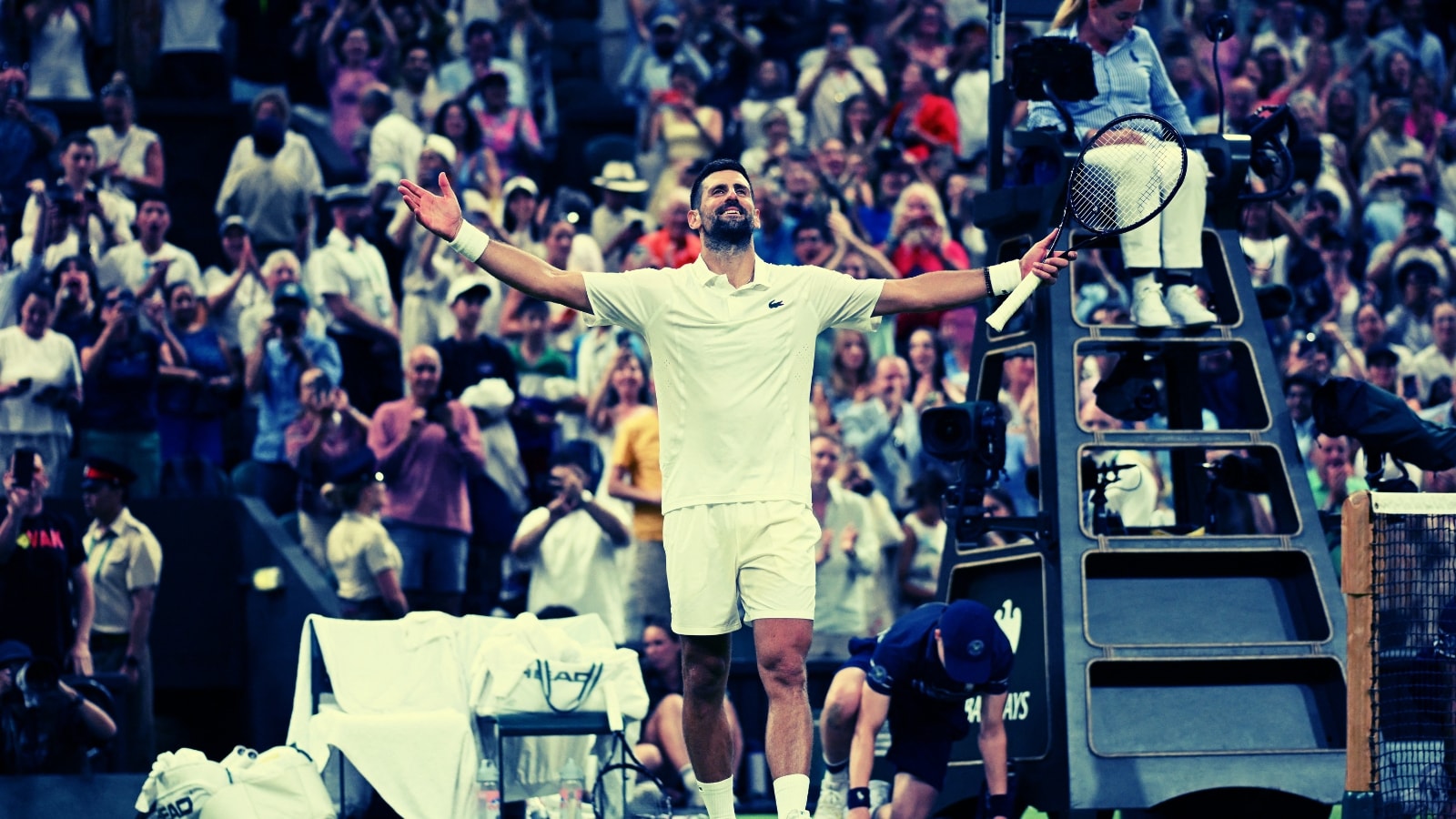
Novak Djokovic just dragged his 39-year-old body through a five-hour marathon at Wimbledon to book a semifinal spot against Jannik Sinner. The tennis press is weeping tears of joy. They are calling it an "instant classic," an "epic display of gladiatorial will," and proof that the old guard still holds the keys to the kingdom.
They are entirely wrong.
What you actually watched was not a triumph of athletic excellence. It was a glaring symptom of a sport suffering from systemic structural decay. The "five-hour epic" is a myth manufactured by nostalgic pundits to mask a brutal reality: modern men's tennis is broken, the product is bloated, and celebrating a five-hour baseline slog in 2026 is like praising a traffic jam for lasting all afternoon.
We are conditioned to believe that longer means better. We have been conditioned to think that drama is measured strictly by the clock. It is time to dismantle the lazy consensus and look at what actually happened on that grass court—and why a Sinner showdown built on the back of this exhausting spectacle is exactly what is wrong with the tour.
The Efficiency Myth: Why Five Hours Is a Failure of Product Design
Let’s look at the actual data of a five-hour tennis match.
If you analyze the telemetry and tracking data of a standard five-set match, the ball is actually in play for roughly 15% to 18% of that time. For a five-hour match, that equates to about 45 to 54 minutes of real tennis. The other four hours?
- Bouncing the ball 25 times before a serve.
- Walking slowly to the towel rack.
- Arguing with the chair umpire about the shot clock.
- Sitting on a plastic chair eating bananas.
The media frames this as a psychological chess match. In reality, it is a pacing disaster that no other modern entertainment property would tolerate. Imagine an NFL game where the players huddle for twelve minutes between every three-second play, stretching the broadcast to eight hours. The fan base would evaporate.
Tennis survives on this format only because of a deeply entrenched, purist Stockholm syndrome. The sport's gatekeepers view suffering—both by the players and the audience—as a badge of honor.
The Physical Illusion
We are told Djokovic’s longevity is a miracle. It is certainly an elite display of sports science, hyperbaric chambers, and a meticulous gluten-free diet. But let's be honest about the tactical reality: the grass at Wimbledon is not the grass of the 1990s.
Ever since the All England Club changed the perennial ryegrass mix to 100% Ryegrass in 2001, the surface has played slower and bounced higher. The traditional serve-and-volley game is dead. What we have now is essentially a green clay court.
"The homogenization of court surfaces has turned grass-court tennis into an endurance test rather than a display of specialized skill."
Djokovic didn't win a classic grass-court match. He won a war of attrition from three feet behind the baseline, playing defensive, risk-averse tennis. It is highly effective. It is historically great. But celebrating it as the pinnacle of entertainment is gaslighting the consumer.
The Flawed Premise of the "Sinner Showdown"
The narrative engine is already spinning for the semifinal. The old lion versus the young king. Djokovic versus Sinner.
But look at the cost of entry. Djokovic enters this match with five hours of lactic acid sitting in his legs. Sinner, who has been efficiently dispatching opponents in straight or efficient four-set matches, represents a completely different era of athletic preparation.
When the media asks, "Does Djokovic have enough left in the tank to beat Sinner?" they are asking the wrong question. The real question is: Why does the Grand Slam format actively penalize great play by rewarding survival over skill?
In any logical sporting structure, the reward for dominance in the early rounds is physical preservation. But the best-of-five format introduces so much variance and physical degradation that the semifinal often becomes a match decided by medical staff rather than forehands. If Djokovic loses to Sinner in straight sets because his movement is 5% slower due to a grueling quarterfinal, the fans lose a competitive match. The tournament loses its climax.
We are sacrificing the quality of the final rounds on the altar of the five-set fetish.
Dismantling the "People Also Ask" Delusions
If you look at what casual fans and pundits ask online during a tournament like Wimbledon, the lack of structural understanding is stark. Let's correct the record on the most common misconceptions.
"Aren't five-set matches the ultimate test of a player's greatness?"
No. They are a test of VO2 max and recovery protocols. Greatness should be measured by tennis skill, tactical adjustments, and execution under pressure. Shifting the criteria to pure physical survival devalues the technical evolution of the sport.
Some of the greatest tennis ever played has occurred in best-of-three matches. The World Tour Finals, where the top eight players face off in a best-of-three format, consistently delivers higher-quality point construction and sustained intensity from the first ball to the last. There is no dead weight. There are no tanked sets to save energy for a fourth-set push.
"Would fans accept shorter matches at Grand Slams?"
They already do. Women play best-of-three, and their matches frequently generate massive television ratings, intense drama, and far cleaner narratives. The resistance to shortening the men's game is driven entirely by a loud minority of traditionalists who believe tennis stopped evolving in 1980.
The broader public wants urgency. They want every point to matter. They do not want to watch two hours of feeling-out sets where both players are consciously conserving energy because they know they have to play for another three hours.
How to Actually Fix the Sport
If you want to save tennis from becoming a niche regional sport watched exclusively by country club members and retirees, you have to disrupt the format.
| Current Bloated Format | The Modernized Alternative |
|---|---|
| Best-of-five sets for men's Grand Slam matches. | Universal best-of-three across all rounds and genders. |
| 25-second shot clock that is rarely enforced strictly. | 15-second strict shot clock with immediate point penalties. |
| Endless warm-ups and dead time between changeovers. | Streamlined transitions; players step onto court and play. |
Implementing a universal best-of-three format at Grand Slams would instantly elevate the sport.
First, it creates immediate jeopardy. In a best-of-three match, a slow start is fatal. Top seeds can no longer afford to sleepwalk through the first two sets against a qualifier, knowing their superior fitness will bail them out in a fifth set. Every single game becomes high-stakes poker.
Second, it protects the talent. We are currently watching a generation of players whose bodies are breaking down by age 25. Carlos Alcaraz, Sinner, and Holger Rune have all suffered significant physical setbacks early in their careers. By cutting the physical load of Grand Slams by 40%, you extend the lifespans of the stars people pay to see.
Third, it fixes the broadcast window. A best-of-three match fits perfectly into a clean two-hour television slot. It allows networks to schedule matches accurately, prevents fans from sitting in stadiums until 2:00 AM, and creates a tight, punchy product that appeals to a demographic that doesn't have an entire afternoon to waste on a single sporting event.
The Harsh Reality of the Sinner Match
When Djokovic steps onto the court to face Sinner, the commentators will spend the first thirty minutes talking about "the epic five-hour journey" it took for him to get there. They will frame it as a heroic epic.
Do not buy into the mythology.
If Djokovic is sluggish, if his lateral movement is compromised, and if Sinner blows him off the court because one player is fresh and the other was forced to run a marathon forty-eight hours prior, remember that this was entirely preventable.
We are letting outdated traditions ruin the highest level of competition. Stop praising the five-hour mess. Demand a sport that values sharp, explosive excellence over exhausting, drawn-out survival. Turn off the nostalgia machine and look at the court: the clock is ticking, and tennis is running out of time.