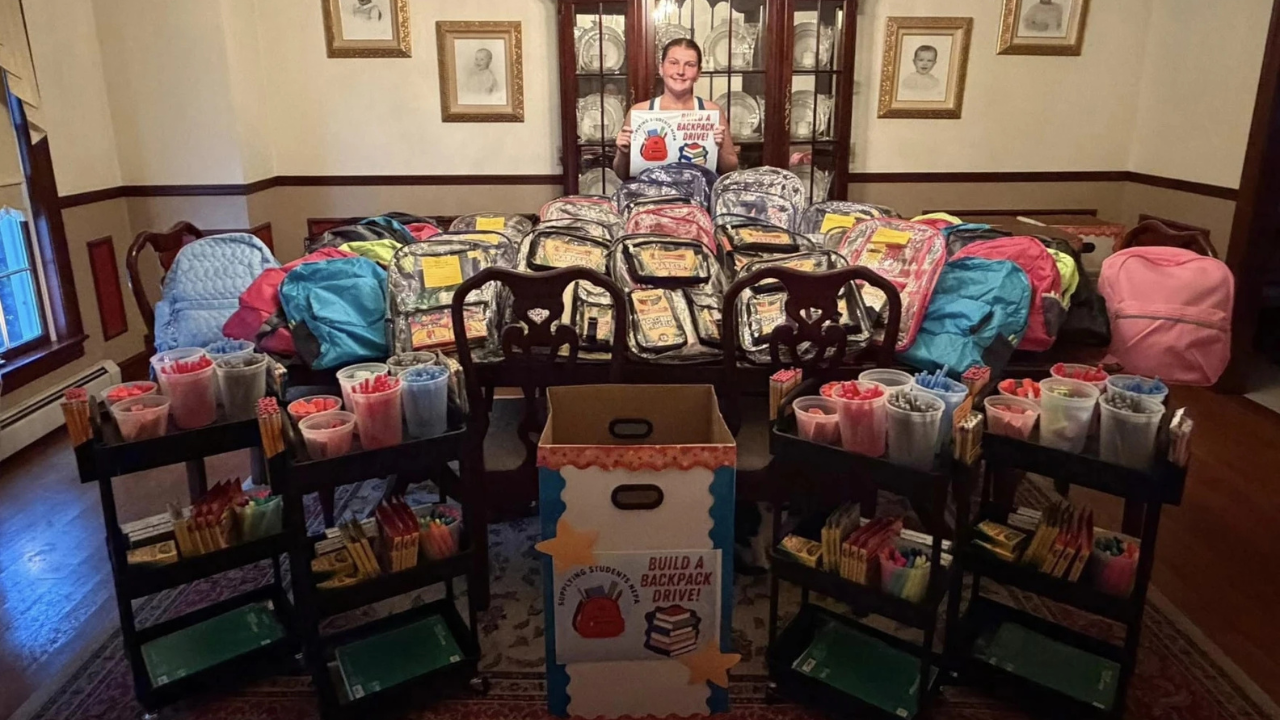
Sixty backpacks across seven schools. Four "Kindness Karts." Applause all around.
Hold the applause. Look closer.
When a teenager collects sixty backpacks for seven schools and rolls out four mobile carts of supplies, the standard local-news script writes itself. Heartwarming. Inspiring. Proof that the kids are alright. Anyone who questions the model gets painted as a cynic allergic to generosity.
Generosity is not the problem. Performative, episodic charity is the problem.
The lazy consensus around youth-led drives and feel-good distribution carts assumes that collecting stuff and making it visible equals solving a need. Gather items. Snap a photo. Drop off gear. Feel noble. Repeat next semester.
That model confuses motion with progress. Sixty backpacks split across seven schools averages fewer than nine bags per school. Even if every single one goes to a student in acute need, nine bags in a building of hundreds—or thousands—of kids is a drop in a dry bucket. Four carts rolling through hallways or campuses might brighten a Tuesday afternoon, yet carts do not fix chronic underfunding, uneven district procurement, stigma around needing free supplies, or the quiet reality that students run out of basic materials in October and February, not just during a camera-ready launch week.
I have spent years watching schools, nonprofits, and well-meaning community initiatives burn energy and donor goodwill on visible giveaways that leave structural gaps untouched. I have seen districts celebrate a pile of donated binders in August while teachers pay out of pocket for dry-erase markers by November. I have seen "kindness" campaigns treated as substitutes for predictable budgets, dignified access, and real partnership with the people actually living the problem.
Let us define the terms cleanly before going further. Material scarcity in schools is not merely the absence of a new nylon backpack on day one; it is ongoing, uneven access to core learning tools, personal essentials, and classroom supplies across the school year. Episodic charity is one-off or sporadic giving driven by donor impulse, seasonal spikes, or publicity cycles rather than continuous operational need. Dignified distribution means getting needed items into students' hands discreetly, reliably, and without turning poverty into a public spectacle.
When someone hears about a sixteen-year-old organizing sixty backpacks for seven schools and building four kindness carts, their instinct is to ask, How can more teens start projects like this?
That is the wrong question.
The better question is: What happens to a student after the cart leaves the hallway and the photo op ends?
The Flaw in "People Also Ask" Questions About Youth Charity
Search feeds around stories like this are predictable. Readers type questions into search bars expecting neat, comforting answers. Most of those questions start from a broken premise.
"Why are school supply drives and kindness carts so effective?"
They are not automatically effective. They are visible.
Visibility gets coverage. Visibility gets likes. Visibility gets a pat on the back at a community meeting. Effectiveness requires measurable continuity—whether a kid has pencils in January, whether supplies match actual teacher syllabi, and whether students feel safe asking for help without being singled out.
A mobile cart stocked by a seasonal drive often carries whatever people happened to have lying around or bought on sale: novelty gel pens, half-empty packs of index cards, mismatched folders, or items that do not fit what middle and high schoolers actually use. A sixteen-year-old can easily get seventy-five packs of pastel highlighters and zero scientific calculators or college-ruled notebooks that hold up through May.
Effective support looks boring on camera. It looks like quiet restocking in a counselor's office or nurse's station. It looks like coordinated lists built with department chairs. It looks like recurring funding rather than a one-time haul.
"How can young people make the biggest impact in their communities?"
By stopping the rush to invent a shiny new initiative and starting with actual demand.
Too many young changemakers—and too many adults encouraging them—treat community work like a resume-building sprint. Launch a brand. Name it something catchy with alliteration. Build a prop. Distribute a batch. Move on.
Real impact comes from listening first and building systems that outlast one person's high school graduation. A teenager who partners with a school social worker to keep a locked, discreet supply cabinet stocked every month for two years does more durable good than someone who stages a single high-profile drop and vanishes when AP exams start.
"What do low-income students actually need most during the school year?"
Not a novelty cart. Consistency.
Think about what happens inside a real school building. A student needs a backpack with zippers that do not blow out in six weeks. They need basic writing tools, notebooks, hygiene items they do not have to beg for in front of peers, and sometimes food or bus fare. None of that requires a themed cart. All of it requires reliability.
Imagine a scenario where a school receives four carts full of donated goods in September. For two weeks, students crowd around or avoid them depending on how conspicuous the setup is. By mid-October, the most useful items are gone, the remaining odds and ends sit untouched, nobody has time or budget to restock the cart consistently, and the cart becomes either an empty frame or a storage rack for clutter. The story already ran in September, so nobody notices the quiet stall in October.
That is not malice. That is how under-resourced, good-intentioned projects drift when nobody designs for maintenance.
What the Feel-Good Story Misses About School Needs
Public narratives love a neat arc: young person sees need, rallies peers, delivers goods, problem moves forward. Real school logistics are messier.
First, distribution across multiple schools dilutes impact fast. Sixty backpacks across seven schools is roughly eight or nine per site. Even if a principal hands those directly to the most vulnerable students, the demand inside a single comprehensive high school or middle school usually exceeds nine students. Spreading tiny quantities across seven campuses creates broad geographic coverage on paper while leaving thin impact on the ground.
Second, public-facing "kindness" models carry a hidden social cost. Adolescents are hyper-aware of status, embarrassment, and peer judgment. Anything that marks a kid as a charity recipient—even gently, even under a cheerful banner—can push the exact students who need help the most to walk right past it. Discretion is not cold; discretion respects privacy.
Third, physical carts create operational friction. A cart has to be stored somewhere safe. Someone has to inventory what is inside. Someone has to clean it, wheel it, guard against theft or damage, and replenish it when supplies run low. In busy schools where custodians, counselors, and teachers are already stretched thin, a new cart can quietly become another task on someone else's plate.
Researchers and policy analysts who study youth civic engagement and educational equity—including scholars associated with organizations like CIRCLE (the Center for Information and Research on Civic Learning and Engagement) and poverty-and-education researchers like Greg Duncan and Richard Murnane—have long pointed out that structural inequities in schools are shaped by funding formulas, resource distribution, and chronic gaps, not lack of individual goodwill. Goodwill is abundant. Reliable infrastructure is scarce.
The Honest Downside of Taking a Hard Line on Youth Drives
Let us be straight about the risk of attacking feel-good projects like backpack drives and kindness carts.
Push too hard against youth charity, and you risk sounding like you want teenagers to sit on their hands and do nothing. That is a terrible outcome. Young people should care about their classmates. They should organize, build, problem-solve, and show up for their schools. Telling a sixteen-year-old their effort is worthless because it did not reform district budgets is lazy cynicism masquerading as rigor.
There is another real downside to my argument: perfectionism kills momentum. Plenty of flawed, small-scale efforts have sparked lifelong civic habits in young people. A student who starts with a slightly lopsided supply drive at eighteen might learn how logistics work, discover what schools actually lack, and build something far sharper by twenty-two. If you demand institutional-grade systems from a teenager on day one, almost nobody starts.
Critique should raise the bar, not salt the earth.
How to Do This Right Without Killing the Spark
If you care about students—and if you want young people to build projects that actually hold up—change the playbook.
- Ask before you collect. Talk to school counselors, social workers, family liaisons, and teachers first. Ask what runs out fastest, what cannot be bought with standard school funds, and how students prefer to receive items without embarrassment.
- Concentrate before you scatter. Sixty items placed where ten kids who need them most can get steady refills beats splitting a handful across seven buildings with no follow-through.
- Design for month four, not launch day. Anyone can run a one-week collection drive. The real test is whether supplies still exist in November and March. Build a restock schedule, assign clear ownership, and keep the inventory practical.
- Prioritize dignity over optics. If a student has to make a public scene at a decorated cart to get basic supplies or personal items, rethink the delivery method. Quiet access through trusted adults usually wins.
- Measure usefulness, not volume. Counting how many items were gathered tells you about effort. Tracking whether teachers and students actually used them—and ran out of specific items—tells you about impact.
A sixteen-year-old caring enough to act deserves credit for showing up. The rest of us owe them something better than applause: honest standards, real guidance, and a clear look at what actually helps students stay equipped all year long.
Stop clapping for the cart. Stock the gap.