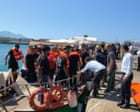
Maritime structural failures rarely emerge from singular anomalies. When a high-capacity catamaran ferry carrying nearly 270 passengers and crew capsized and sank off the coast of Kyrenia, the incident exposed vulnerabilities in regional transit safety vectors, emergency response protocols, and vessel stability limits. Operating on the high-volume maritime corridor between northern Cyprus and southern Turkey, the vessel took on water roughly four nautical miles offshore before completely sinking into a depth exceeding 500 meters. Deconstructing the mechanics of this event requires examining three core vectors: hydrodynamic stability failure, evacuation bottlenecks, and macro-regulatory oversight.
The Hydrodynamic Failure Vector of Catamaran Hulls
The vessel involved was a twin-hulled catamaran designed for speed and passenger volume on short-sea shipping routes. Catamarans offer high initial transverse stability due to wide beam dimensions, but they exhibit distinct failure modes when compromised by uncontrolled water ingress.
Unlike single-hull displacement vessels that settle progressively when flooded, catamarans possess enclosed structural bridge decks connecting the twin hulls. If water enters one hull or the main vehicle and passenger deck unevenly, asymmetric weight distribution generates a rapid list. The mechanics of the sinking indicate that free-surface effect played a primary role. When liquid sloshes inside an uncompartmented or partially flooded space, it shifts the vessel's center of gravity laterally.
As the Kyrenia-Tasucu ferry began taking on water shortly after departure, the internal fluid mass shifted dynamically against the listing angle. This accelerated the heel rate beyond the restoring moment of the buoyant hulls. Once the heel angle surpassed the critical threshold, downflooding through ventilation trunks or windows occurred exponentially, neutralizing remaining positive stability and causing the vessel to invert and capsize.
Evacuation Mechanics and Survival Dynamics
With approximately 270 occupants onboard, the time-to-evacuation window was narrow. Maritime safety standards mandate that high-speed craft must be capable of total evacuation within minutes. However, real-world execution depends heavily on crew intervention timing and passenger compliance.
Reports from survivors indicate that the captain instructed passengers to don life jackets as the vessel lost buoyancy control four miles out. The transition from a controlled transit state to panic compression severely degraded evacuation efficiency. In high-density passenger configurations, bottlenecks occur at stairwells and muster stations.
The survival distribution split into two distinct cohorts: those who managed to deploy into life rafts or open water before complete inversion, and those who utilized the overturned hull as a temporary refuge. The dual-hull design provided an exposed bottom structure post-inversion, which acted as an impromptu stabilization platform for individuals clinging to the orange hull until rescue units arrived.
However, individuals trapped inside the superstructure faced extreme survival constraints. Because the vessel sank rapidly into 514-meter-deep waters, sub-surface structural entrapment precluded rescue for anyone unable to clear the cabin prior to sinking. Search and recovery operations were forced to pivot immediately from surface rescue to deep-water recovery scanning, constrained by extreme depth parameters that render conventional diving operations impossible.
The Cost Function of Regional Transit Deregulation
The economic drivers behind maritime corridors linking northern Cyprus to mainland Turkey encourage high-frequency, cost-sensitive transit options. Ferries provide an economical alternative to air travel for cross-border commuters and tourists, creating commercial pressure to maximize passenger manifests and turnaround speeds.
This economic pressure introduces operational trade-offs:
- Maintenance turnaround windows are compressed to maintain high daily sailing frequencies.
- Passenger load verification systems face administrative strain during peak travel periods.
- Safety briefings and individual safety gear allocations are occasionally deprioritized by passengers accustomed to routine commuter travel.
When a privately operated vessel suffers catastrophic structural compromise under sunny weather conditions and calm sea states, the variable shifts away from environmental forcing functions toward internal mechanical failure, cargo shift, or hull integrity breaches. The subsequent detention of the captain and crew underscores the legal transition from a search-and-rescue operation to a forensic liability investigation focused on pre-voyage seaworthiness and stability calculations.
Deploy maritime surveillance assets equipped with autonomous underwater vehicles to map the sunken superstructure at depth, preserving perishable evidence regarding hull plate integrity and internal valve settings before bottom currents displace structural components.


