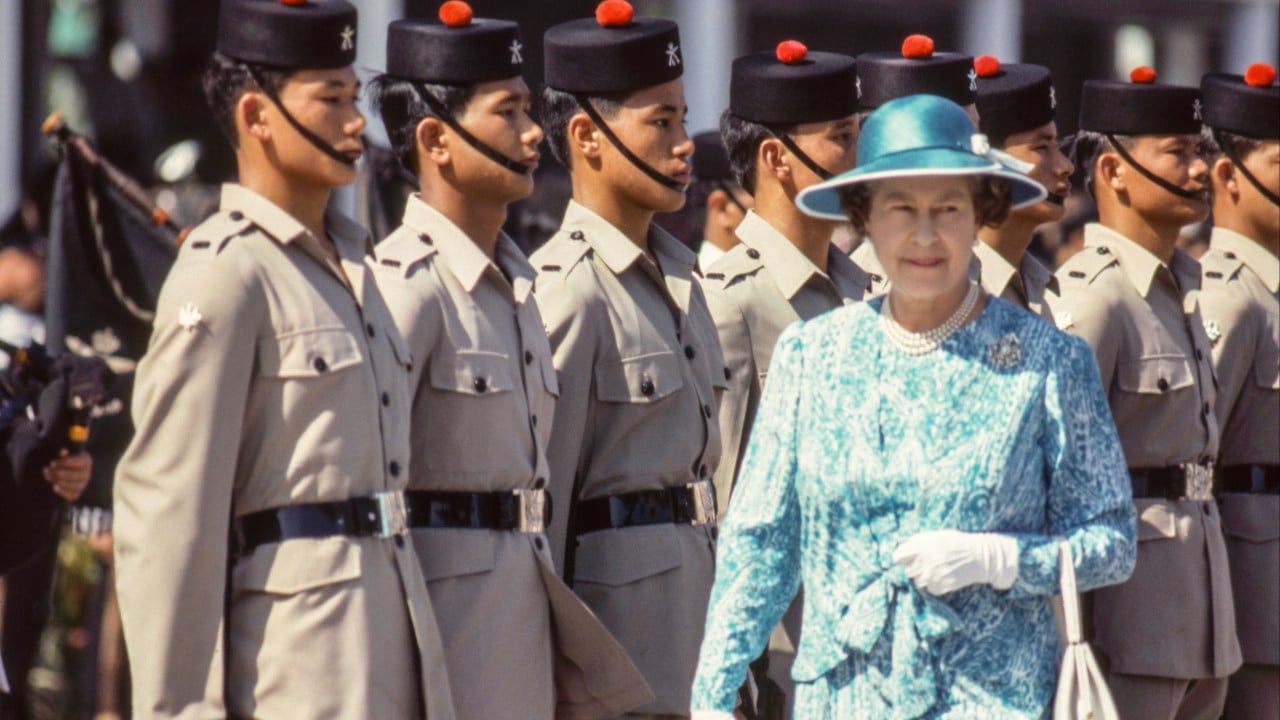
Queen Elizabeth II's single-day return to Hong Kong on October 21, 1986, functioned less as a ceremonial reprise of her 1975 tour and more as a calibrated political decompression valve following her landmark state visit to mainland China.
A standard archival retrospective treats royal tours as nostalgic checklists: arrivals, parades, racecourse appearances, and waves to cheering crowds. That framing obscures the structural mechanics of late-imperial statecraft. Between May 1975 and October 1986, Hong Kong's constitutional horizon shifted irreversibly. The signing of the Sino-British Joint Declaration in 1984 locked in a fixed calendar toward July 1, 1997, transforming British administration from an open-ended mandate into a time-bound transition. Reading the October 1986 stop through institutional signaling, diplomatic sequencing, and domestic reassurance reveals why a one-day itinerary carried disproportionate strategic weight.
Deconstructing Standard Archival Narratives
Archive-driven coverage typically relies on a linear sequence of events: the Queen and Prince Philip completed their tour of mainland China, arrived aboard the Royal Yacht Britannia, attended civic and sporting engagements—including the Sha Tin Racecourse—and departed for London after ten years remained on the colonial clock.
The first limitation of this narrative is its treatment of time. A multi-day tour in 1975 allowed the Crown to project permanence and everyday civic integration across public housing estates, street markets, and community institutions. Compressing the 1986 visit into a single day after a seven-day tour of mainland cities (October 12–18, 1986) changed the signal. Hong Kong was no longer the sole focal point of imperial presence in East Asia; it was now a stopover in a broader diplomatic realignment that included formal engagement with Beijing.
The second limitation is the separation between ceremonial spectacle and constitutional reality. Observers often conflate royal popularity with executive authority. In constitutional monarchy, the sovereign does not negotiate treaty clauses or set sovereignty timelines. Yet ceremonial authority serves an operational purpose: it stabilizes expectations among citizens, civil servants, and commercial actors when formal legal sovereignty is already scheduled to change hands.
The Three Pillars of the 1986 Itinerary
To understand how a brief appearance absorbed complex pressures, the visit can be broken into three interlocking functions: sovereign legitimacy transfer, institutional continuity, and civic reassurance.
Sovereign Legitimacy and Post-1984 Sequencing
Signing the Sino-British Joint Declaration in 1984 established the framework for Hong Kong's return to Chinese sovereignty in 1997. By October 1986, the question was no longer whether sovereignty would transfer, but how smoothly institutions and confidence would carry through the intervening decade.
Preceding the Hong Kong stop with the first visit by a reigning British monarch to the People's Republic of China altered the diplomatic hierarchy. In Beijing and other mainland cities, British statecraft engaged directly with the incoming sovereign power. Arriving in Victoria Harbour immediately afterward signaled that London's engagement with Beijing and its continuing administration in Hong Kong were meant to run on parallel, non-adversarial tracks during the transition window.
Institutional Continuity and Civic Anchors
A single-day schedule forces strict prioritization. Rather than attempting broad geographical coverage across the territory, the 1986 program anchored itself around recognizable civic and institutional touchstones—such as formal appearances alongside Governor Sir Edward Youde, engagements tied to local education and technology such as Hong Kong Polytechnic, military remembrance at the Cenotaph, and high-visibility public culture at Sha Tin Racecourse.
Each venue performed a distinct institutional role:
- Executive and diplomatic alignment: Appearing with the Governor reinforced the chain of administrative authority operating under the Joint Declaration framework.
- Human capital and modernization: Highlighting technical and community education underscored Hong Kong's value as a functioning, modernizing economy whose competitiveness depended on skilled local talent.
- Historical memory and social order: Ceremonial remembrance and mass leisure events such as horse racing tapped into established civic rhythms that predated and would outlast specific political arrangements.
Psychological Reassurance Under Uncertainty
Public sentiment in mid-1980s Hong Kong combined pragmatism with anxiety over long-term governance, rule of law, and personal autonomy. Crowds lining the harbor and streets were not merely watching pageantry; they were reading body language, protocol, and tone for signals of British commitment during the remaining eleven years.
This creates a measurable tension in late-colonial visits. Too little visibility risks making residents feel abandoned prior to 1997; overpromising permanence contradicts the legal reality of the Joint Declaration. A tightly bounded one-day visit navigated that narrow band by offering warmth and recognition without manufacturing false illusions of indefinite British rule.
Cause-and-Effect Chains Archival Summaries Miss
Surface accounts list what happened without tracing why certain constraints produced specific outcomes.
Why the Mainland Tour Preceded Hong Kong
Had the monarch visited Hong Kong first and traveled to mainland China afterward, the narrative arc would have read as a retreat from British territory toward a rival capital. Reversing the sequence—visiting mainland China first and stopping in Hong Kong on the return leg—framed Hong Kong as a vital bridge within a wider regional relationship.
This sequencing carries a trade-off. Because the mainland tour carried historic first-time diplomatic weight, media and political attention in 1986 was split across two distinct theaters rather than concentrated exclusively on Hong Kong as in 1975. The analytical cost of broader strategic integration was narrower domestic spotlighting.
Why Duration Contracted Between 1975 and 1986
In 1975, Hong Kong's future status was not governed by a signed bilateral handover agreement with a fixed expiration date. Long-form engagements suited a posture of ongoing governance. By 1986, Britain's strategic objective was orderly stewardship until 1997 rather than indefinite territorial extension.
Shorter duration matched that objective. A prolonged visit could have amplified expectations of a British backstop that London was not constitutionally positioned to guarantee post-1997. Keeping the stop concise aligned symbolic presence with legal realism.
Known Facts Versus Educated Hypotheses
Separating verified historical record from analytical interpretation prevents overreach.
Known facts include the timing of the visits (May 1975 and October 1986), the 1984 Sino-British Joint Declaration setting the 1997 sovereignty transfer, the monarch's 1986 tour of mainland China prior to arriving in Hong Kong aboard the Royal Yacht Britannia, and public appearances involving local institutions, Governor Edward Youde, and Sha Tin Racecourse.
Educated hypotheses include interpreting crowd enthusiasm as a proxy for specific political preferences, treating single-day attendance figures as proof of long-term confidence in post-1997 arrangements, or assuming that ceremonial warmth translated into leverage over Beijing's future policies. Crowds gather for spectacle, curiosity, and civic tradition as much as for geopolitical endorsement; treating attendance as a single-variable referendum overstates what event observation can prove.
Method for Analyzing Archival Historical Coverage
When auditing or writing historical features based on newspaper archives—whether evaluating legacy coverage or building a competing editorial asset—apply a four-step analytical workflow:
- Isolate the structural inflection point. Identify the treaty, policy shift, or calendar constraint that changed the rules between earlier events and the focal event (here, the 1984 Joint Declaration and the 1997 deadline).
- Map the sequencing and scope. Compare duration, travel order, and institutional stops against prior baselines to see what expanded, contracted, or shifted in priority.
- Separate symbolic signaling from formal power. Specify what ceremonial figures could influence (morale, diplomatic tone, public visibility) versus what required executive or legislative action.
- Audit evidentiary boundaries. Label what archival photos, itineraries, and contemporary reports prove directly, and state clearly where causal claims rely on inference.
This method has clear limits. Archival clips and photo captions capture curated public moments; they rarely record private diplomatic cables, cabinet trade-offs, or quiet household decisions about emigration and capital allocation. Over-relying on visual archives without structural context turns complex political transitions into costume drama.
Strategic Editorial Play
For any publication, brand, or research team revisiting the 1986 Hong Kong royal visit, do not compete with nostalgic photo galleries on sentiment alone. Build a comparative transition dossier pairing the 1975 and 1986 itineraries side by side against the 1984–1997 policy timeline, explicitly distinguishing documented public appearances from broader geopolitical inference. Positioning archival reporting as a structured study of how ceremonial institutions operate during a fixed political countdown turns a routine throwback into an enduring reference asset.
When Queen Elizabeth visited Hong Kong and mainland China
This archival video clip provides direct visual context on Queen Elizabeth II's 1986 visit to Hong Kong alongside her tour of mainland China, complementing the historical analysis above.