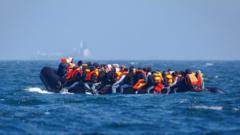
Every time bodies wash up on the shores of northern France or make the grim headlines off the coast of Kent, the political theater plays out with predictable, nauseating precision. The media wrings its hands. Politicians stand behind podiums, furrow their brows, and chant the exact same tired phrase: we need to stop the boats. They demand tighter security, heavier naval patrols, more drone surveillance, and millions more funneled into border defense.
The lazy consensus is that geography and unyielding cartels are driving this crisis. The narrative assumes that if you just build a higher wall, deploy a faster cutter, or pay border guards a larger retainer, the problem will evaporate.
That theory is not just wrong. It is lethal.
The conventional focus on stopping small boats treats the symptom while aggressively mutating the disease. Every single time governments throw money at border enforcement without creating legal, accessible pathways for movement, they do not deter desperate human beings. They simply force those human beings into the hands of more ruthless criminal syndicates, using flimsier vessels, in worse weather, across deadlier shipping lanes.
Let us look at the actual mechanics of what happens when you militarize a maritime border.
The Economics of Prohibition
I have spent years analyzing illicit supply chains and high-stakes logistics under pressure. Basic economic principles do not vanish just because human lives are on the line. When you increase the enforcement risk on a contraband route—and make no mistake, human smuggling operates on identical market curves as narcotics or prohibition-era alcohol—you do not eliminate demand. You dramatically drive up the price and professionalize the supply chain.
When border security in Calais or Dunkirk tightens up, the cost of a crossing goes up. Smugglers respond by stuffing twice as many people into lower-quality inflatable dinghies with zero safety gear. They use cheap, disposable outboard motors. They launch at night, in the fog, directly into the busiest commercial shipping channel on the planet, because the increased naval presence forces them to take insane risks to avoid interception.
Imagine a scenario where a local police department decides to crack down on illegal street racing by doubling the number of spiked road hazards on a particular highway. Do racers stop driving fast? No. They turn off their headlights and drive twice as fast down dark side streets to avoid the traps, turning a minor traffic infraction into a mass casualty event.
That is what modern border policy does in the English Channel. Every additional cutter deployed by the Home Office acts as a catalyst for greater recklessness.
The Fallacy of Deterrence
Politicians love the word deterrence. It sounds tough. It projects strength. But deterrence only works on rational actors who have viable alternatives.
Ask yourself a brutal question: If someone is fleeing active persecution, systemic state collapse, or absolute destitution, does a warning sign about a choppy stretch of water change their calculus? When your baseline is zero future, a thirty percent chance of drowning on a rubber raft looks like a rational lottery ticket compared to staying put.
The current debate completely ignores the fundamental laws of human desperation. We keep asking: How do we make the journey harder?
That is the wrong question.
The correct question is: Why are we forcing desperate people to use a logistical network run by violent criminals in the first place?
By refusing to issue humanitarian visas or process asylum claims outside of mainland territory, governments have effectively outsourced the entire migration management system to human traffickers. The cartels have a guaranteed monopoly. They do not need to advertise. Western governments are doing their marketing for them by making the legal options non-existent.
Dismantling the Status Quo
If we want to stop people from dying in the English Channel, we have to do something that makes orthodox politicians hyperventilate. We have to dismantle the border enforcement complex as it currently stands and replace it with friction-free processing at the point of origin.
- Open Processing Hubs Abroad: Allow individuals to apply for asylum or work visas at embassies and dedicated centers in source and transit countries. If a person can board a commercial ferry or a budget airline with a proper document, the smuggling market collapses overnight. Zero dinghies. Zero midnight launches. Zero drowning statistics to exploit on the nightly news.
- Shift Capital from Walls to Infrastructure: Take the billions currently wasted on offshore contracts, thermal cameras, and police overtime, and reinvest it into rapid adjudication systems. The backlog exists because the system is intentionally designed to be bureaucratic quicksand.
- Legalize Movement, Decimate Cartels: Prohibition created Al Capone. Maritime militarization created the modern Channel smuggling barons. The moment you introduce a legal, safe alternative, you strip the criminal networks of their leverage, their revenue, and their victims.
The people pointing fingers at the shores of northern France while demanding more armed patrols are not trying to save lives. They are trying to save face. They want the optics of control while ignoring the body count their policies generate.
Stop funding the drowning machine. Open the doors.