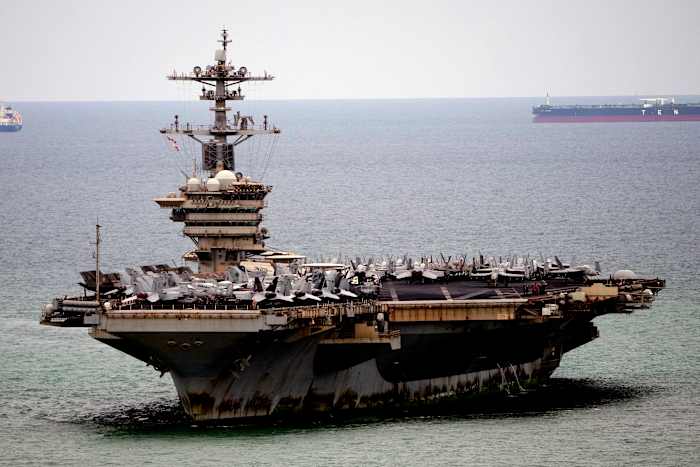
Another port call makes headlines. The USS Abraham Lincoln pulls into Thailand, media outlets breathlessly report on diplomatic goodwill, crew R and R, and the sheer jaw-dropping tonnage of American power projection sliding into a friendly harbor. The lazy consensus among defense analysts treats this routine transit as proof of enduring regional dominance.
It is nothing of the sort.
I spent over a decade tracking naval logistics and defense procurement, and I have watched defense bureaucrats pump infinite cash into floating relics while ignoring the brutal physics of modern anti-access architecture. Every time a Nimitz-class carrier pulls into Laem Chabang or drops anchor somewhere exotic, the defense press treats it as a flex. The reality is far darker. We are parading 1980s architecture through contested waters while cheap, land-based precision guidance systems wait for the math to catch up.
Let us strip away the PR gloss of port visits and look at the ledger.
The Arithmetic of Obsolescence
A nuclear-powered aircraft carrier does not travel alone. It brings a Carrier Strike Group, a floating city of destroyers, cruisers, and supply ships carrying thousands of sailors and billions of hardware dollars. The narrative says this is a deterrent. The deployment schedule says it is a stretched rubber band.
When the Lincoln shifts from the Middle East to the Indo-Pacific, defense commentators talk about strategic pivots as if moving a chess piece across a felt board. They ignore the wear and tear on the airframes, the reactor maintenance cycles, and the crew burnout. More importantly, they ignore the hypersonic elephant in the room.
Imagine a scenario where a conflict breaks out within a first-island-chain scenario. You have a hundred-thousand-ton floating airfield packed with aviation fuel, ordnance, and four thousand service members sitting inside the engagement envelope of land-based anti-ship ballistic missiles. These weapons do not need to punch through armor to win; they just need to mission-kill the flight deck. One well-placed impact turns a floating fortress into an expensive salvage operation.
The defense establishment loves to talk about layered defense, Aegis combat systems, and electronic warfare magic. But the cost asymmetry is catastrophic. Intercepting a barrage of modern maneuvering re-entry vehicles or anti-ship cruise missiles drains magazine depths faster than supply chains can replenish them. You are firing multi-million-dollar interceptors at fraction-of-the-cost saturation weapons. That is not a strategy. That is a bank run.
The Port Call Charade
Why do we keep doing the port visits? Because diplomacy requires theater.
When a carrier docks in Thailand, it is not projecting tactical deterrence against high-end peer competitors. It is reassuring regional partners who are quietly hedging their bets between Washington and Beijing. It is sailors buying cheap beer and getting shore leave. These are human and diplomatic functions, not tactical victories.
Conflating diplomacy with combat capability is how militaries sleepwalk into disasters. The press release treats the Lincoln arrival as a shift in the regional balance of power. The Thai naval strategists watching from the pier know better. They understand that surface action groups close to mainland industrial bases are living on borrowed time when regional powers achieve local missile supremacy.
We cling to the carrier because it represents a comforting psychological anchor. It looks imposing on a morning news broadcast. It is a physical manifestation of American reach. But war does not care about your aesthetic nostalgia.
What Actually Matters in Modern Naval Combat
If you want to understand where naval warfare is going, stop looking at displacement tonnage and start looking at distributed lethality, autonomous surface vessels, and subsurface supremacy.
The future belongs to things that can hide, disperse, and strike from unexpected vectors. A massive carrier group is a beacon. It emits electromagnetic radiation that can be tracked from space, leaves a thermal wake, and demands constant logistical umbilical cords.
Compare that to an integrated network of long-range strike platforms, unmanned underwater drones, and mobile land-based coastal defense batteries. Which one survives the opening forty-eight hours of a peer conflict?
The defense contractors will never admit this because their quarterly earnings depend on building multi-billion-dollar steel leviathans that take seven years to construct and three days to become strategically obsolete. The admirals will not say it out loud because their entire career path, culture, and institutional prestige are tied to the flight deck.
So the Lincoln docks in Thailand. The band plays. The sailors hit the beach. And the defense establishment pretends the world hasn't fundamentally changed beneath their feet.
The next real naval conflict will not be decided by how many F-35s can launch off a teakwood-flat deck in a designated theater. It will be decided by who managed to stop fighting the last war before the next one started. Right now, our bet is still on the floating target.