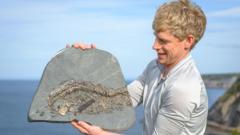
When a routine fossil hunting expedition on an eroding coastal cliff yields an ichthyosaur, the academic community sits up straight. When that discovery is made by a mountaineer whose life was radically re-engineered by a near-death experience, the narrative shifts from simple paleontology to something far more profound. This is the story of how an amateur eye, sharpened by trauma and a newly found obsession with survival against the odds, spotted the fossilized silhouette of a prehistoric marine predator eroding from ancient shale.
Most people walk past ancient rock formations seeing only gray stone and random lines. They miss the macro-indicators of geological time. They fail to recognize how a shift in coastal erosion exposes millions of years of marine history in a single afternoon.
The Anatomy of a Sea Dragon
Ichthyosaurs are frequently mischaracterized as swimming dinosaurs. They are not. They are marine reptiles that converged on a dolphin-like body plan independently of both fish and cetaceans. Their evolution stands as one of nature's most staggering examples of evolutionary adaptation.
To understand the magnitude of this recent find, one must examine the fossilization process itself. Soft tissue preservation in marine reptiles is exceptionally rare. Most skeletons scatter across the ancient sea floor before sediment can cap them. Scavengers tear apart carcasses, and wave action grinds bones to powder long before mineralization can occur.
When a complete or near-complete ichthyosaur emerges from a cliff face, it represents a very specific sequence of prehistoric events.
- Rapid burial in anoxic sediment deprived of oxygen.
- Gradual replacement of organic bone material by minerals over tens of millions of years.
- Tectonic uplift that pushes ancient sea floors thousands of feet into the air.
- Modern coastal erosion that finally strips away the overburden to expose the fossil.
The mountaineer at the center of this discovery understood altitude, topography, and the way brittle rock fractures under stress. Those climbing skills translate directly to fossil prospecting. Both disciplines require reading vertical faces, identifying handholds that might break, and understanding how environmental forces reshape physical structures over time.
The Psychological Shift of Trauma and Discovery
Severe trauma changes how a human brain processes sensory input. Survivors of near-death experiences frequently report an intense hyper-focus on their immediate environment, a shedding of trivial anxieties, and a hyper-awareness of the present moment.
When you stare down your own mortality on a mountain ledge, your relationship with time alters permanently. You begin to think in epochs rather than calendar weeks. That psychological shift makes individuals remarkably receptive to deep time. Standing before a wall of Jurassic shale becomes less about finding an object and more about connecting with an immense, indifferent timeline that existed long before human fragile existence began and will continue long after it ends.
Amateur fossil hunters uncover a staggering percentage of significant paleontological finds worldwide. Professional institutions simply do not have the manpower to monitor every crumbling kilometer of coastline or every inland quarry. Coastlines shift constantly. Winter storms batter cliffs, bringing down tons of rock overnight and revealing treasures that were safely entombed twelve hours prior.
This creates a dynamic partnership between citizen scientists and academic institutions. Yet, tension often exists. Academics worry about amateur collectors damaging specimens or failing to record precise stratigraphic data. Conversely, amateurs sometimes feel dismissed by credentialed researchers who view them as untrained interlopers rather than essential boots on the ground.
That friction diminishes when an amateur follows proper protocols. Spotting a bone fragment weathering out of a cliff requires immediate restraint. Digging it out with a pocketknife destroys context. The proper procedure demands leaving the specimen in place, noting GPS coordinates, photographing the context, and notifying regional paleontologists immediately.
Reading the Jurassic Record
The rock strata hiding these prehistoric marine reptiles tell a grim story of ancient oceans. During the Jurassic period, much of what is now dry land lay submerged beneath shallow, warm seas teeming with life.
These waters were not peaceful tropical paradises. They were hyper-saline, oxygen-depleted zones where marine reptiles hunted squid, fish, and smaller ichthyosaurs. When these creatures died, they sank into the murky benthic layer where scavengers could not survive due to the lack of oxygen.
That lack of oxygen saved them.
Every time a major storm hits modern coastlines, it accelerates the erosion of these ancient mudstones. The ocean takes back what it laid down millions of years ago, grinding cliffs into sand and occasionally liberating a rib cage, a vertebra, or an entire skull.
The mountaineer who found this specific specimen was scanning the cliff base not for climbing routes, but for symmetry. Nature rarely draws straight lines or perfect circles. When a series of vertebral discs appears in cross-section within a block of limestone, the geometry stands out against the chaotic texture of the stone.
The Ethics and Economics of Fossil Recovery
Fossil collecting exists in a complex legal and ethical gray area. On private land, fossils generally belong to the landowner, opening the door to commercial sales where rare specimens command six-figure sums from private collectors. On public lands, stringent regulations often govern collection, requiring permits and mandating that significant finds remain accessible to science.
When a commercial collector beats researchers to a rare marine reptile, science loses. Unique anatomical features, stomach contents that reveal diet, or embryonic fossils preserved inside pregnant females can be locked away in a private vault where researchers cannot study them.
The mountaineer did not sell the find. Recognizing the historical weight of the object, the discoverer contacted museum curators, ensuring the fossil would be properly excavated, prepared, and housed in a facility where future generations could study it.
Preparation alone takes months, sometimes years. Technicians working with pneumatic air scribes under microscopes chip away microscopic grains of matrix from fragile bone. A single mistake can shatter a skull that survived millions of years underground.
The Enduring Mystery of the Deep Past
We look at these fossils and project our own fears of extinction and deep time onto them. We marvel at their size, their speed, and their adaptation to an alien world.
Yet, the ocean that birthed these creatures is returning to haunt modern coastlines through rising sea levels and accelerated erosion. The very forces destroying our beaches are the ones unearthing the ghosts of the Jurassic.
The cliff will continue to crumble. More stone will fall into the surf. Somewhere out there, another rock face is splitting open right now, waiting for an eye trained to look past the surface and into the deep, dark history of the earth.