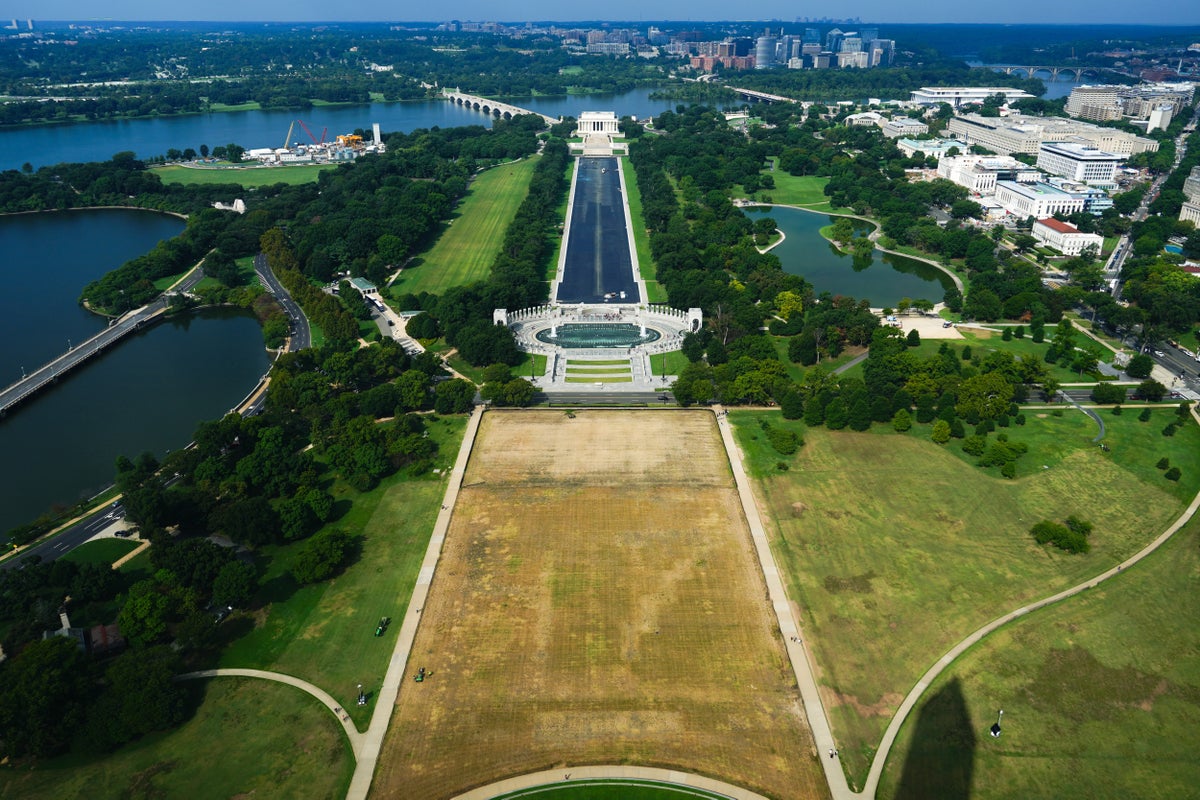
Every time a politician touches grass, urbanists lose their minds. The internet is currently hyperventilating over Washington D.C. shutting down yet another section of the National Mall for renovations, framing it as an authoritarian tantrum born from past event scars. They call it a closed-off public asset. They scream about pedestrian displacement. They act like putting a chain-link fence around decaying turf is a crime against civic freedom.
They are entirely, breathtakingly wrong.
I have spent the last fifteen years advising municipal governments on high-density public space management. I have watched cities blow millions of dollars trying to maintain civic lawns that were never engineered to withstand the modern tourist crush. The lazy consensus among commentators is that public space must remain constantly open, raw, and accessible at all costs, as if asphalt and turf possess magical self-healing properties.
That is not public stewardship. That is municipal neglect masquerading as populism.
The Myth of Permanent Accessibility
The core fallacy driving the outrage against the National Mall closure is the belief that high-traffic public real estate can survive a continuous, unmitigated beating without structural collapse. Walk the central axis of the Mall on any random Tuesday in July. You are not experiencing a vibrant public square. You are witnessing an ongoing ecological disaster. Soil compaction from millions of annual footsteps chokes out root systems. Drainage systems installed during the Eisenhower administration buckle under the weight of mobile food vendors, security infrastructure, and massive crowds.
When a city closes a zone for heavy-duty infrastructure overhaul, people act like their constitutional rights have been revoked. This is amateur hour thinking. Public spaces are not pristine monuments that stay frozen in time through good vibes alone. They are heavy industrial zones disguised as parks. They require engineering interventions, sub-surface drainage re-routing, soil aeration, and hardscape reinforcement.
If you do not take the asset offline, you cannot fix it. You just slap cosmetic sod over mud pits and call it a day. That cycle of perpetual cheap fixes is what drains municipal budgets.
What the Critics Miss About Foot Traffic Dynamics
Let us look at the data governing crowd management in federal districts. The National Mall handles roughly thirty-five million visitors a year. For context, Yellowstone National Park—spanning over two million acres—sees around four and a half million. The Mall packs a visitor volume seven times higher than a major national park into a tight, two-mile strip of urban green space.
Under those conditions, traditional park management models fail instantly. Turf management experts know that grass subjected to more than ten thousand foot-passes per week requires structured rest cycles to survive. Without closure periods, the soil turns to concrete, water runoff accelerates, and the entire ecosystem dies off, leaving behind bare dust bowls that turn into mud slicks at the first autumn rain.
Closing a segment isn't a political punishment. It is basic agronomy.
Imagine a scenario where a major downtown highway bridge shows severe structural fatigue. You would expect the Department of Transportation to close lanes, rip up the concrete, and rebuild the deck, regardless of how much commuters complain about traffic jams. Yet, when the exact same structural logic is applied to the nation’s front yard, people throw tantrums because they cannot jog past a specific monument for six months.
The Cost of Aesthetic Nostalgia
We suffer from a collective nostalgia for a National Mall that never actually existed in the form we romanticize. The wide-open, pastoral lawn vision popularized by the McMillan Plan was designed for an era when Washington D.C. moved at a horse-and-buggy pace and hosted a fraction of its current population.
Today, the Mall functions simultaneously as a protest ground, a tourist thoroughfare, a security buffer, and an outdoor museum. It is a multi-use engine taking a relentless beating from every direction. Treating it like an untouchable sacred artifact prevents it from being upgraded to handle the realities of the twenty-first century.
Better drainage. Hardier turf cultivars. Embedded utility conduits that stop vendors from ripping up the grass to hook up temporary generators. These are the boring, unsexy upgrades that keep a public space functional. You cannot install smart irrigation grids or underground electrical vaults while thousands of tourists are tripping over your backhoes.
The Uncomfortable Truth About Public Ownership
Here is the part nobody in the activist class wants to admit: absolute, unrestricted access destroys the very thing people claim to love. When a resource is free and open to everyone without limits, it suffers from the classic tragedy of the commons. Nobody takes responsibility for the degradation because everyone assumes the government will magically keep it green.
When the administration puts up construction barriers, they are forcing a reset. They are taking the hit on short-term aesthetic disruption to secure long-term structural viability. It is a high-friction decision, and yes, it causes logistical headaches for local event planners and weekend visitors. But the alternative is watching the heart of the capital devolve into a degraded, dusty wasteland that requires emergency remediation every single election cycle.
Stop treating routine urban infrastructure maintenance as a political conspiracy. Sometimes a fence is just a fence, and letting the grass recover is the smartest thing a government can do.



