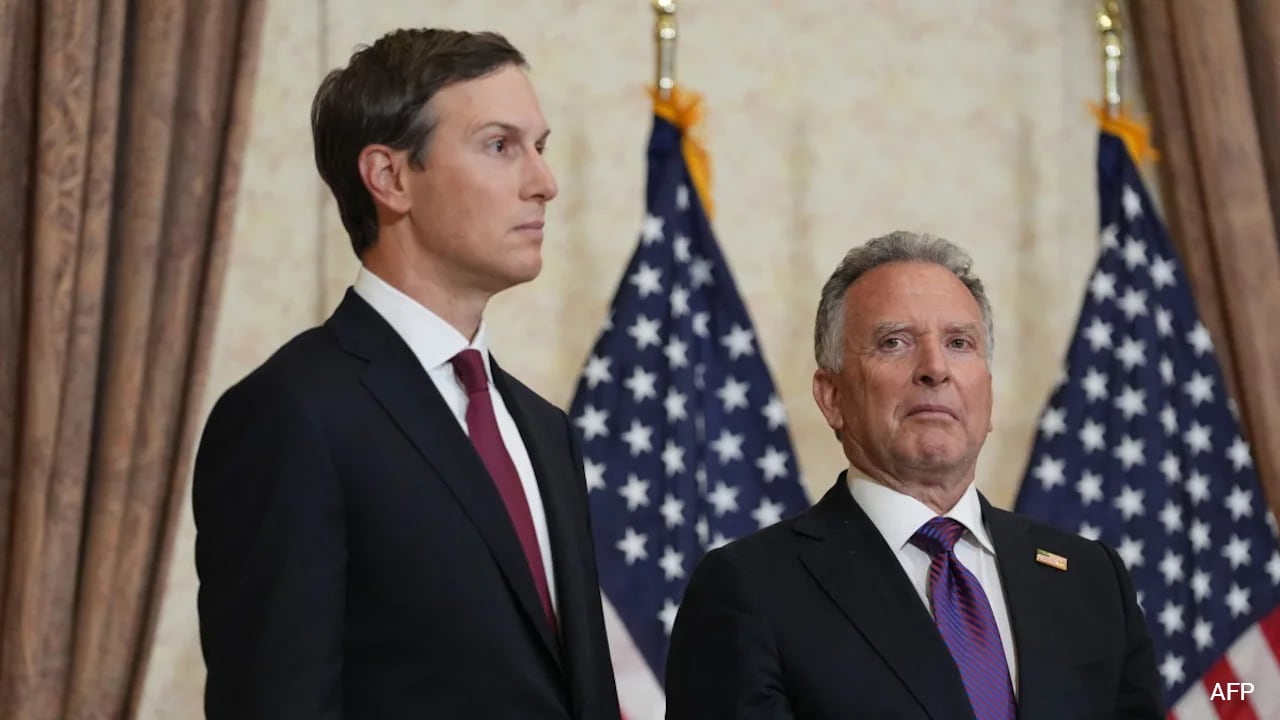
The resumption of high-level shuttle diplomacy by United States envoys Steve Witkoff and Jared Kushner, structured around a coordinated circuit to Moscow and Kyiv, represents a renewed attempt to break a protracted negotiation freeze. Standard media commentary frames this initiative through the lens of political personalities and sudden executive intent. A rigorous structural analysis, however, requires deconstructing the underlying strategic variables, the cost functions of the primary actors, and the systemic barriers preventing a durable settlement.
The Strategic Incentive Matrix
To understand why this diplomatic intervention is occurring now, one must map the utility functions of the three central nodes: Washington, Moscow, and Kyiv. Also making news in related news: Southern Lebanon Under Fire The Escalating Cost of Border Warfare.
The United States administration operates under a political cost function that penalizes prolonged, stagnant foreign conflicts, prioritizing the diplomatic closure of major external crises. For Washington, an active peace proposal functions as an instrument of signaling. It demonstrates diplomatic momentum, even when structural prerequisites for agreement are absent.
Moscow's calculus is governed by asymmetric endurance. The Kremlin evaluates the conflict through territorial accumulation and macroeconomic resilience against sanctions. While high casualty rates and infrastructural degradation from long-range drone strikes impose domestic friction, Russian leadership continues to price these costs below its minimum settlement terms. Those terms require structural concessions regarding Ukrainian sovereignty and territorial disposition that currently exceed what Kyiv can accept without systemic political collapse. Further details regarding the matter are covered by The Guardian.
Kyiv faces an existential optimization problem. President Volodymyr Zelenskyy's provisional offer of a reciprocal, localized suspension of aerial hostilities during the envoys' visit highlights Ukraine's operational alignment with Western mediation efforts. Yet, Ukraine's strategic boundary remains defined by the necessity of enforceable security guarantees. Without a credible Western backstop capable of deterring future military resumption, any paper agreement functions merely as a tactical operational pause for the adversary.
The Mechanics of the Stalled Framework
Negotiations between Russia and Ukraine have repeatedly broken down along specific structural fault lines.
Territorial control of the Donbas region remains the primary zero-sum variable. Moscow's operational baseline demands full administrative and military control over territories it only partially occupies, viewing this outcome as a non-negotiable minimum requirement to validate the conflict's human and economic expenditure. Conversely, Kyiv's legal and political architecture treats territorial integrity as an invariant.
Security architecture creates the secondary point of failure. A functional peace requires an enforcement mechanism. Proposals involving a coalition of international partners to provide postwar security guarantees collide directly with Russian strategic objectives, which historically demand the permanent limitation of Western military integration along its borderlands.
Information Asymmetry and Signaling
Recent intelligence and diplomatic maneuvers—including the preceding visit to Moscow by Central Intelligence Agency Director John Ratcliffe—indicate that Washington has attempted to communicate the permanence of certain geopolitical boundaries directly to the Russian security apparatus. Despite these high-level channels, signaling has failed to alter battlefield behavior. The intensification of high-profile aerial strikes against urban infrastructure in Kyiv and regional hubs demonstrates that escalation remains the preferred instrument for shaping the pre-negotiation environment.
When diplomatic envoys engage in dual-capital circuits without a prior convergence on foundational terms, the intervention risks serving as an information-gathering exercise rather than a settlement mechanism. Both belligerents utilize the presence of high-level intermediaries to test the other's resolve, calibrate domestic messaging, and manage relationships with external patrons, rather than to alter core strategic demands.
Execute diplomatic engagement through parallel, low-visibility technical working groups focused exclusively on localized disengagement zones and technical verification protocols, decoupling immediate humanitarian corridors from the intractable political disposition of disputed provincial boundaries.
Trump Envoys Witkoff And Kushner Set To Visit Moscow, Kyiv
This video provides contemporary context regarding the diplomatic deployment of Steve Witkoff and Jared Kushner to Moscow and Kyiv to revive stalled negotiation frameworks.
http://googleusercontent.com/youtube_content/1