The pre-dawn air in Gaza used to carry the scent of fried eggs, warm pita, and the heavy, sweet aroma of sage tea. It was the smell of Suhoor—the final meal before the sun claims the day and the fast of Ramadan begins. In the Abu Al-Naja household, this hour was usually a chaotic symphony. There was the scraping of chairs, the rhythmic thumping of a toddler’s heels against a table leg, and the hushed, urgent whispers of elders discussing the day’s chores.
This year, the silence is physical. It has a weight. It sits in the corners of the room like a thick layer of dust that no amount of sweeping can clear.
Ramadan is traditionally a month of presence. It is the period where the "we" triumphs over the "I." But for those left behind after a single Israeli airstrike dismantled a family lineage in an instant, the holy month has become a grueling exercise in counting the missing. When you lose thirty members of your kin in a flash of heat and grey concrete, the calendar stops being a guide for prayer and starts being a ledger of ghosts.
The Anatomy of an Instant
Statistics are easy to digest because they are cold. We hear a number—thirty dead, seventy injured, thousands displaced—and the mind categorizes it under "tragedy" before moving on to the next headline. But a family is not a statistic. A family is a complex web of inside jokes, shared debts, hereditary cowlicks, and the specific way a grandmother seasons her lentil soup.
When a missile strikes a residential block, it doesn't just collapse floors. It severs those invisible threads.
Consider the "hypothetical" survivor—though in Gaza, he is anything but hypothetical. Let’s call him Bassem. Bassem wakes up at 4:00 AM by habit. His hand reaches out to wake his brother, a man he has shared a room with for twenty years. His fingers meet cold air and tattered wallpaper. The strike didn't just take his brother; it took the person who remembered the childhood story about the lost goat. It took the only person who knew why Bassem feared the sound of low-flying planes long before this war began.
The strike on the Abu Al-Naja family home was one of many that have defined the recent conflict, yet its timing gives it a sharpened cruelty. The strike occurred just as the preparations for the holy month were beginning. Dates were being bought. Lanterns—the colorful fanous—were being dusted off. Then, the sky opened up.
A Hunger That Fasting Cannot Mimic
There is a profound irony in fasting during a famine. Ramadan is designed to teach empathy for the poor, to tether the soul to the physical reality of hunger so that the spirit might grow. But what happens when the hunger is not a choice?
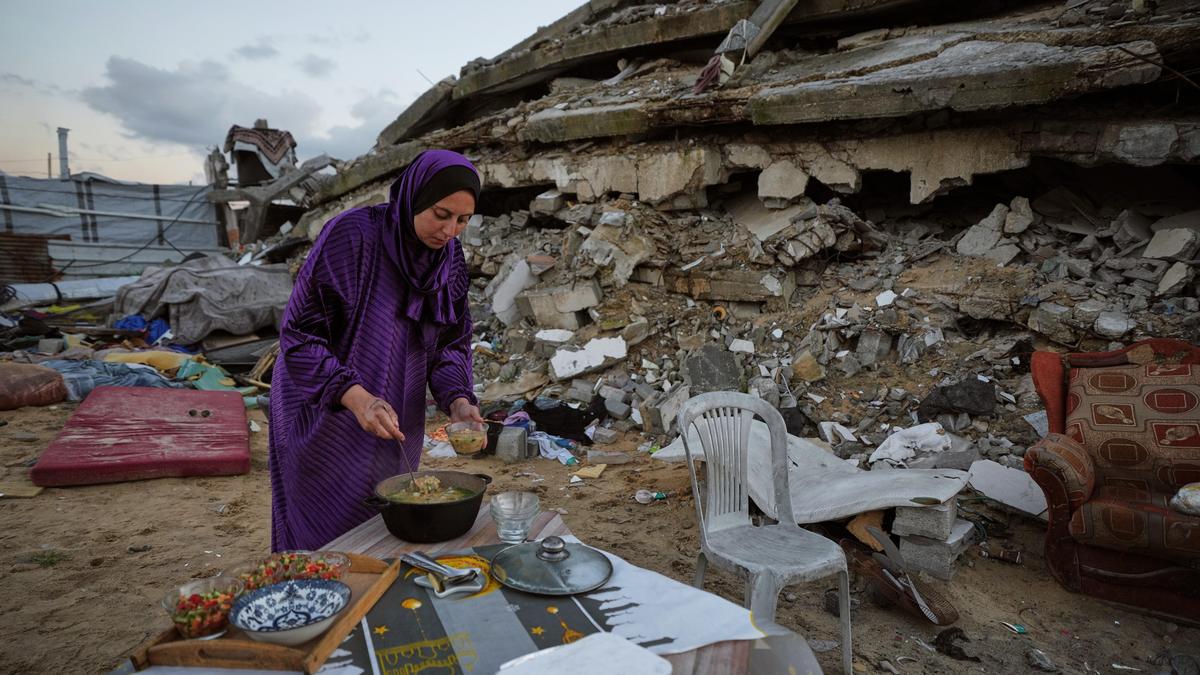
In Gaza, the formal fast of Ramadan is layered over a systematic lack of resources that has pushed the population to the brink of starvation. In the North, families are grinding animal feed to make bread. They are boiling weeds gathered from the sides of cratered roads. When the sun sets and the Maghrib prayer echoes from the few minarets still standing, there is no feast to break the fast. There is only a date, perhaps a cup of cloudy water, and the memory of what a table used to look like.
The stake here isn't just caloric. It’s the erosion of dignity.
To be a provider is a central pillar of identity in this culture. To stand before your children at Iftar with empty hands is a psychological trauma that leaves scars deeper than shrapnel. The "invisible stake" of this season is the slow death of the communal ritual. If you cannot gather, if you cannot feed, if you cannot find safety in the mosque, then the very structures that hold a society together begin to fray.
The Geography of Grief
Grief in a war zone is displaced. Normally, when a loved one passes, there is a graveyard. There is a stone. There is a place to sit and talk to the earth.
In Gaza, the graveyard is often the basement of the house you grew up in. Because of the intensity of the bombardment and the lack of heavy machinery, many bodies remain under the rubble for weeks. The Abu Al-Naja survivors didn't just lose their family; they lost the ability to bury them with the rites the faith demands.
Imagine walking past a mountain of broken concrete every day, knowing your mother is beneath it. You cannot reach her. You cannot wash her according to tradition. You cannot wrap her in white linen. You simply have to keep walking because the drones are still overhead and your remaining children are crying for water.
This is the reality of "collateral damage." It is a term invented by people in air-conditioned rooms to sanitize the act of crushing a dinner party. It ignores the fact that when a patriarch dies, the family’s history often dies with him. When a mother dies, the domestic glue dissolves. The survivors are left as orphans of both their parents and their own futures.
The Psychology of the Remaining
We often talk about resilience as if it is a bottomless well. We praise the "strength" of those who endure. But resilience is often just a mask for exhaustion.
The people sitting in tents in Rafah or huddled in the ruins of Gaza City aren't being "brave" in the cinematic sense. They are trapped in a biological imperative to survive the next ten minutes. The emotional core of this Ramadan is a mixture of resentment and profound loneliness. There is a feeling of being watched by the world as if through a glass screen—a global audience observing a slow-motion extinction while debating the semantics of the word "proportionate."
But the real problem lies elsewhere. It isn't just the lack of food or the threat of the next strike. It is the loss of the "Ordinary."
The Ordinary is a powerful thing. It is the ability to complain about the heat. It is the annoyance of a loud neighbor. It is the boredom of a long afternoon. In Gaza, the Ordinary has been murdered. Every moment is now Loaded. Every sound is a potential threat. Every meal is a miracle.
Beyond the Crescent Moon
As the moon waxes and wanes through this holy month, the survivors of the Abu Al-Naja family—and the hundreds of families like them—face a question that no essay or political speech can answer: How do you rebuild a soul when the foundation is gone?
The answer isn't found in aid trucks, though they are desperately needed. It isn't found in ceasefire negotiations that move with the glacial pace of bureaucracy while children die of dehydration.
The answer is found in the small, defiant acts of humanity that persist despite the ruins. It is the man who finds a single sweet and gives it to a neighbor’s child. It is the woman who leads a prayer in the middle of a tent city, her voice steady even as the ground shakes. It is the refusal to let the silence have the last word.
But even that defiance has a shelf life. Human spirits are made of carbon and memory, not steel.
Tonight, as the sun dips below the Mediterranean horizon, turning the smoke-filled sky a bruised purple, a father will sit down on a plastic mat. He will pour a cup of water. He will look at the empty space beside him where a daughter used to sit, her hair braided, her eyes bright with the anticipation of the holiday.
He will drink. He will pray. And he will wonder if the world knows that when that daughter died, a whole universe disappeared with her.
The chair remains empty. The tea grows cold. The world keeps turning, but in one corner of the map, the light has gone out, and no amount of moonlight can bring it back.