The shadow war is over. For decades, the friction between Israel and Iran was a matter of proxies, cyber-attacks, and "accidents" at enrichment facilities, but the events of the last twenty-four hours have dismantled that playbook. We are no longer looking at a controlled escalation. By launching direct, synchronized strikes across multiple Iranian urban centers, the United States and Israel have fundamentally altered the calculus of Middle Eastern security. Iran’s immediate retaliatory barrage into northern Israel confirms that the era of strategic ambiguity has been replaced by a cycle of high-intensity kinetic warfare. This is not a drill, and it is not a temporary flare-up. It is the beginning of a sustained military confrontation that the global diplomatic apparatus is currently powerless to stop.
The Architecture of the Strike
The operation began under the cover of a moonless sky, utilizing a combination of electronic warfare to blind regional radar and long-range precision munitions. Unlike previous targeted assassinations, this wave focused on the structural backbone of the Islamic Revolutionary Guard Corps (IRGC). Intelligence reports indicate that the primary targets were not just missile silos, but the command-and-control nodes that link Tehran to its regional affiliates.
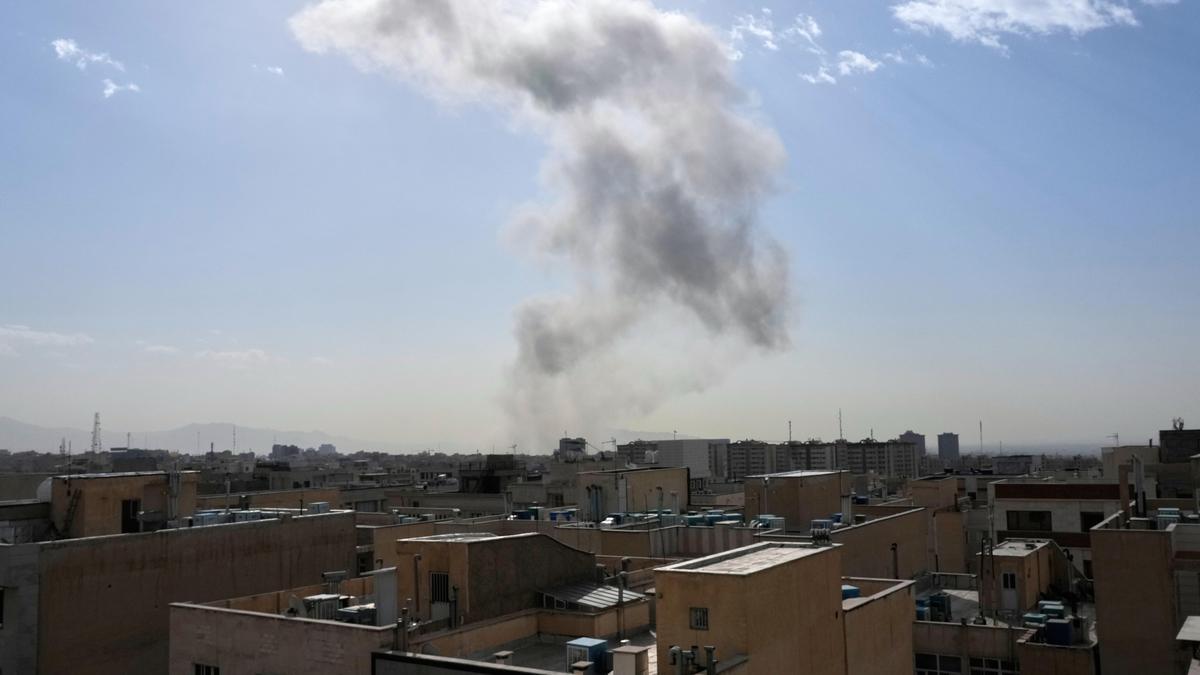
Logistics hubs in Isfahan and military outskirts near Tehran saw the heaviest activity. The choice of targets suggests a specific intent: to degrade Iran’s ability to coordinate a multi-front response. However, the sheer scale of the American involvement marks a departure from the "lead from behind" strategy of previous months. This was a clear demonstration of force designed to do more than just signal. It was meant to break things.
The technical execution involved $F-35I$ Adir jets and U.S. standoff platforms, effectively creating a corridor of air superiority that lasted for nearly three hours. While the Iranian air defense systems—specifically the $S-300$ batteries—attempted to intercept, the sheer volume of incoming fire overwhelmed the aging infrastructure. This was a failure of hardware as much as a failure of intelligence.
Tehran Responds in Kind
Tehran did not wait for the smoke to clear before hitting back. Within ninety minutes of the final wave of Western strikes, the skies over northern Israel were filled with the characteristic orange glow of solid-fuel rockets. These were not the slow-moving Shahed drones that are easily picked off by the Iron Dome. These were medium-range ballistic missiles, launched in clusters to saturate the defense grid.
The Galilee region bore the brunt of the impact. While the Arrow and David’s Sling systems maintained a high interception rate, several warheads breached the perimeter. The message from the Iranian Supreme Council was unambiguous: if you strike the heart of our cities, we will ensure your northern settlements become uninhabitable.
This retaliation serves a dual purpose. Domestically, the regime must show strength to maintain its grip on power. Regionally, it needs to prove to its partners in Lebanon and Yemen that it will not be cowed by a direct hit to its sovereignty. The tragedy of this exchange is that both sides have now crossed lines that were previously considered "red." Once a capital city is targeted, the threshold for what constitutes a "proportional response" disappears.
The Intelligence Gap and the Why Now
Analysts have spent the morning arguing over the timing. Why risk a regional conflagration at this specific moment? The answer lies in the crumbling walls of the nuclear status quo. Recent movements in Iran’s enrichment programs suggested they were weeks, not months, away from a breakthrough that would make them untouchable.
Washington and Tel Aviv likely viewed this as the final window for action. If they waited, any future strike would carry the risk of a nuclear exchange. By moving now, they are betting that they can degrade the IRGC’s conventional capabilities enough to force a pause in the nuclear timeline. It is a high-stakes gamble that ignores the social and political volatility currently ripping through the region.
There is also the matter of the "deterrence vacuum." For the past year, Iran’s proxies have been poking at Western interests with relative impunity. The U.S. military leadership clearly decided that small-scale strikes on warehouses in Syria were doing nothing to change the behavior in Tehran. This shift to a direct offensive is an admission that the previous policy of containment has failed completely.
Economic Aftershocks and the Oil Narrative
The markets are reacting with predictable panic. Brent crude spiked immediately, and shipping insurance rates for the Strait of Hormuz have become prohibitively expensive. This isn't just about the price at the pump in a Western suburb; it is about the total freezing of the energy artery that fuels the global economy.
Projected Market Volatility
| Asset | Immediate Impact | 48-Hour Forecast |
|---|---|---|
| Brent Crude | +8% | High Volatility |
| Gold | +3% | Safe Haven Influx |
| Tech Stocks | -4% | Liquidity Withdrawal |
If Iran decides to fully close the Strait—a move they have threatened for decades—the global GDP could see a contraction not seen since the 1970s. The U.S. knows this. The fact that they proceeded with the strikes anyway suggests they believe the threat of a nuclear Iran is greater than the threat of a global depression. It is a grim hierarchy of fears.
The Myth of Surgical Precision
The term "surgical strike" is a favorite of Pentagon briefers, but it is a lie. There is no such thing as a clean war in a densely populated region. Every missile that misses its mark, and every interceptor that rains debris onto a residential street, creates a new generation of combatants.
Reports coming out of northern Israel describe a civilian population that has spent the last twelve hours in bomb shelters. In Iran, the state media is broadcasting images of destroyed infrastructure to whip up nationalist fervor. The human cost is immediate, but the psychological cost—the total erosion of any hope for a diplomatic off-ramp—is the real casualty here.
We are seeing a collapse of the middle ground. The "moderate" voices in both governments have been sidelined by the hardliners who have been waiting for this fight for years. In this environment, nuanced diplomacy is viewed as treason.
The Role of Global Power Players
Russia and China have been uncharacteristically quiet in the immediate aftermath, likely waiting to see if the situation stabilizes or spirals into a ground war. Russia’s dependence on Iranian drones for its own conflicts makes them a silent partner in Tehran's defense. Meanwhile, Beijing's reliance on Iranian oil puts them in a position where they must eventually intervene, if only to protect their own energy security.
The United Nations is, as usual, a theater of the absurd. Emergency sessions will be called, and strongly worded condemnations will be issued, but the reality is being written in the dirt and the fire of Isfahan and Haifa. The international order, designed to prevent this exact scenario, is currently an observer.
The Inevitability of the Next Wave
What happens tonight? The logic of this kind of conflict demands a "last word." If Israel does not respond to the missiles in the north, they appear weak. If Iran does not respond to the destruction of their IRGC hubs, the regime loses its legitimacy.
This is the "Escalation Ladder" in its most literal form. Each step up feels necessary to those on the ladder, but the top of the ladder is total war. There are no more back-channel negotiators in Muscat or Geneva who can fix this with a signed piece of paper. The hardware has taken over.
Military planners are likely already fueling the next sorties. The drones are being programmed with new coordinates. The cycle is self-sustaining now. It is a cold, mechanical process that ignores the protests of the international community.
The hard truth is that we have entered a period where military force is the only language being spoken. The strikes across Iranian cities and the subsequent retaliation in Israel aren't just headlines; they are the closing of a chapter on forty years of cold war.
Watch the skies over the next forty-eight hours. The frequency and weight of the munitions will tell you more about the future of the Middle East than any press release ever could.
Would you like me to analyze the specific missile defense capabilities being utilized by both sides in this escalation?