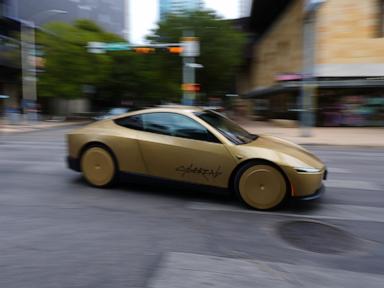
The collective pearl-clutching across automotive media over the National Highway Traffic Safety Administration opening an audit query into Tesla's Cybercab self-certification exposes a fundamental misunderstanding of how hardware transitions actually happen. Watchers are hyperventilating because a vehicle without a steering wheel or pedals hit public asphalt in Austin, and regulators are doing what regulators are paid to do: shuffle paper, demand justifications, and perform procedural theater.
The lazy consensus claims this federal probe is a massive roadblock that threatens to choke Tesla's autonomous ambitions before they leave the starting gate. That panic is amateur hour.
The Bureaucracy Trap
Federal Motor Vehicle Safety Standards were written when humans held round metal hoops to keep rubber on asphalt. When an engineering team strips out the steering wheel, accelerator, and rearview mirrors, they step outside a rulebook drafted decades ago.
Critics cry foul, pointing out that self-certifying compliance without explicit prior bureaucratic blessing is legally audacious. They forget how every single modern transit shift occurred. Zoox spent years begging for customized federal exceptions while burning investor capital at a blistering pace. Waymo scaled at a snail's crawl, hiding behind geofenced safety drivers for half a decade before removing the human element inch by inch.
Tesla bypassed the multi-year waiting room entirely by utilizing self-certification provisions. Whether that legal framework holds up under a microscope is secondary. The audit query is not a ban; it is a bureaucratic stress test. It forces a legal collision between antiquated safety mandates and deterministic autonomy.
The Data Reality
Skeptics love to contrast Tesla’s camera-only approach against competitor reliance on expensive LiDAR sensor suites. They argue that removing redundant mechanical controls without a safety driver is an unacceptable gamble.
Look at the underlying mechanics. Human drivers rely on eyes and biological neural nets. High-definition maps and LiDAR crutches create brittle software systems that choke the moment a construction zone moves a orange cone by three inches. Tesla's fleet-scale neural network learns from millions of edge cases daily. The absence of a steering wheel is not an oversight; it is the logical conclusion of eliminating the single greatest point of failure in a motor vehicle: the distracted human being behind the wheel.
An audit query examining technical compliance data will drag out for months. Bureaucrats will demand documentation on how software handles scenarios traditionally managed by manual overrides. Tesla will hand over petabytes of edge-case telemetry. The process will be noisy, contentious, and heavily reported by outlets desperate for clicks.
The Real Power Dynamic
The investigation changes nothing about the core economic reality. Robotaxi scaling does not depend on whether a mid-level federal regulator likes the absence of a brake pedal. It depends entirely on cost per mile and fleet uptime.
Traditional automakers spend fortunes lobbying for slow, incremental oversight because it protects their legacy manufacturing moats. When a company builds a dedicated two-seater capsule designed strictly for automated point-to-point transit, the old paradigm breaks. Regulators are forced to react to software-defined hardware they structurally cannot comprehend.
Ignore the hand-wringing over compliance paperwork. The transition to driverless transit is not a legal negotiation; it is an engineering steamroller.
Stop watching the regulators chase ghosts and start watching the cost curves.