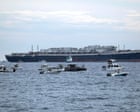
When viral video footage captures a historic ship slipping beneath the Atlantic swells off the coast of Florida, the clip usually triggers a predictable wave of public grief and maritime nostalgia. Viewers watch the bow tilt, hear the groan of stressed steel, and assume they are witnessing a tragedy or a catastrophic failure at sea. They are wrong. In almost every modern instance where cameras are rolling in high definition from charter boats and helicopters just off the Sunshine State, that sinking is a meticulously engineered, multi-million-dollar municipal operation known as artificial reef deployment.
Local governments, marine biologists, and commercial dive operators spend years stripping down retired military vessels, decommissioned freighters, and obsolete ferries before towing them miles offshore and blasting holes in their hulls. The goal is not destruction. It is economic survival and ecological triage along a coastline where natural coral systems have suffered decades of bleaching, disease, and storm damage. What looks like a burial at sea is actually the birth of an underwater real estate market.
The Economics Behind Deliberate Shipwrecks
Follow the money in any coastal Florida county—from Pensacola in the Panhandle down to Key West—and you will quickly find that sunken steel generates far more revenue than floating scrap. A retired tugboat or coastal freighter sold for scrap metal might fetch a few hundred thousand dollars after accounting for the labor required to cut it apart in a dry dock. Dropped intact onto a flat, sandy ocean floor in eighty to one hundred and thirty feet of water, that same hull transforms into a permanent tourism magnet.
Charter captains rely on predictable coordinates. Unlike natural reefs, which can be fragile and subject to strict anchoring bans, a sunken ship offers a massive, concentrated structure that holds game fish and attracts recreational scuba divers year-round. Dive shops sell multi-tank boat trips, hotels fill rooms during the shoulder seasons, and local restaurants capture the spillover spending from traveling divers who spend heavily on gear, gas, and lodging.
Consider the sheer scale of the infrastructure already resting on Florida's continental shelf. Florida maintains one of the largest networks of permitted artificial reefs in the United States, encompassing thousands of individual deployments ranging from concrete culvert pipes to massive naval warships. When a high-profile vessel goes down—such as the former USS Oriskany off Pensacola or the USNS Gen. Hoyt S. Vandenberg off Key West—the economic return on investment often covers the preparation and towing costs within the first few years of operation.
How a Vessel Becomes Reef-Ready
You cannot simply tow an old boat out to sea and pull the plug. Doing so would create an environmental disaster, leaching fuel, heavy metals, and toxic insulation into delicate coastal waters. Preparing a historic ship for intentional sinking is an exhaustive, tightly regulated industrial strip-down that routinely takes twelve to twenty-four months.
Environmental contractors board the vessel long before it ever leaves the dock. Every drop of residual bunker fuel, hydraulic fluid, and lubricating oil must be pumped out and steam-cleaned from the tanks and piping. Crews then move through the compartments to strip out polychlorinated biphenyls (PCBs) found in older electrical wiring, gaskets, and paint layers, alongside asbestos insulation wrapping engine room pipes.
Once the toxins are gone, the ship undergoes structural modification for diver safety. A ship designed to keep water out and crew members confined is a death trap for recreational divers. Salvage teams use plasma torches to cut massive access holes—often called diver swim-throughs—into bulkheads, decks, and interior cabins. Doors are welded open or removed entirely. Narrow passageways that could snag a scuba tank or trap a disoriented swimmer in low visibility are sealed off with steel grating.
The final stage happens at the deployment site. Marine demolition experts wire shaped explosive charges along the waterline and inside the bilges. At the exact moment determined by marine patrol boats clearing the perimeter, the charges detonate. Seawater floods the lower compartments in a controlled sequence designed to keep the ship upright as it settles onto the sand. If a vessel rolls onto its side or lands upside down, much of its structural appeal for both divers and schooling fish is severely diminished.
Ecological Triage or Underwater Junkyard
Not everyone cheers when a historic vessel hits the bottom. Beneath the glossy promotional videos released by county tourism boards lies a fierce, ongoing debate among marine ecologists, commercial fishermen, and preservationists.
Proponents argue that sunken ships act as vital habitat enhancers. The vast expanses of sand off Florida's Atlantic and Gulf coasts are essentially underwater deserts—flat, featureless plains where juvenile fish have nowhere to hide from larger predators. Dropping a three-hundred-foot steel hull into that sand creates instant vertical relief. Within weeks, algae and barnacles colonize the bare metal. Sponges, soft corals, and hydroids follow within months. Baitfish swarm the upper superstructure to feed, drawing in grouper, snapper, amberjack, and pelagic hunters like barracuda and reef sharks.
Yet fisheries biologists raise an uncomfortable question that tourism brochures never mention: the attraction versus production problem. Does a sunken ship actually increase the total population of fish in the ocean, or does it simply act like a giant underwater magnet, pulling existing fish away from surrounding natural reefs and concentrating them in one convenient spot where anglers can catch them faster?
If an artificial reef merely aggregates fish without boosting their overall reproduction and survival rates, it can accelerate overfishing. Charter boats armed with modern side-scan sonar and GPS pinpoints can drop lines directly onto the wreck day after day, stripping out breeding-size snapper and grouper at a pace the local ecosystem cannot replace.
The Historic Preservation Dilemma
There is also the cultural cost. When a vessel with genuine historical significance—a World War II landing craft, a Cold War missile-tracking ship, or a century-old coastal steamer—is scuttled to become a dive site, it is preserved in one sense and destroyed in another.
Saltwater is relentless. Even thick naval hull plating eventually succumbs to galvanic corrosion, boring organisms, and the violent surge of major hurricanes. Hurricanes regularly shift, crack, or flatten artificial reefs that engineers assumed would remain intact for a century. Once a historic ship goes underwater, maritime historians can no longer maintain it, and the general public can no longer walk its decks. For non-divers, the ship ceases to exist outside of grainy underwater video clips.
Museums and preservation trusts face brutal financial math. Maintaining a floating historic ship in saltwater requires continuous dry-docking, hull scraping, anti-fouling paint, and insurance premiums that run into the millions every year. When fundraising falls short and rust eats through the waterline, reefing committees often step in as the buyer of last resort. For cash-strapped municipalities, sinking a historic ship is far cheaper than preserving it afloat, and infinitely better PR than sending a beloved vessel to a scrapyard torch.
What Happens When a Sinking Goes Wrong
Despite years of naval architecture calculations and hydrographic surveys, the ocean rarely cooperates with human timetables. Even the best-planned sinkings carry significant operational risks that rarely make the thirty-second highlight reels shared on social media.
Trapped air pockets are the primary enemy during a controlled scuttling. As water rushes into the lower hull, air gets compressed in upper compartments, creating uneven buoyancy. If a bulkhead fails suddenly or one side floods faster than the other, the ship can list violently, turtle upside down, or slide off its target sandbar into deeper water beyond recreational scuba limits.
To illustrate how quickly the math can turn against a deployment crew, consider a hypothetical example involving a two-hundred-fifty-foot coastal freighter slated to rest in ninety feet of water. If an unexpected subsurface current pushes the hull just three hundred yards east during its descent, the wreck could miss the flat sandy plateau entirely and tumble down a continental shelf drop-off into two hundred feet of water. At that depth, standard recreational divers using compressed air cannot legally or safely visit the site, wiping out the primary tourism return the county paid millions to secure.
Weather windows present another gamble. Towing a stripped, unpowered hull miles offshore requires calm seas and predictable swells. A sudden squall or shifting Gulf Stream current can force tugboats to hold position at massive daily charter rates, burning through municipal contingency budgets before a single charge is detonated.
Why Cameras Are Always Rolling Now
The modern media spectacle surrounding these sinkings is no accident. Twenty years ago, artificial reef deployments were quiet, utilitarian affairs attended by a handful of county engineers, Coast Guard observers, and local dive shop owners. Today, they are choreographed media events.
County tourism development councils—funded by bed taxes collected from hotel stays—actively court news crews, content creators, and underwater cinematographers to document every second of the scuttling. A dramatic video showing a towering bow disappearing beneath boiling white foam generates millions of organic views across news feeds and video platforms.
That viral clip functions as free global advertising for the destination. Every viewer who watches the footage learns the exact town, county, and coastline where the new wreck now rests. Within days of the Coast Guard lifting the safety perimeter around a newly sunk vessel, charter boats are already tied to the mooring buoys, dropping their first wave of paying divers onto the fresh steel.
The Reality Beneath the Surface
Watch closely the next time a dramatic video circulates showing a historic vessel vanishing off the Florida coast. Look past the theatrical plumes of smoke and the nostalgic headlines mourning the loss of a maritime relic.
What you are actually seeing is a calculated transaction between coastal economics, environmental regulation, and modern tourism marketing. A retired ship that could no longer pay its way above water has been stripped of its identity, scrubbed of its toxins, and dropped into the sand to work a second career on the seafloor. Whether that trade-off represents smart marine stewardship or an irreversible loss of maritime heritage depends entirely on whether you are standing on the shore watching it disappear, or strapping on a scuba tank to follow it down.