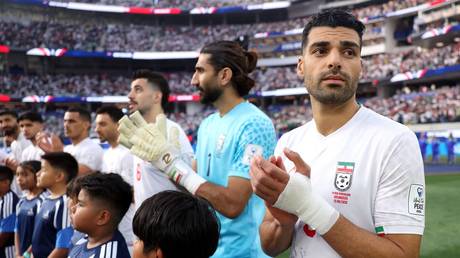
International sports governance operates at the intersection of cultural capital, soft power maximization, and state-level compliance. When the presidency of the Fédération Internationale de Football Association (FIFA) engages directly with the Iranian national football ecosystem, the interaction cannot be viewed merely as a goodwill visit or a standard athletic inspection. It represents a calculated diplomatic maneuver within a highly constrained geopolitical framework.
The structural relationship between global football governance and the Islamic Republic of Iran reveals a complex matrix of regulatory enforcement, political balancing acts, and public relations optimization. By deconstructing this interaction through the lens of institutional leverage and strategic signaling, we can map the hidden incentives driving both FIFA and Iranian state stakeholders.
The Dual Incentive Matrix of International Football Governance
To understand the mechanics of FIFA interaction with Iran, one must first isolate the core objectives of both entities. These objectives form a dual incentive matrix where compliance and autonomy are constantly traded.
       FIFA's Strategic Objectives               Iran's Strategic Objectives
+----------------------------------------+ +----------------------------------------+
| 1. Universal Market Penetration         | | 1. Validation of State Normalcy        |
|    • Preserve global footprint         | |    • Utilize sport for soft power      |
|    • Protect broadcasting rights       | |    • Signal compliance to global body  |
|                                        | |                                        |
| 2. Regulatory Enforcement Consistency  | | 2. Retention of Domestic Control       |
|    • Maintain non-interference rule    | |    • Manage systemic internal pressure|
|    • Enforce basic human rights codes  | |    • Prevent full institutional exile |
+----------------------------------------+ +----------------------------------------+
                    \                                  /
                     \                                /
                      v                              v
                      +------------------------------+
                      |    The Strategic Compromise  |
                      |  Conditional engagement over |
                      |     outright banishment      |
                      +------------------------------+
FIFA Institutional Mandate
FIFA operates under a charter that demands universal market penetration and strict adherence to its regulatory framework, specifically the prohibition of third-party or governmental interference in local football associations. However, its secondary mandate is the global preservation of the sport’s footprint. Total isolation of a major member association, such as the Islamic Republic of Iran Football Federation (FFIRI), creates a systemic fracture that diminishes the value of regional tournaments, disrupts broadcasting rights in the Middle East, and alienates millions of consumers. Therefore, the governing body's default strategy is conditional engagement rather than outright banishment.
The Iranian State Strategy
For the Iranian administration, football serves as a critical mechanism for domestic diversion and international normalization. The national team, Team Melli, possesses immense cultural capital within the country. Success on the pitch signals state competency and offers a rare avenue for soft power projection on the global stage. Conversely, a FIFA-imposed ban due to regulatory violations—such as the historical exclusion of women from stadiums or government meddling in FFIRI elections—presents a severe threat to internal stability.
This environment transforms presidential visits into a highly choreographed performance of mutual leverage. The governing body uses the threat of institutional exile to extract micro-concessions, while the state uses the visual of cooperation to project an image of compliance and international acceptance.
The Mechanism of Selective Compliance and Institutional Pacification
The interaction between an international governing body and a sovereign state with conflicting domestic laws relies on a process known as selective compliance. Rather than demanding immediate, systemic alignment with global standards, the international body accepts incremental, often superficial adjustments that allow both parties to claim a policy victory.
The primary friction point in this specific relationship centers on stadium access and human rights. For decades, the Iranian state maintained an unwritten ban on women entering football stadiums for men's matches. When FIFA faces intense pressure from global advocacy groups to enforce its non-discrimination statutes, the cost function of inaction rises sharply. The governing body must act to preserve its corporate partnerships and reputational capital.
The response to this pressure follows a distinct three-step pacification cycle:
- The Escalation Threshold: Global outcry or specific domestic incidents reach a volume where the governing body can no longer ignore the violation without risking its own commercial brand value.
- The High-Level Direct Engagement: The presidency or a senior delegation conducts a highly publicized visit to the nation. This serves a dual purpose: it offers the host country the prestige of international validation while providing the governing body with a platform to deliver a direct, private ultimatum regarding regulatory thresholds.
- The Micro-Concession Execution: The host state implements a tightly controlled, limited variation of the requested reform. For example, allowing a selected quota of women into a specific section of a stadium for an isolated international match, rather than reforming domestic league access nationwide.
This structural compromise allows the international body to report progress to its stakeholders, while the host state preserves the core architecture of its domestic policy. The underlying tension is not resolved; it is merely recalibrated to an acceptable equilibrium.
The Financial Bottleneck of Frozen Capital and Asset Allocation
Beyond the ideological and regulatory dimensions, the relationship is heavily dictated by macroeconomic constraints. The imposition of international banking sanctions creates a severe financial bottleneck for Iranian football, altering the economic power dynamics between Zurich and Tehran.
Under standard operations, member associations receive substantial financial distributions from the central governing body via programs designed to develop local infrastructure, youth academies, and women's football. However, due to compliance protocols tied to global banking networks, millions of dollars in development funds and World Cup prize money earmarked for the FFIRI remain frozen in international bank accounts.
This creates a distinct economic paradox:
- The Balance Sheet Illusion: On paper, the Iranian federation possesses the capital necessary to build a self-sustaining football infrastructure and retain world-class technical staff.
- The Operational Reality: In practice, the inability to liquidate these assets forces the federation to rely on direct state funding, which automatically violates the core principle of independence from governmental interference.
When a global sports president meets with national players and officials under these conditions, the subtext is invariably financial. The governing body uses its custody of these frozen assets as an existential carrot. It signals that full compliance with specific institutional demands could unlock alternative pathways for fund disbursement—such as direct payments to third-party contractors or international coaches, bypassing national banking restrictions. The host country, meanwhile, seeks to use the visit to pressure the international organization into acting as a financial intermediary against global sanctions, a role that the governing body cannot legally assume without risking its own institutional survival.
The Strategic Failure of Total Isolation
A common critique from external observers is that global sports organizations should employ the ultimate sanction: total suspension or expulsion of the non-compliant member state. This perspective ignores the structural feedback loops that govern international relations and institutional control.
Applying a total ban on a nation like Iran breaks the feedback loop entirely. Once an association is completely severed from the global network, the governing body loses all institutional leverage. The state no longer has any incentive to make micro-concessions on human rights, gender equity, or regulatory independence, as the primary benefit of those concessions—participation in global competition—has been removed.
The strategy of persistent engagement, punctuated by high-profile presidential visits, maintains an active channel of influence. It exploits the state's desire for international validation to keep them within a managed regulatory orbit. The objective is not a rapid transformation of domestic policy, but rather the maintenance of a continuous, stabilizing dialogue that prevents a complete collapse of governance standards within that territory.
The Calculus of Player Alignment and State Coercion
The internal dynamics of the national team during these diplomatic visits reveal the deep fractures within the host nation’s athletic ecosystem. National team players occupy a precarious position as both symbols of state pride and individual cultural icons who often possess their own global platforms.
During periods of domestic social unrest, the national jersey becomes a contested battleground. Players face a binary pressure system: domestic audiences demand that they use their international visibility to protest state actions, while state security apparatuses demand absolute demonstrations of loyalty.
When international sports leadership enters this environment and engages directly with the squad, it introduces a third variable into the calculus. The presence of the global president serves as an administrative shield for the athletes. For the duration of the visit, the state cannot easily enact punitive measures against players who have shown subtle signs of dissent, as doing so under the direct scrutiny of the global football executive would trigger immediate, catastrophic regulatory sanctions.
The visit creates a temporary zone of de-escalation. The players receive a tacit guarantee of safety, the state receives the visual asset of a functioning, compliant national team, and the international federation demonstrates its supposed commitment to athlete welfare without having to take an explicit political stance against the host government.
Operational Execution of the Next Strategic Play
The stabilization of this complex relationship requires moving beyond performative diplomatic visits and establishing a formalized, metric-driven framework for engagement. To ensure long-term regulatory compliance while preserving market access, international sports executives must transition from ad-hoc crisis management to a structured system of conditional operational milestones.
       Phase 1                      Phase 2                      Phase 3
+--------------------+       +--------------------+       +--------------------+
| Escrow-Backed Fund | ----> | Proportional Gate  | ----> | Institutional Shield|
|   Accountability   |       |    Access Audit    |       |   Implementation   |
+--------------------+       +--------------------+       +--------------------+
1. Implement an Escrow-Backed Compliance Fund
The central governing body must formalize the release of frozen development capital by tying disbursements directly to verified, independent human rights audits. Instead of attempting to navigate standard banking networks, funds should be paid directly to verified international vendors for infrastructure development—such as hybrid pitches, VAR technology installations, and medical equipment—only after the host federation meets specific, pre-determined domestic access quotas for female spectators across all tiers of domestic competition. This shifts the dynamic from a political debate to a strict contractual transaction.
2. Standardize Proportional Gate Access Audits
To counter the strategy of tokenism—where a small number of women are permitted access only to high-profile international matches—FIFA must mandate an independent stadium access monitoring system for domestic league matches. The compliance metric must be structural, requiring that a minimum percentage of total stadium capacity be made available to the general public regardless of gender, without segregation practices that compromise safety or dignity. Failure to meet these domestic league quotas over a rolling 90-day period must result in the automatic forfeiture of hosting rights for upcoming continental club matches.
3. Establish an Independent Athlete Protection Protocol
To mitigate the risk of state coercion against athletes who exercise their basic rights of expression, the international governing body must establish a direct, encrypted reporting channel between national team players and the global player union (FIFPRO), overseen by a neutral arbitrator. Any verified instance of state retaliation, contract termination, or travel restriction applied to an athlete based on political or social stance must trigger an immediate freeze on all national team marketing rights and a suspension from the next immediate international window, removing the state’s ability to exploit the team for political capital during moments of domestic crisis.