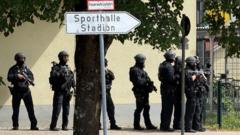
Another school knife attack in Germany, another predictable wave of institutional hand-wringing. After a 13-year-old boy allegedly stabbed and seriously injured two 13-year-old girls at a secondary school in central Germany, the media machinery immediately defaulted to its favorite, lazy script: demand more security, question the decline of youth morals, and call for stricter laws.
They are asking all the wrong questions.
The media focuses entirely on the horror of the event rather than the structural logic of why these incidents bypass every security theater measure we throw at them. For years, I have analyzed security protocols and crisis management frameworks. I have watched municipalities burn millions of euros on "hardening" campuses, installing cameras, and drafting zero-tolerance policies.
It is completely useless.
The standard consensus is that we can engineer safety through surveillance and restriction. This is a dangerous lie. By treating school violence as a physical security problem to be solved with locks, guards, or metal detectors, we ignore the grim mathematical reality of "soft targets."
The Illusion of the Hardened Campus
When an incident like this occurs, the immediate reaction from politicians is to turn schools into low-security prisons. They want turnstiles. They want locker searches. They want a visible apparatus of control.
This approach fails because it misunderstands the nature of proximity.
In the German school attack, the perpetrator was not an outside infiltrator scaling a fence. He was a student. He belonged there. He had legitimate access. When the threat originates from inside the perimeter, physical security architecture collapses.
The Proximity Paradox
Consider the mechanics of a typical school day. Hundreds of individuals gather in confined spaces, moving in predictable patterns at specific times.
- Access points: Even if you restrict entry to a single gate, you create a massive bottleneck outside that gate every morning. You have simply moved the soft target 20 meters to the sidewalk.
- Contraband realities: A knife is small, non-metallic in many modern iterations, or easily concealed within standard school supplies. Short of strip-searching every child daily—a logistical and ethical impossibility—weapons will get in.
- The Reaction Gap: Most school attacks are over in less than 120 seconds. Security guards or police forces, even when stationed on-site, operate on a delay. They respond to an event that has already begun.
The lazy consensus screams for more containment. But containment only works when you can accurately predict the threat vector. In a school environment, every single student is a potential vector.
Why Germany's Weapon Laws Won't Fix This
Europe loves to contrast its lower rates of gun violence with the United States, wrapping itself in a blanket of regulatory superiority. Germany already has some of the strictest weapon laws in the world. The country overhauled its Weapons Act after the Erfurt school shooting in 2002 and the Winnenden shooting in 2009.
It did not stop a teenager from carrying a blade into a classroom.
+-------------------------------------------------------------+
|               THE CRISIS INTERVENTION FAILURE               |
+------------------------------+------------------------------+
| Traditional Response         | The Reality                  |
+------------------------------+------------------------------+
| Increased Surveillance       | Drives behavior underground  |
| Stricter Weapon Laws         | Ineffective against household|
|                              | items                        |
| Zero-Tolerance Policies      | Isolates at-risk youth       |
|                              | further                      |
+------------------------------+------------------------------+
When you ban one mechanism of violence, intent simply shifts to another available tool. A kitchen knife, a blunt object, a flammable liquid—the inventory of everyday items that can be weaponized is endless.
Focusing on the tool is a bureaucratic distraction. It allows ministries to check a box and claim they took action without addressing the volatile social dynamics that cause a 13-year-old to decide that radical violence is his best option.
Dismantling the People Also Ask Myth: "Can We Predict Who Will Snap?"
Whenever these attacks hit the headlines, the public immediately looks for a checklist. They want a profile. They ask: What are the warning signs of a school attacker?
Psychologists and law enforcement agencies have tried to build this profile for decades. The Federal Bureau of Investigation (FBI) and the German Federal Criminal Police Office (BKA) have poured immense resources into threat assessment models.
The brutal truth? Profiling does not work.
There is no uniform profile for a school attacker. The traits commonly associated with attackers—social isolation, interest in violent media, academic decline, or being bullied—are shared by hundreds of thousands of teenagers who will never hurt a fly. If you use these traits as a dragnet, you end up falsely accusing, stigmatizing, and alienating an entire generation of awkward kids.
Imagine a scenario where a school flags every student who exhibits three signs of social withdrawal. You create an atmosphere of intense paranoia. Students stop trusting teachers. They stop trusting each other. The school transforms from a community into an environment of mutual surveillance.
Instead of preventing violence, you have built a pressure cooker.
The Fatal Flaw of "Zero Tolerance"
In the wake of tragedies, school boards invariably double down on zero-tolerance policies. Suspensions skyrocket. Expulsions are handed out like candy for minor infractions.
This is the exact opposite of what actually works.
When a student is spiraling toward targeted violence, they are usually experiencing an acute sense of grievance or hopelessness. If you cut their remaining ties to the social structure via expulsion, you do not solve the problem. You merely remove them from your sight.
You have accelerated their trajectory. You have validated their belief that the system is rigged against them. You have given them nothing left to lose.
The contrarian reality is that keeping problematic students closer, embedding them in intense, high-touch monitoring and support systems, is far safer than casting them out into the void where their grievances can metastasize in isolation. But that requires time, money, and emotional labor. It is far cheaper to sign an expulsion order and pretend the danger has passed.
Redefining School Safety: The Decentralized Approach
If hardening the infrastructure is a failure and profiling is a myth, how do we actually reduce the frequency and severity of these events?
We have to accept a terrifying premise: Absolute safety is an illusion. You cannot eliminate the risk of a motivated individual committing an act of violence in a free society.
Once you accept that risk cannot be reduced to zero, your strategy changes from wasteful prevention theater to active mitigation and decentralized resilience.
Peer-Level Intelligence
Attackers almost always tell someone before they act. It is a phenomenon known as "leakage." They post on encrypted chat groups, they drop hints to classmates, or they brag on social media.
The most effective sensor network in any school is not a multi-million-dollar camera system. It is the student body.
But students will not report leakage if they believe the consequence will be a heavy-handed, punitive police response that ruins their friend's life over a misunderstanding. We need anonymous, low-stakes reporting mechanisms that trigger psychological intervention rather than immediate criminalization.
Decentralized First Response
Stop waiting for the authorities. By the time sirens are heard, the event is over.
Teachers and older students need to be trained not just in passive hiding protocols, but in active, tactical triage and immediate physical intervention when cornered. The "Run, Hide, Fight" framework is often taught poorly, with too much emphasis on hiding. Hiding in a corner makes a classroom a shooting gallery or a compliance zone for a knife-wielding attacker.
We must cultivate a culture of collective responsibility and immediate action. If an attacker faces immediate, uncoordinated, chaotic resistance from multiple angles, their orientation collapses. Attackers rely on absolute compliance to execute their plans. Break the compliance, break the attack.
Stop building higher walls. Stop buying more cameras. Stop passing redundant laws that law-abiding citizens follow and criminals ignore.
The next attacker is already sitting inside the classroom, looking at the security cameras, knowing exactly how useless they are. Turn off the monitors, look the students in the eye, and start addressing the rot before it reaches the blade.