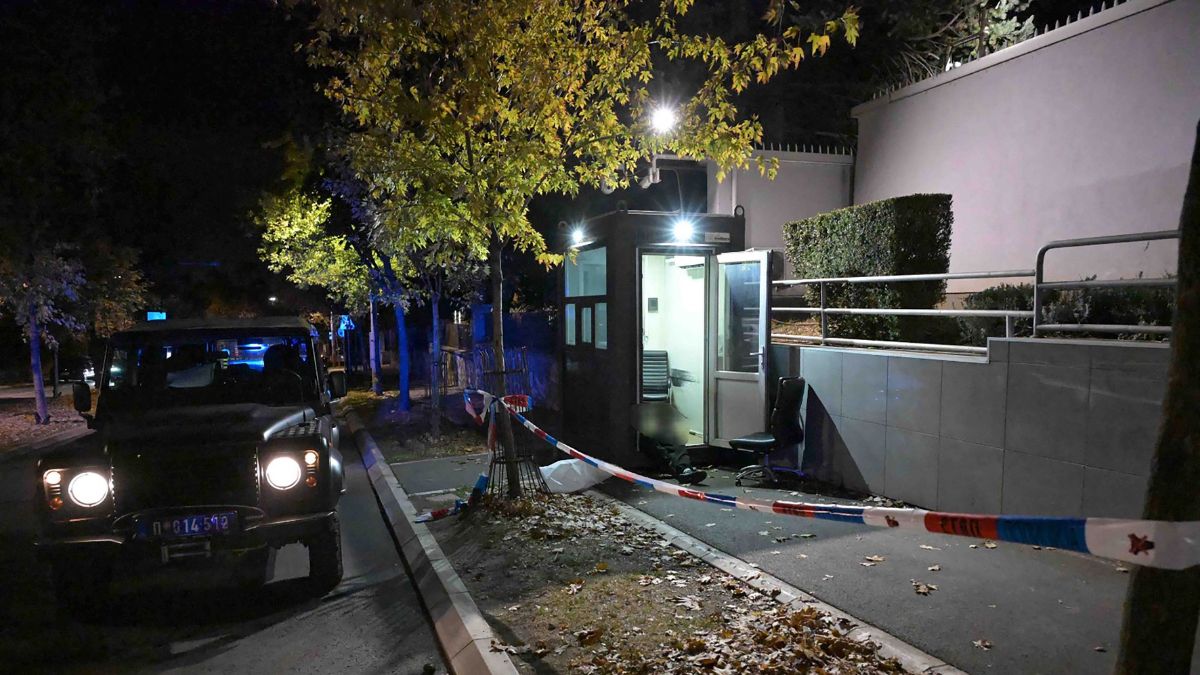
On June 29, 2024, a young man walked up to the Israeli embassy in Belgrade, pulled a crossbow from a bag, and shot a Serbian gendarme in the neck. Within seconds, the wounded officer drew his service weapon and fired back, killing the assailant on the pavement outside the diplomatic compound. Initial reports identified the attacker as Miloš Žujović, a 25-year-old convert to Islam, though conflicting early wires circulated by international outlets initially mischaracterized the suspect as a minor before Serbian interior ministry officials clarified his identity and radicalization history.
The weapon was primitive. The execution was clumsy. Yet the Belgrade embassy attack exposed a severe, simmering vulnerability in the Western Balkans that security agencies have struggled to contain for over a decade.
When a lone actor uses a silent, easily acquired sporting weapon to strike a heavily guarded diplomatic target in broad daylight, the incident forces an uncomfortable reckoning. Standard counterterrorism playbooks built around intercepting encrypted bomb-making chatter or tracking military-grade firearms fail completely against low-tech, self-directed violence. Serbia immediately raised its terror threat level to red, deploying armed patrols across transit hubs, shopping centers, and diplomatic quarters. That visible show of force treats the symptom while leaving the underlying contagion untouched.
Anatomy of a Low-Tech Strike
The mechanics of the June 29 assault reveal a deliberate exploitation of European weapon laws. In Serbia, as in much of continental Europe, acquiring an illegal firearm carries steep criminal penalties and requires navigating entrenched organized crime networks—networks that are heavily infiltrated by domestic intelligence services. Buying a crossbow does not.
Crossbows are classified across many jurisdictions as sporting goods or category C weapons, subject to minimal background checks and zero ongoing monitoring. They generate no ballistic signature, require no propellant, and can be purchased over the counter or online without triggering the algorithmic tripwires set by financial intelligence units.
Gendarme Miloš Jevremović was stationed inside a guardhouse outside the Israeli diplomatic mission when Žujović approached. According to accounts from the Serbian Ministry of Internal Affairs, the assailant asked a routine question—inquiring about a museum—to close the physical distance between himself and the officer. Once inside striking range, he produced the crossbow and fired a bolt directly into Jevremović's neck.
That Jevremović survived, managed to neutralize the threat while bleeding heavily, and underwent successful emergency surgery in Belgrade is a testament to individual tactical discipline. It is not a validation of perimeter security. If the attacker had carried a concealed blade or an improvised incendiary device, the outcome inside that confined guard post could have been catastrophic.
The Radicalization Pipeline in the Balkans
To understand how a young man from Mladenovac—a quiet municipality roughly 30 miles south of Belgrade—ended up dying outside an Israeli diplomatic mission, you have to look beyond the immediate geopolitical flashpoints in the Middle East. The Israel-Hamas war undoubtedly acted as an accelerant, providing a potent grievance narrative that extremist recruiters routinely weaponize. However, the infrastructure that facilitated Žujović's transformation has existed in the Balkans since the mid-1990s.
Following the collapse of Yugoslavia and the Bosnian War, foreign fighters and radical clerics established isolated enclaves across Bosnia and Herzegovina, the Sandžak region straddling Serbia and Montenegro, and parts of Kosovo. Over the past thirty years, these networks evolved. They shifted away from isolated rural compounds toward decentralized digital ecosystems operating on Telegram, TikTok, and closed gaming servers.
Serbian Interior Minister Ivica Dačić confirmed shortly after the shooting that Žujović had converted to Islam, adopted the name Salahudin, and relocated to Novi Pazar—the administrative and cultural center of the Sandžak region. Novi Pazar has long been a focal point for Serbian security services monitoring Wahhabi and Salafist currents. Yet the vast majority of the local Muslim population rejects extremism, leaving radical elements to operate in tight, insular micro-communities.
These micro-communities thrive on personal alienation. Converts are statistically overrepresented in Western European and Balkan lone-actor plots. Lacking deep roots in traditional religious institutions, they are uniquely susceptible to rigid, literalist interpretations of scripture fed to them online. They seek absolute certainty and immediate belonging. Extremist handlers provide both, framing violent action not as a crime, but as an obligatory act of purification.
Intelligence Failures and the Lone-Actor Dilemma
Why wasn't Žujović stopped before he reached the embassy gates? The answer lies in the structural limitations of modern intelligence gathering.
Serbian security agencies—primarily the Security Information Agency (BIA)—possess deep institutional memory regarding domestic political threats, organized crime syndicates, and regional ethnic tensions. Monitoring fragmented, self-radicalized individuals operating without a formal command structure requires an entirely different operational posture.
In traditional counterterrorism, investigators look for operational signatures:
- Financial transfers moving across borders or through known hawala networks.
- Travel patterns showing movement toward conflict zones like Syria, Iraq, or Afghanistan.
- Procurement attempts involving precursor chemicals, detonators, or automatic weapons.
- Direct communications with known recruiters flagged by international intelligence sharing.
Žujović bypassed almost every one of these tripwires. Subsequent police raids across Serbia following the attack led to the arrest of several individuals suspected of maintaining contact with him, including Igor Despotović, a Belgrade resident previously arrested in 2017 for plotting a truck attack inspired by Islamic State propaganda. That connection is damning. It demonstrates that Žujović was not operating in a total vacuum; he was orbiting a known constellation of domestic extremists who had already drawn the attention of state security.
When a suspect is already on the radar—or actively associating with convicted or previously detained radical figures—the failure to prevent an attack usually stems from resource triage. Security services cannot place twenty-four-hour physical surveillance on every individual who expresses extremist sympathies online. They have to prioritize based on perceived capability. Because Žujović had no access to firearms or explosives, analysts likely categorized him as a low-capability sympathizer rather than an imminent operational threat.
Why Diplomatic Targets Remain Vulnerable
Diplomatic missions sit at the intersection of international law and domestic policing. Under the Vienna Convention on Diplomatic Relations, the host nation bears the absolute responsibility to protect foreign embassies from intrusion or damage. Yet host nations must balance physical security with diplomatic accessibility. An embassy cannot function as an impenetrable military bunker in the middle of a residential capital city without disrupting daily commerce and civic life.
Israeli diplomatic facilities face the highest threat matrix of any nation globally. Since October 2023, missions from Stockholm to Buenos Aires have experienced heightened alert levels, foiled plots, and perimeter breaches. In Belgrade, the Israeli embassy is situated in a residential neighborhood (Dedinje), surrounded by private villas and other diplomatic residences.
Static guard posts, like the one manned by Gendarme Jevremović, are inherently reactive. A uniformed officer standing at a fixed point absorbs the first blow in any surprise assault. By the time the officer registers the threat, the attacker has already seized the initiative. Modern diplomatic security doctrine attempts to mitigate this through layered defense:
- Outermost intelligence perimeter: Identifying threats days or weeks before they approach the physical street.
- Dynamic behavioral detection: Plainclothes officers patrolling surrounding blocks to spot surveillance or erratic behavior.
- Physical stand-off barriers: Bollards, reinforced glass, and automated entry locks that prevent rapid physical approach.
- Immediate armed response: Static guards equipped with ballistic protection and rapid-fire capability.
In Belgrade, layers one through three failed to intercept Žujović. Only the fourth layer—the individual resilience of a single wounded officer—prevented the assailant from breaching the embassy grounds.
The Geopolitical Fallout for Serbia
The timing of the attack could not have been worse for Belgrade's delicate foreign policy balancing act. President Aleksandar Vučić has spent years cultivating bilateral ties with Israel, navigating historical complexities while securing defense technology, intelligence cooperation, and economic investment. Simultaneously, Serbia maintains close diplomatic and economic relationships with several Arab states and relies heavily on non-aligned nations to support its position regarding Kosovo's independence.
A successful terror attack against Israeli diplomats on Serbian soil would have shattered Belgrade's carefully curated image as a stable, secure anchor in Southeast Europe. It would have invited intense scrutiny from Western intelligence partners—particularly Washington and Brussels—regarding Serbia's ability to police extremist networks within its borders.
By immediately declaring the incident a terrorist act and launching sweeping nationwide raids, the Serbian government sought to project absolute control. Raising the terror threat level to red serves a dual purpose. Tactically, it floods high-risk areas with visible deterrent forces, discouraging copycat attacks. Politically, it signals to foreign governments and domestic voters that the state apparatus is decisive and unyielding.
Yet high-alert postures are unsustainable. You cannot keep elite gendarmerie units stationed outside every shopping mall and train station indefinitely without exhausting personnel and draining municipal budgets. Eventually, the red alert drops back to yellow, the armored vehicles return to their barracks, and the underlying structural vulnerabilities remain.
The Contagion of Low-Cost Extremism
The broader security lesson of the Belgrade crossbow shooting extends far beyond the Balkans. Counterterrorism agencies across Europe and North America are confronting a generational shift in how extremist violence is conceived and executed.
During the height of ISIS's territorial caliphate between 2014 and 2017, attacks were frequently coordinated by external operations planners who provided funding, forged documents, and tactical instruction. Today, the threat is largely decentralized. Online ecosystems act as ideological force multipliers, radicalizing isolated individuals rapidly while encouraging them to use whatever tools are immediately available.
When an extremist organization broadcasts instructions telling followers to use kitchen knives, rental vans, or sporting crossbows, the barrier to entry drops to zero. There is no supply chain to disrupt. There are no safe houses to raid. The entire operational cycle—from decision to execution—can occur inside a single bedroom over the course of a few weeks.
Furthermore, media coverage of these incidents inadvertently reinforces the tactic. Even when an attacker is killed within seconds and fails to breach their primary target, the resulting international headlines, emergency security deployments, and political statements hand the extremist movement a propaganda victory. The narrative pushed within closed chat groups is simple: one individual, armed with a cheap sporting weapon, forced an entire European capital onto high alert.
Rethinking Counter-Radicalization in the Digital Era
Policing alone cannot solve a problem rooted in digital isolation and ideological manipulation. The arrests made in Serbia following the June 29 shooting dismantled a specific cell of associates, but the digital pipelines that fed Žujović remain wide open.
Effective intervention requires disrupting the radicalization process long before a suspect walks up to an embassy gate. That means addressing three persistent blind spots in European and Balkan security strategy:
First, algorithmic accountability on fringe platforms. Mainstream social media companies have invested billions in automated content moderation, successfully purging the vast majority of overt terrorist propaganda from public feeds. Extremist recruiters simply migrated to encrypted messaging apps and niche gaming forums where moderation is nonexistent. Security agencies need legal frameworks and technical capabilities to monitor public and semi-public channels on these platforms without waiting for a physical crime to occur.
Second, targeted intervention for high-risk converts. Religious communities, families, and local social workers are almost always the first to notice behavioral changes when an individual falls into extremist circles. Sudden isolation, the rejection of family members, and obsessive consumption of hardline online content are clear warning signs. However, in regions like the Balkans, deep mistrust between minority communities and state security forces often prevents families from reporting concerns. Building credible, community-led off-ramps—where families can seek help without immediately triggering a heavy-handed police raid—is essential.
Third, closing the sporting weapon loophole. While banning every dangerous everyday object is impossible, subjecting high-powered crossbows and compound bows to basic registration and waiting periods introduces friction into the procurement process. Friction buys time. For an impulsive, self-radicalized actor, a mandatory seven-day waiting period or a local police notification can be enough to disrupt operational momentum or trigger an intervention.
The Illusion of Total Security
Serbia's swift tactical response outside the Israeli embassy prevented a mass-casualty diplomatic crisis, yet the incident stands as a stark warning to security planners across the continent. Raising threat levels and deploying armored patrols creates an immediate sense of safety, masking the reality that modern counterterrorism is increasingly fighting an invisible, decentralized adversary.
Gendarme Miloš Jevremović survived because of his own training and split-second reaction under extreme trauma. Relying on individual heroism at the perimeter gate is not a sustainable national security strategy. Until intelligence agencies adapt to track low-tech, self-directed actors—and until governments confront the digital ecosystems manufacturing them—the next attacker will not need a bomb or a rifle to bring a capital city to a standstill.