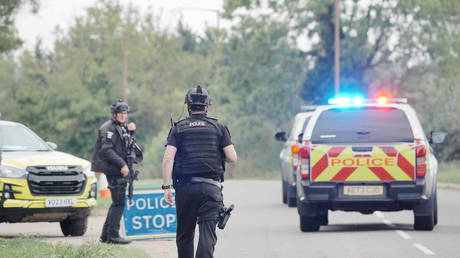
Security alerts don't usually start with three suspicious vans rolling up to a rural military perimeter in the dead of night. But that is exactly what happened on September 27 at RAF Fairford in Gloucestershire. When British counter-terrorism police intercepted those vehicles, they uncovered the fingerprints of an aggressive state-backed operation. The UK prime minister and international prosecutors soon made it clear that Iran was almost certainly behind the aborted assault.
If you think modern state conflicts stay neatly confined to cyberspace or regional proxy battlegrounds, this plot proves otherwise. The operation targeted a British Royal Air Force base heavily utilized by United States military personnel and long-range bombers. It highlights a dangerous shift where foreign actors attempt to strike critical defense infrastructure on Western soil using local proxy networks. You might also find this connected coverage interesting: The Whispering Border And The Weight Of Peace.
What Actually Happened at RAF Fairford
The timeline of the Gloucestershire incident reads like a thriller, but the mechanics were entirely pedestrian. Operatives directed from afar purchased vans, fuel barrels, and metal objects intended to serve as crude shrapnel. Local surveillance of the base perimeter was outsourced to contacts within the UK.
Police action came swiftly on September 27, evacuating nearby residents and deploying bomb-disposal squads. While officers found gasoline containers in the vans, no active explosives detonated. Multiple arrests followed immediately, drawing in a mix of London residents and British-Iranian dual nationals. As highlighted in latest articles by Al Jazeera, the implications are notable.
The threat level prompted immediate operational changes. The U.S. military swiftly adjusted its footprint, withdrawing bombers stationed at the base to ensure personnel safety. Bases used to launch or support operations against Iran had long been labeled legitimate targets by Tehran's Islamic Revolutionary Guard Corps (IRGC), but translating that rhetoric into physical attacks inside the UK crossed a major threshold.
The Global Network Uncovered by Prosecutors
The local arrests in Gloucestershire were just the tip of a much larger iceberg. Federal prosecutors in the United States unsealed sweeping indictments targeting individuals linked directly to the IRGC and Kata'ib Hezbollah.
The legal documents mapped out a sprawling conspiracy. Key figures like Mohammad Ali al-Hassani and Mohsen Mohajeri coordinated logistics from inside Iran, using digital channels and financial incentives to manage operatives abroad. Even incarceration failed to halt the plotting. Mohammad Baqer al-Saadi, an operative jailed in New York, allegedly continued directing coordination using coded communication passed through family phone calls in Iraq.
This international reach exposes how modern threat actors operate. They combine state sponsorship with decentralized, low-level operatives who may not fully understand the scope of the intelligence network pulling their strings. It is a shadowy business of encrypted messaging, proxy financing, and deniability.
Why This Changes UK and US Security Posture
Intelligence agencies face a nightmare scenario with these types of plots. When hostile states recruit locally based individuals with clean records or minor criminal backgrounds, traditional border surveillance often misses them. They blend into ordinary urban life until the moment of execution.
Governments are responding by tightening internal security measures around joint military installations. The UK government faces mounting pressure to plug security gaps that allow foreign intelligence services to cultivate local assets. At the same time, joint intelligence sharing between Washington and London has accelerated to map out remaining cells tied to these operations.
You can expect stricter monitoring of sensitive military perimeters, tighter restrictions on unauthorized drone activity near defense zones, and a zero-tolerance approach toward foreign-directed surveillance networks operating within Western cities. The illusion that domestic soil offers absolute immunity from geopolitical conflicts has officially shattered.