The air inside the clinic in Beni smelled of bleach, warm sweat, and the unmistakable, metallic tang of unceasing fear.
Outside, the dense equatorial sun beat down on the red dirt roads of the Democratic Republic of Congo. Inside, the world had narrowed down to a terrifying perimeter of plastic sheeting, rubber gloves, and the rhythmic, exhausted beeps of a monitor tracking a failing heart.
Jean-Paul clutched a damp cloth to his forehead. He was twenty-nine years old, a teacher who loved the intricate architecture of French grammar, but right now, his body was staging a violent mutiny. Every cell screamed. Every joint felt as though it had been beaten with stones. Worse than the pain was the isolation. The faces of the nurses, masked and muffled behind heavy plastic visors, looked like astronauts peering down at an alien planet. They moved with mechanical precision, treating him not as a man who recited poetry to his students, but as a biological hazard. A walking contagion.
He wanted to scream that he was a person. He wanted to tell them about his daughter’s laugh, the way the rain sounded on the corrugated tin roof of his classroom, the exact shade of green the valley turned after a November storm. But the fever stole the words from his throat.
He was living through the deadliest Ebola outbreak in the history of the Democratic Republic of Congo. And he was losing.
History books record disasters with cold, clinical detachment. They speak of case fatality rates, transmission chains, and R-nought values as if human suffering can be neatly contained within a spreadsheet. But anyone who has stood on the ground during a medical emergency knows that numbers are merely the skeleton of a much more brutal story. The true architecture of an outbreak is built on suspicion, grief, exhaustion, and the profound, agonizing friction between ancient cultural traditions and the sudden, brutal demands of survival.
Consider how it begins. It never starts with a dramatic explosion. It starts quietly.
A farmer falls ill in a remote village nestled near the edge of the Virunga rainforest. The symptoms mimic malaria or typhoid—common visitors in a region where healthcare has long been an afterthought, starved of resources by decades of political instability and systemic neglect. Families do what families have always done for generations. They care for their own. They wash the body of the fallen with bare hands. They offer comfort, touch, and tears. It is an act of deep, unyielding love.
And in that precise act, the invisible machinery of the virus takes root.
By the time the alarm bells ring, the invisible embers have already spread across provincial lines. The Beni outbreak, unfolding in the volatile North Kivu and Ituri provinces, was unlike any before it. It did not strike in an isolated, sleepy district where containment was a matter of logistics. It struck in bustling trade hubs. It moved through crowded markets where thousands of people cross borders daily, carrying goods, dreams, and, unknowingly, a microscopic executioner.
Fear is a contagion all its own.
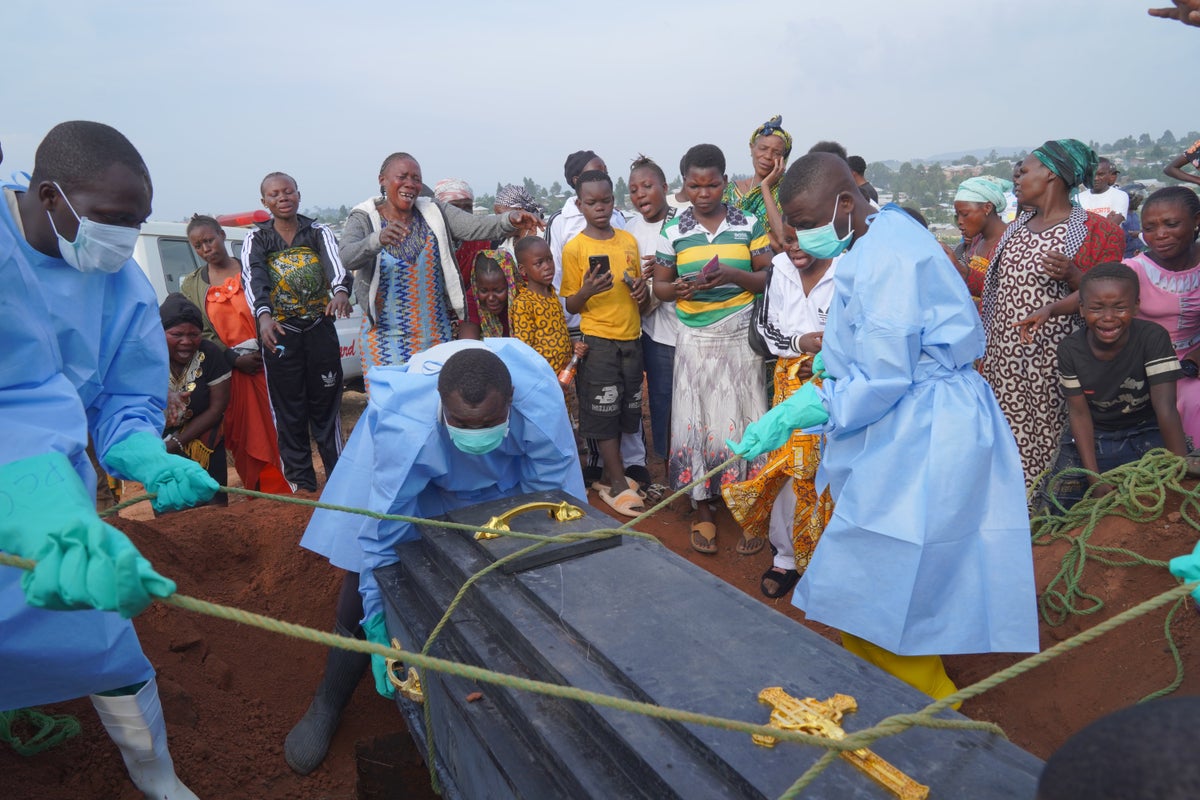
When international medical teams arrived in heavy personal protective gear, looking like figures from a science fiction nightmare, the local population did not see saviors. They saw strangers speaking foreign languages, imposing strange rules, and taking away their sick, never to be seen again except inside a sealed body bag. Traditional burial rites—the very rituals that gave the living a sense of closure and spiritual safety—were banned overnight.
Imagine the psychological toll of that reality. You lose your mother, your brother, your child. You are told you cannot touch them. You are told you cannot bury them the way your ancestors did. You are told that the very people trying to help might somehow be the architects of your doom, whispered rumors spreading faster than the virus itself that the disease was brought to line the pockets of corrupt officials or shadowy foreign interests.
Distrust became a fortress. Treatment centers were attacked with stones and firebombs. Contact tracers—brave local health workers who walked miles every day through hostile territory—were spat on, threatened, and sometimes killed.
Medical expertise alone cannot cure an epidemic of this scale. You need something far rarer. You need radical empathy.
The turning point did not arrive in a sleek laboratory in Geneva or Washington. It arrived when international organizations finally surrendered their top-down arrogance and handed the microphone to the community.
Local leaders, pastors, traditional healers, and survivors who had beaten the virus stepped into the breach. They became the translators of science. They walked into the heart of the villages not in hazmat suits, but in ordinary clothes, speaking local dialects, listening to grievances with infinite patience, and validating the very real trauma of a community that felt forgotten by the capital and exploited by the world.
They explained the science of contagion not with dense epidemiology lectures, but through intuitive analogies. They compared the virus to a spark in a dry thatch-roofed hut. You do not wait to see if the fire burns out on its own; you clear a perimeter immediately. You remove the fuel. You starve the flame.
At the same time, a quiet revolution was happening in the field of medicine.
For decades, contracting Ebola was practically a death sentence. The odds were heavily, relentlessly stacked against the patient. Survival depended almost entirely on supportive care—IV fluids, managing electrolytes, hoping the human immune system could mount a miraculous defense before the organs completely collapsed.
During the Kivu outbreak, that paradigm shifted forever.
Experimental treatments, pushed through clinical trials under conditions of unimaginable chaos, changed the math of survival. Monoclonal antibodies and antiviral drugs—therapies like mAb114 and REGN-EB3—began to turn the tide. When administered early enough, these drugs neutralized the virus inside the bloodstream, acting like precision-guided missiles against an enemy that had previously roamed free.
For the first time in history, doctors could look a patient in the eye and offer a genuine promise: You do not have to die.
Equally transformative was the deployment of the rVSV-ZEBOV vaccine. Using a "ring vaccination" strategy—immunizing not just the immediate contacts of an infected person, but the contacts of those contacts—health teams built a firewall of immunity around the spreading embers. It was a race against time, fought in muddy fields, across rebel-held territories, and through active conflict zones where armed groups treated human health as a political chess piece.
Yet, vaccines and drugs are just tools. The real heavy lifting was done by human resilience.
Think of the adolescent girls who became primary caregivers for their younger siblings after losing both parents, refusing to let despair swallow them whole. Think of the burial teams who volunteered day after day, performing their grim, necessary tasks with a quiet, heartbreaking dignity, ensuring that every person who passed away was honored according to sanitary protocols without losing their human face. Think of the survivors who walked out of the treatment centers, weak-legged and hollow-eyed, only to turn right back around and volunteer to feed the new arrivals because they knew what it felt like to be terrified and alone.
The numbers eventually told a grim story. Over two thousand lives lost. The second deadliest outbreak in recorded history, trailing only the catastrophic West African epidemic of 2014 through 2016.
But numbers fail to capture the victory embedded in the survival of thousands of others who walked back out into the blinding equatorial sun. They fail to capture the institutional knowledge forged in fire—lessons that transformed how the world responds to biological threats, proving that local leadership and scientific innovation must march arm-in-arm if humanity is to prevail.
Jean-Paul survived.
Weeks after the fever broke, he stood on the porch of his home, leaning against the wooden pillar for support. His legs still trembled slightly. His skin was paler, marked by the invisible scars of a battle fought in the deep trenches of his own biology.
Down the red dirt road, children were running home from school, their laughter cutting through the humid afternoon air. One of them waved. He raised a weak, steady hand in response.
The virus had tried to write an end to his story, but the pen had slipped from its grasp. In the fragile, beautiful quiet of that afternoon, life reclaimed its territory.