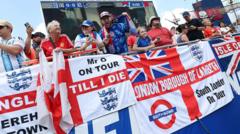
An estimated 15,000 England fans are currently finalizing travel plans to descended upon Texas for the opening stages of the tournament. While early media reports have focused on the spectacle of the event, the stark reality on the ground suggests a massive infrastructure shock for traveling supporters. This is not a traditional European football pilgrimage where trains connect city centers to stadiums. This is an operation dropping thousands of fans into a sprawling, car-dependent metroplex built for a entirely different sporting culture.
The primary issue is geographic deception. When fans bought tickets for matches listed under Dallas, many assumed they would be staying in a compact city with accessible transit. Instead, they are arriving at an event anchored in Arlington, a city located roughly twenty miles west of downtown Dallas. Arlington famously holds the title of the largest city in the United States without a comprehensive public mass transit system. Expanding on this theme, you can also read: The Thomas Partey Visa Denial Shows Why Sports Diplomacy is Officially Dead.
For a fan base accustomed to walking from a train station straight to the turnstiles, this setup poses unprecedented hurdles. The financial and operational strain of moving this many people across a highway-dominated terrain will define the opening week of the tournament.
The Arlington Transit Void
Getting to the stadium will be the first major test for the traveling contingent. In European tournaments, local governments typically provide free shuttle trains or extended metro services to handle matchday crowds. Arlington relies almost exclusively on private vehicular transport and rideshare networks. Analysts at FOX Sports have also weighed in on this situation.
Imagine 15,000 supporters trying to book a rideshare vehicle at the exact same time from various spots across Fort Worth and Dallas. The local road network around the venue is notorious for gridlock during standard domestic gridiron games, which draw crowds accustomed to tailgating for six hours before kickoff. Football fans operate on a tighter schedule, usually aiming to arrive closer to the start of the match.
The surge pricing on rideshare apps will likely catch many off guard. During high-profile events, a ride that normally costs twenty dollars can easily surpass one hundred and fifty dollars one way. Supporters who spent thousands on flights and match tickets will find their daily budgets consumed entirely by highway transport.
Local authorities have suggested designated drop-off zones, but these zones require vehicles to navigate the same clogged arteries as everyone else. Walking to the venue from external neighborhoods is virtually impossible due to the lack of continuous sidewalks and the sheer scale of the arterial roads surrounding the sports complex.
The Brutal Reality of Texas Summer Heat
The climate presents another immediate hazard that goes beyond mere discomfort. Matches played in the region during June and July frequently experience ambient temperatures exceeding thirty-eight degrees Celsius. While the stadium itself features a climate-controlled interior and a retractable roof, the journey to the gates is entirely exposed.
Supporters from the UK often underestimate the intensity of the southern sun. Walking through asphalt parking lots that act as heat sinks can induce heat exhaustion within minutes.
The traditional fan zone experience will look radically different. In previous tournaments across Germany or France, fans gathered in public squares shaded by old architecture or trees. In this region, the pre-match gathering spaces are massive, unshaded concrete lots.
Public drinking laws add another layer of friction. Texas has strict open-container laws outside of designated festival zones or private property. A fan cracking open a beer on a public sidewalk faces immediate fines or arrest, a sharp contrast to the permissive atmosphere of European fan marches.
Accommodation Scarcity and the Decentralized Fan Base
Because Arlington lacks the hotel density to house 15,000 international visitors alongside thousands of other global fans, the traveling contingent is being forced to scatter across a hundred-mile radius. Supporters are booking rooms anywhere from Plano in the north to Fort Worth in the west.
This dispersion breaks the traditional camaraderie of an international tournament. There will be no single hub where England fans can gather the night before the match to sing and socialize. Instead, the fan base will be fragmented into isolated pockets across various suburban hotel strips and short-term rentals.
The cost of these accommodations has skyrocketed. Rooms that typically go for eighty dollars a night are currently listed for four times that amount. Some fans have resorted to booking campsites or staying in distant towns, necessitating commutes of over an hour each way just to reach the metropolitan periphery.
Security Policies and the Culture Clash
Local law enforcement agencies operate under a different philosophy than European police forces. Texas officers are heavily armed and maintain a strict posture regarding public intoxication and disorderly conduct.
The concept of football policing in the UK relies heavily on dialogue and crowd management specialists who understand fan psychology. In contrast, local police are trained for rapid intervention and strict enforcement of property boundaries.
The stadium itself enforces a rigid bag policy. Fans attempting to enter with standard backpacks, large banners, or traditional supporter gear will be turned away at the security perimeter. Only small, clear plastic bags are permitted inside the gates.
This policy is designed to expedite screening for domestic crowds who leave most of their belongings in their vehicles while tailgating. For an international traveler who has been on public roads or in transit for five hours prior to the match, carrying nothing but what fits in a clear pouch is an immense inconvenience.
The True Cost of the Opening Match
The financial burden extends far beyond transport and lodging. Inside the venue, concession prices reflect the corporate nature of modern American sports franchises. A single beverage can easily cost fifteen dollars, with standard food items priced similarly high.
Unlike tournaments held in countries where consumer protection laws limit price gouging around sporting events, the local market is entirely unregulated in this regard. Fans will pay a premium for water, which is a necessity given the climatic conditions outside.
Ticket distribution has also seen significant volatility. The secondary market remains a confusing web of platforms, with prices fluctuating wildly based on corporate demand. Many fans have traveled without confirmed tickets, hoping to secure them on arrival, a strategy that looks increasingly risky as corporate sponsors snap up remaining allocations.
The narrative of a joyous opening match masks a complex logistical puzzle. The fans who made the journey are about to experience a tournament model that prioritizes corporate infrastructure over the traditional, pedestrian-centric fan experience. Navigating this environment will require a total recalibration of what it means to follow the national team abroad.