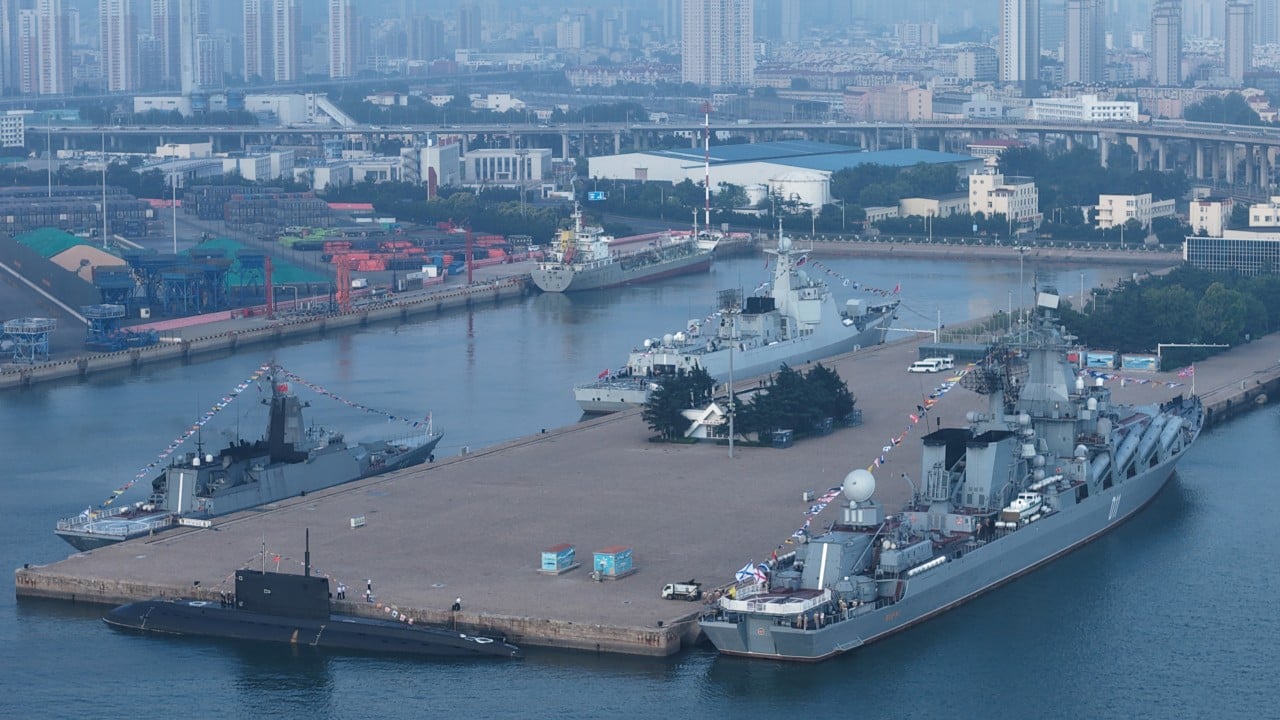
The operational survival of an undersea fleet relies on a binary reality: the capacity to operate undetected, and the mechanical infrastructure to recover crews when that detection or mechanical integrity fails. The Joint Sea 2026 naval exercises in the Yellow Sea near Qingdao expose a deliberate shift in Sino-Russian naval cooperation. Rather than relying on symbolic surface maneuvers, the integration of Russia’s specialized rescue ship Igor Belousov and China’s Type 926 submarine rescue vessel Yangchenghu reveals a systematic attempt to bridge the technical divide in deep-submergence rescue operations. This bilateral integration addresses specific operational vulnerabilities within the First Island Chain while solidifying a functional framework for undersea contingency management.
The Triad of Undersea Survivability
To evaluate the strategic significance of these exercises, the deployment must be viewed through three distinct structural pillars: technical standardization, command-and-control synchronization, and geographic containment mitigation.
Technical Standardization and Docking Architecture
Submarine rescue cannot occur without precise mechanical compatibility. The core risk in joint operations lies in the interface between a rescue vehicle and the escape hatch of a distressed submarine. The Russian Navy brings the Bester-1 deep-submergence rescue vehicle (DSRV), operated from the Igor Belousov, which features a specialized mating skirt capable of sealing against distinct hatch configurations even under significant current pitch and roll.
China's Type 926 rescue ship utilizes LR7-class DSRVs. The technical challenge is optimizing the compression seal protocols and life-support connection transfers between these platforms. When a Type 039A/B Yuan-class conventional submarine or a Russian Project 636.3 Kilo-class submarine (such as the Ufa, present in these drills) sits compromised on the continental shelf, the internal atmospheric pressure varies wildly from the rescue vehicle. Standardizing the decompression matrices and the physical docking collars represents the first engineering hurdle of this alliance.
Command and Control Synchronization
The second pillar involves the establishment of a joint tactical headquarters capable of real-time acoustic communication. Undersea search and rescue requires a localized acoustic network to replace degraded radio signals. The integration of the Type 055 guided-missile destroyer Anshan and the Slava-class cruiser Varyag as command platforms during the drill serves a dual purpose. These surface assets manage the airspace and surface perimeter, establishing a defensive umbrella against external surveillance, while coordinating the search phase using hull-mounted and towed sonar arrays to locate a simulated "downed" vessel.
Geographic Containment Mitigation
The Yellow Sea features an average depth of only 44 meters, with maximum depths rarely exceeding 150 meters. This shallow littoral zone presents unique acoustic challenges, including severe bottom-reverberation that complicates active sonar detection. For China's People's Liberation Army Navy (PLAN), perfecting shallow-water rescue protocols ensures that its primary entry and exit corridors remain survivable under high-intensity conflict conditions. For Russia's Pacific Fleet, operating in these waters provides data on how its diesel-electric assets perform in highly constrained, sensor-dense environments.
The Transfer Function of Rescue Expertise
Russia's undersea recovery doctrine was forged through historical catastrophe, forcing the development of specialized diving methodologies and deep-sea life support systems. The deployment of the Igor Belousov—a vessel specifically engineered for deep-sea search, rescue, and salvage—indicates that Moscow is trading premium operational know-how for broader strategic alignment with Beijing.
The operational architecture of the Igor Belousov includes the GVK-450 deep-water diving system, which allows divers to compress to depths up to 450 meters and undergo decompression in a controlled on-board chamber complex. The PLAN, despite its rapid surface fleet expansion, lacks equivalent long-term operational experience in sustained deep-sea decompression management during mass-casualty recovery. By conducting professional seminars at the PLA Navy Submarine Academy alongside the physical maneuvers, the two navies are building an unclassified data-sharing loop that accelerates China's mastery of the physical mechanics of saturation diving.
This knowledge transfer operates through a specific sequence of actions:
- Acoustic Localization: Utilizing high-frequency side-scan sonar arrays deployed from the Yangchenghu and Igor Belousov to map the seafloor debris field and isolate the target hull signature from bottom topography.
- Environmental Assessment: Deploying remote operated vehicles (ROVs) to clear tangled fishing nets or underwater obstructions from the distressed submarine’s escape hatch.
- Mating and Sealing: Lowering the DSRV onto the escape hatch, executing a hydraulic seal, draining the intermediate water chamber, and equalizing pressure.
- Iterative Extraction: Transferring personnel in small groups to avoid destabilizing the rescue vehicle’s ballast variables.
The mechanical friction in this process is high. Variations in hydraulic fluids, communication frequencies (underwater telephones), and metric-vs-imperial machinery tolerances create a high-risk operational friction point. The Joint Sea 2026 drills are designed to isolate these variables and build standard operating procedures that mitigate the risk of catastrophic failure during a combined operation.
Strategic Friction and Structural Limits
The expansion of joint maritime patrols into the broader Pacific Ocean following the harbor and at-sea phases demonstrates an appetite for outward power projection. There are hard structural limits to this undersea convergence that analysts must quantify accurately.
The first limitation is the asymmetry in nuclear propulsion data sharing. While Russia is willing to share conventional rescue protocols and docking commonalities applicable to diesel-electric platforms like the Kilo and Yuan classes, a strict wall remains regarding nuclear-powered attack submarines (SSNs) and ballistic missile submarines (SSBNs). The acoustics, hatch designs, and internal atmosphere scrubbing technologies of Russia’s Yasen-M or China’s Type 094 platforms remain deeply guarded state secrets. True interoperability is blocked by the fundamental need for acoustic opacity between even aligned nuclear powers.
The second limitation is logistical tethering. A rescue ship like the Igor Belousov requires a dedicated support network. While the Type 903A replenishment ship Kekexilihu provides fuel and basic provisions during the exercise, specialized components for Russian rescue assets cannot be manufactured or easily serviced within Chinese naval infrastructure. This structural bottleneck means that in a true contingency scenario outside the Yellow Sea, the operational response time would be dictated by the physical transit speed of the rescue ships from Vladivostok or Hainan, rather than a permanently integrated forward-deployed force.
Tactical Reconfiguration of the First Island Chain
The long-term implication of these joint rescue drills extends beyond humanitarian cooperation. By standardizing submarine rescue protocols, China and Russia are systematically lowering the operational risk calculations for deploying underwater assets within contested choke points like the Miyako Strait, the Taiwan Strait, and the Luzon Strait.
When a state optimizes its rescue capabilities, it inherently increases the combat tolerance of its submarine crews. Submariners operating with the knowledge that a robust, bilateral rescue infrastructure exists are capable of executing high-risk, silent-running maneuvers in shallow littoral zones where grounding or collision risks are elevated. This behavioral shift alters the undersea balance of power within the First Island Chain.
The inclusion of advanced surface combatants like the Type 052D destroyer Kaifeng and the Steregushchiy-class corvette Rezkiy ensures that these rescue exercises are executed under simulated wartime conditions, defending the rescue assets against hostile anti-submarine platforms. This tactical integration signals to regional observers that any future underwater rescue operation will be protected by a multi-layered surface-to-air and anti-ship missile envelope.
Naval planners must monitor the specific communication protocols established during the post-drill Pacific patrols. If China and Russia successfully integrate their underwater acoustic communication networks to allow seamless tracking and status verification between a Russian submarine and a Chinese rescue vessel, the bilateral partnership will have transitioned from a political alignment into a functional, interoperable military coalition capable of contested undersea denial operations.