Power grids fail when the heat climbs. We lose food, medicine goes bad, and entire supply chains stall out. That vulnerability drives engineers crazy. Back in 2022, a team at MIT decided to do something about it. They built a four-inch cube that keeps things cold without a single watt of electricity. It sounds like science fiction. It is actually simple physics, and it changes how we should think about refrigeration.
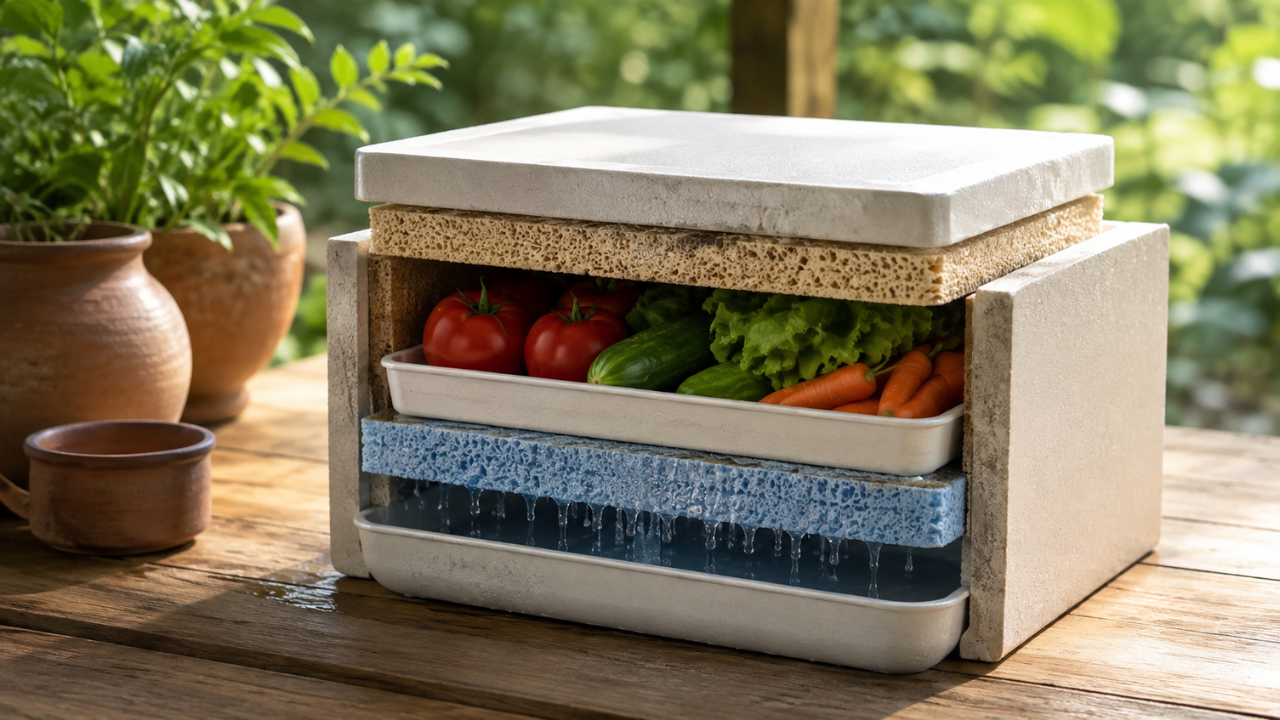
Most people assume keeping things cold requires compressors, chemical refrigerants, and plugs. That assumption traps us in a high-emission loop. If the grid goes down, your fridge dies. Simple as that. But the MIT setup relies entirely on passive cooling. It combines aerogel, hydrogel, and a mirrored surface to bounce solar heat away while using water evaporation to suck thermal energy right out of the chamber.
Let's look at how the materials actually work together.
The Physics Behind the MIT Cooler
The genius isn't in some complex electronic circuit. It's in material science.
The team used an aerogel made mostly of air. That material acts as an incredible insulator, blocking heat from the outside world from leaking in. At the same time, they paired it with a hydrogel layer. Water inside that hydrogel evaporates. As it turns into vapor, it pulls heat out of the container below it.
Think about sweating on a hot day. Your body uses the exact same mechanism to cool down. Water on your skin absorbs your body heat and carries it away into the air.
The MIT device takes that biological trick and scales it into a solid-state material. The top layer reflects sunlight so the sun doesn't heat up the box. The bottom layer handles the insulation. The middle layer uses the phase change of water to drop the internal temperature.
It works in direct sunlight. That is the real kicker. Most passive cooling systems fail the minute the sun hits them because solar radiation overpowers evaporation. By layering a transparent polyethylene aerogel with a hydrogel, the researchers stopped solar heating while letting infrared radiation escape directly into the coldness of deep space through the atmospheric transmission window.
Real World Application and Supply Chain Realities
Why does a four-inch box matter to you? You probably have a massive refrigerator humming in your kitchen right now.
It matters because of the last mile.
Transporting fresh produce and vaccines across hot, arid regions without reliable electricity grids destroys a massive percentage of global food and medicine supplies. When vaccines spoil in rural clinics, kids miss out on immunization. When tomatoes rot before reaching market, farmers lose their livelihoods.
A tiny four-inch proof-of-concept box isn't going to hold your weekly groceries today. But the underlying architecture scales. You can tile these materials across larger structures. You can line shipping containers with them.
The economic implications are massive. Cold chains account for a staggering amount of global energy consumption. If you can shave off even ten percent of that load using passive materials, you drop carbon emissions while making food security more resilient against climate shocks.
People always ask if this will replace household refrigerators. No. Not anytime soon. Compressors are great at chilling warm beer in a closed metal box inside an air-conditioned room. Passive cooling shines where electricity is scarce, expensive, or unreliable.
Overcoming the Scaling Hurdle
Every brilliant lab experiment faces a brutal wall when it hits commercial manufacturing. This one is no exception.
Aerogels are expensive to make. They are fragile. Hydrogels dry out and need water replenishment, meaning the system requires a moisture source to keep running long-term. In a desert environment, where you need cooling the most, water scarcity becomes the primary enemy of evaporative systems.
Solving that requires smart engineering. The MIT team designed the hydrogel to trap moisture efficiently, but open-air evaporation still loses water over time. Future iterations need closed-loop condensation cycles or moisture-harvesting materials that pull humidity straight out of the ambient air at night.
Look at how solar panels evolved. Twenty years ago, they were expensive lab curiosities with low efficiency and high manufacturing costs. Today, they power entire grids because industrial scale drove the price down. Passive cooling materials are sitting right at that twenty-years-ago milestone.
What This Means for Your Future
We are entering an era where climate resilience matters more than convenience. Relying on fossil-fueled grids to keep our food from rotting is a fragile strategy.
When you read about these breakthroughs, don't write them off as academic toys. They represent a fundamental shift in how we manage thermal energy. We spent a century trying to overpower physics with more electricity. The next century belongs to materials that work with physics instead.
Keep an eye on companies spinning out advanced aerogels and radiative cooling films. They are quietly moving out of university basements and into industrial packaging. The next time a storm knocks out your power for a week, you might just be keeping your milk fresh with a block of specially engineered plastic and water.