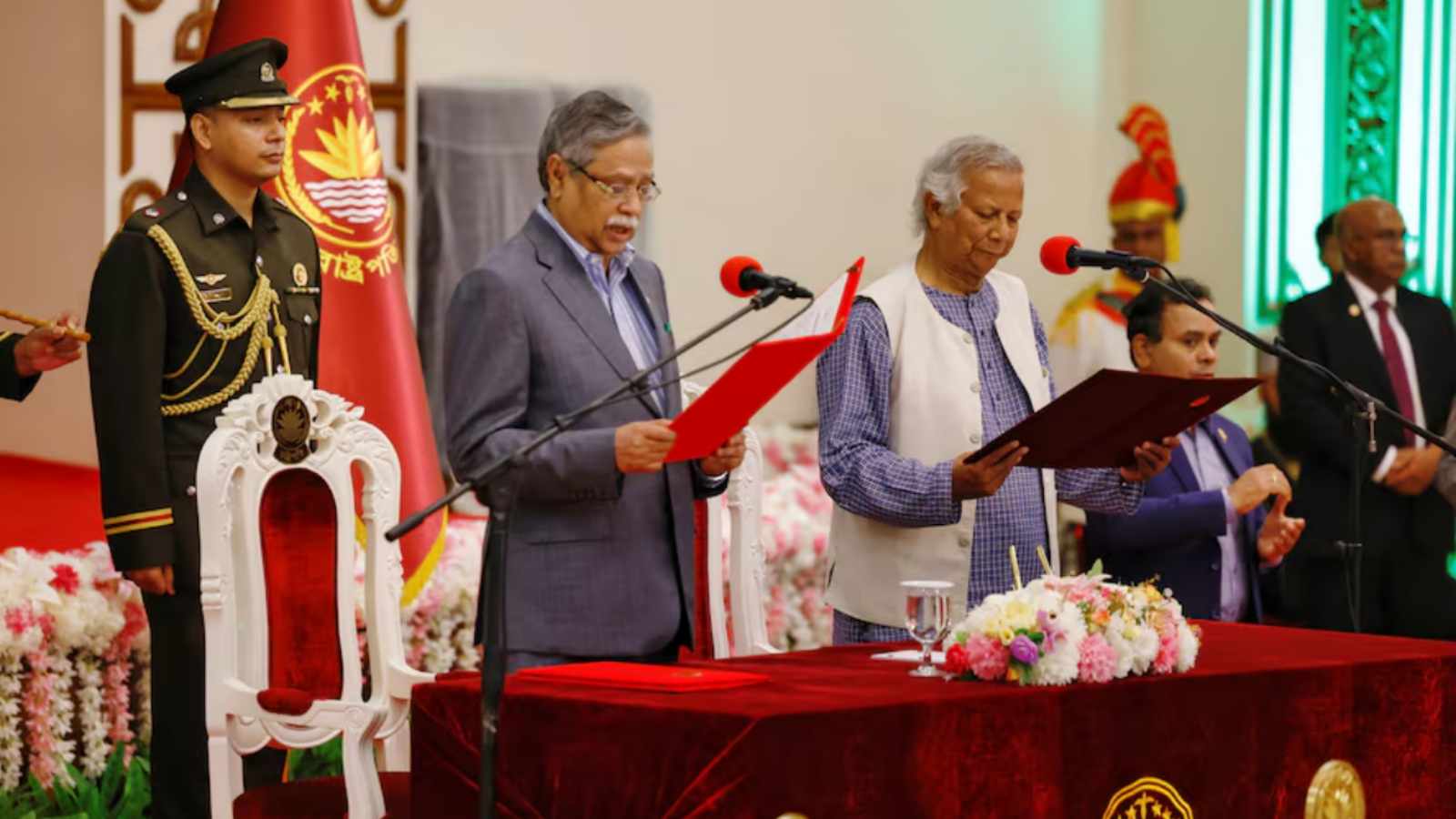
Mohammed Shahabuddin is crying foul because the walls are closing in. The headlines scream about "plots" and "blocked foreign visits," painting a picture of a sidelined head of state struggling against the interim government led by Muhammad Yunus. The mainstream narrative treats this as a breakdown of democratic norms.
They are wrong. This isn't a breakdown. It is the logical conclusion of a constitutional architecture designed for autocracy, now being dismantled by a revolutionary reality that the law wasn't built to handle.
The President’s complaints about being "isolated" or "sidelined" aren't signs of a government in chaos. They are the death rattles of a legal ghost. Shahabuddin remains the last tether to the Sheikh Hasina era, a vestigial organ in a body politic that has already undergone a violent, necessary transplant. To suggest that Yunus is "undermining" the presidency is to misunderstand the very nature of the July uprising. You cannot "undermine" a position that has lost its moral and popular mandate.
The Myth of the Neutral Umpire
The biggest fallacy in the current discourse is the idea that the President of Bangladesh is a neutral, ceremonial figurehead who must be "respected" for the sake of stability.
In a parliamentary system, the President is often described as the "guardian of the Constitution." But in the context of Bangladesh’s recent history, the presidency became a rubber stamp for the executive branch’s excesses. When the President laments that his powers are being curtailed, he is actually complaining that he can no longer serve as a potential bottleneck for the reform process.
Let’s be blunt: Shahabuddin’s presence is a structural anomaly. He was appointed under a regime that the people literally chased out of the country. Expecting a revolutionary government to grant him full diplomatic mobility and "consult" him on every move is like expecting a new management team to ask the former CEO’s assistant for permission to change the locks.
The Foreign Visit Distraction
The President’s gripe about being blocked from traveling abroad is a classic redirection tactic. It sounds like a human rights violation to the uninitiated. In reality, it’s a matter of national security and diplomatic optics.
When a country is in a state of high-stakes transition, the last thing it needs is a holdover official—who still holds theoretical supreme command of the armed forces—jetting off to foreign capitals. Foreign visits by a head of state aren't vacations; they are diplomatic signals. Allowing Shahabuddin to represent Bangladesh on the world stage would send a confused, fragmented message to the international community.
Is the government the one in the streets and the secretariat, or the one in the Bangabhaban?
By restricting his movement, the Yunus administration isn't "bullying" an old man. They are practicing sovereignty management. I’ve seen transitional governments in other regions collapse because they allowed the old guard too much "ceremonial" rope, which they promptly used to hang the new administration by lobbying foreign powers for a counter-coup.
The Logic of the Extra-Constitutional
Critics argue that the interim government is operating in a legal vacuum. They point to the Constitution and say, "This isn't how it's supposed to work."
They are right. And that’s exactly why it’s working.
The 1972 Constitution, despite its various amendments, has been weaponized for decades to justify the consolidation of power. If Yunus and the student-led movement played strictly by the book, Sheikh Hasina would still be in power, or the country would be locked in a perpetual cycle of rigged elections.
We are currently in a period of De Facto Necessity.
$Legal Validity \neq Moral Legitimacy$
When the two diverge as sharply as they did in July 2024, the law must give way to the reality of the people's will. The "plot" the President refers to is simply the process of the state catching up to the revolution. He is a man holding a ticket for a train that has already derailed and been replaced by a supersonic jet. He's standing on the tracks wondering why no one is checking his pass.
Why a Resignation is Irrelevant
The obsession with whether the President will resign or be removed is a waste of intellectual energy.
- The Legalist Trap: If he resigns, who accepts it? The Speaker? The Speaker fled. The Chief Justice? He was replaced.
- The Vacuum Myth: People fear a "constitutional vacuum" if the presidency is vacant. This assumes that the paper document is what’s currently keeping the lights on. It’s not. The lights are on because of a tenuous but functional consensus between the students, the military, and the interim cabinet.
- The Stability Illusion: Keeping a disgruntled, sidelined President in office doesn't provide stability; it provides a focal point for counter-revolutionary energy.
The President’s "outbursts" to the media are calculated. He knows that by claiming he’s being mistreated, he can trigger the "human rights" reflexes of international NGOs and foreign governments who prefer predictable procedures over messy, transformative justice.
The False Equivalence of "Both Sides"
The media often portrays this as a spat between two powerful men: the Nobel Laureate and the President. This framing is a disservice to the facts.
One man is heading an administration tasked with cleaning up fifteen years of systemic corruption and institutional decay. The other is the final remnant of that very system. To treat their grievances as equally valid is to ignore the blood spilled on the streets of Dhaka.
When the President claims he wasn't "informed" about key decisions, he is admitting his own irrelevance. In a fast-moving transition, "information" is a courtesy, not a requirement, for an official who has lost his constituency.
Stop Asking if it’s "Legal" and Start Asking if it’s "Necessary"
People keep asking: "Is the interim government’s treatment of the President constitutional?"
Wrong question.
The right question is: "Can the reform agenda survive if the old guard retains a platform for disruption?"
The answer is a resounding no. You cannot rebuild a house while the old landlord is still sitting in the living room, claiming he owns the floorboards and refusing to let the contractors in.
The friction we see today is the sound of the old system being ground down. It’s loud, it’s ugly, and it makes people uncomfortable. But it is the sound of progress.
The President isn't a victim of a plot. He is a casualty of history. Every day he remains in the Bangabhaban, he isn't preserving the Constitution; he is highlighting its obsolescence.
The interim government’s job isn’t to play nice with the remnants of the past. It’s to build a future where the presidency can never again be used as a shield for a disappearing autocrat. If that means "sidelining" a man who has outstayed his welcome, then so be it.
The revolution wasn't televised so that we could watch the same old actors play the same old roles.
Move the furniture or get out of the room.